How Much Does a Custom AI Agent Cost to Build?
Custom AI agents cost $500-15,000+ to build depending on complexity. Real pricing for chatbots, multi-agent systems, API costs, and ongoing maintenance in 2026.
How Much Does a Custom AI Agent Cost to Build?
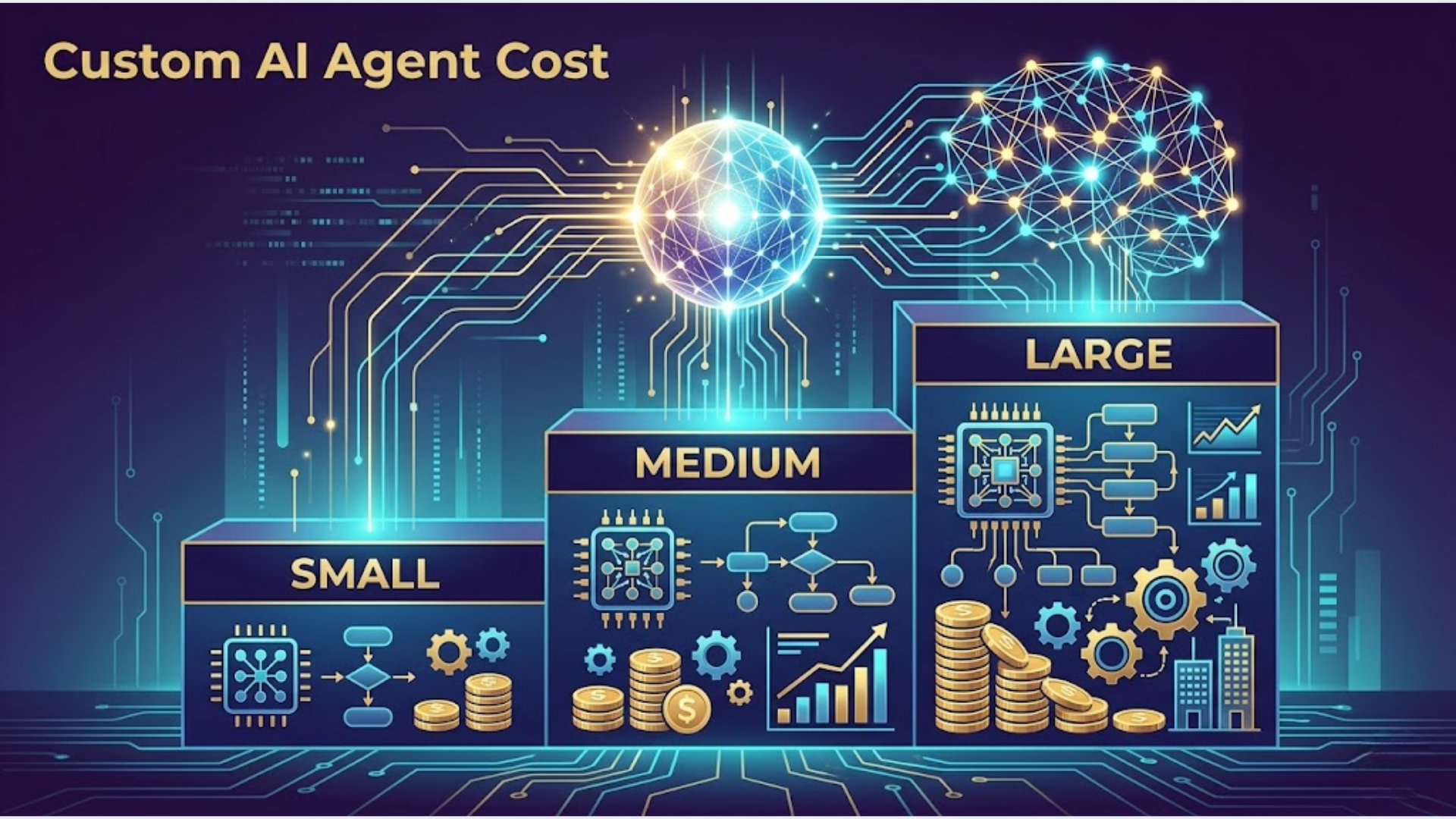
A basic AI chatbot costs $500 to $2,000. A retrieval-augmented generation (RAG) agent that reads your documents runs $2,000 to $7,000. A multi-agent system handling complex workflows across tools and databases will set you back $7,000 to $15,000 or more.
Those are the real numbers I see across client projects. Not hypothetical SaaS pricing pages. Actual build costs for businesses that wanted something custom.
The range is wide because “AI agent” means wildly different things. A support bot answering FAQs from a knowledge base is not the same animal as a system that qualifies leads, checks inventory, drafts proposals, and books meetings across three calendars.
Let me break down exactly what drives those numbers.
Real Cost Ranges by Complexity
Here’s what custom AI agent development actually costs in 2026, based on current market rates:
| Complexity Level | What You Get | Cost Range | Timeline |
|---|---|---|---|
| Basic Chatbot | FAQ bot, single knowledge base, one channel (web or WhatsApp) | $500 - $2,000 | 1-2 weeks |
| RAG Agent | Document retrieval, multi-source knowledge, context-aware responses | $2,000 - $7,000 | 2-4 weeks |
| Multi-Agent System | Multiple agents coordinating tasks, tool use, API integrations, human-in-the-loop | $7,000 - $15,000+ | 4-8 weeks |
| Enterprise Pipeline | Custom training, compliance layers, multi-department deployment, monitoring dashboard | $15,000 - $50,000+ | 2-4 months |
Most businesses land in the RAG agent tier. They want something smarter than a scripted chatbot but don’t need a fleet of agents talking to each other.
The jump from basic to RAG is where real value appears. A $3,000 RAG agent that accurately answers questions from your 200-page operations manual saves more money than a $500 chatbot that frustrates customers with canned responses.
What You’re Actually Paying For
The LLM itself is rarely the expensive part. Here’s the real cost breakdown:
LLM API Costs (the model itself)
| Model | Input Cost (per 1M tokens) | Output Cost (per 1M tokens) | Best For |
|---|---|---|---|
| GPT-4o | $2.50 | $10.00 | General-purpose agents, good balance |
| Claude 3.5 Sonnet | $3.00 | $15.00 | Complex reasoning, long documents |
| Gemini 1.5 Flash | $0.075 | $0.30 | High-volume, cost-sensitive tasks |
| Llama 3 (self-hosted) | Server cost only | Server cost only | Full control, no per-token fees |
| Mistral Large | $2.00 | $6.00 | European data residency, multilingual |
For most business chatbots handling 1,000 conversations per month, API costs run $20 to $150 monthly. That’s not the budget killer.
Development Hours (the real cost)
This is where the money goes. A senior AI developer charges $100 to $200 per hour globally. Building a RAG agent isn’t just “connect API to frontend.” It’s:
- Designing the conversation flow and edge cases
- Chunking and embedding your documents properly
- Testing retrieval accuracy (this alone can take days)
- Building fallback logic when the model doesn’t know something
- Integrating with your existing tools (CRM, helpdesk, calendar)
- Iteration cycles after real users break it in ways you didn’t expect
A typical RAG agent takes 30 to 60 development hours. At $150/hour average, that’s $4,500 to $9,000 in labor alone.
Infrastructure Costs
- Vector database (Pinecone, Weaviate, Qdrant): $0 to $70/month depending on data volume
- Hosting (cloud functions or dedicated server): $10 to $100/month
- Monitoring and logging: $0 to $50/month
Total infrastructure for a mid-tier agent runs $30 to $200 monthly. Not zero, but manageable.
Framework Comparison and Cost Implications
The framework choice affects both build cost and ongoing maintenance. Here’s an honest comparison:
| Framework | Type | Learning Curve | Best For | Typical Build Cost Impact |
|---|---|---|---|---|
| OpenAI Assistants API | Managed | Low | Simple agents, quick MVPs | Lowest (fewer dev hours) |
| LangChain / LangGraph | Code framework | High | Complex chains, custom logic | Higher (more dev time, more flexibility) |
| CrewAI | Multi-agent framework | Medium | Agent teams, role-based tasks | Medium-High (multi-agent = more testing) |
| n8n AI Nodes | Visual workflow | Low-Medium | Business automation + AI | Low-Medium (visual builder, faster iteration) |
| AutoGen | Multi-agent | High | Research, complex reasoning | Highest (cutting-edge, less stable) |
I build most client projects on n8n with AI nodes for a reason. Visual workflows mean the client can actually see what their agent does. Changes don’t require a developer for every small tweak. And it plugs directly into the 400+ integrations n8n already supports.
For pure conversational agents, OpenAI’s Assistants API gets you to a working prototype fastest. But you’re locked into OpenAI’s ecosystem, and costs scale linearly with usage.
LangChain gives you the most flexibility but demands the most development hours. If your agent needs to do something unusual (parse PDFs, query a graph database, call five APIs in sequence), LangChain handles it. You’ll just pay for the complexity in build time.
Ongoing Costs Most People Forget
The build cost is a one-time number. The ongoing costs are what catch people off guard.
API Usage at Scale
A customer support agent handling 5,000 conversations per month with GPT-4o will cost roughly $200 to $500 in API fees alone. That’s before any infrastructure.
If conversations are long (technical support, detailed product questions), costs climb. Each back-and-forth adds tokens. A 10-message conversation with context retrieval can easily consume 8,000 to 15,000 tokens.
Prompt Maintenance
Your agent’s prompts aren’t “set and forget.” Products change. Policies update. New edge cases surface weekly. Budget 2 to 5 hours per month of developer time for prompt tuning. That’s $200 to $1,000 monthly if you’re paying external rates.
Model Migration
This is the one nobody plans for. When OpenAI deprecates a model version (and they will), when pricing changes make your current model uneconomical, when a better model drops and you want to upgrade, someone has to test, adjust prompts, and redeploy. Budget one migration per year at minimum. Each takes 5 to 15 hours depending on complexity.
Monitoring
You need to know when your agent gives bad answers. LLM monitoring tools (LangSmith, Helicone, custom logging) add $0 to $100/month. The real cost is someone reviewing flagged conversations. Even 30 minutes daily adds up.
Realistic monthly ongoing costs:
| Component | Low Estimate | High Estimate |
|---|---|---|
| LLM API fees | $50 | $500 |
| Infrastructure | $30 | $200 |
| Prompt maintenance | $200 | $1,000 |
| Monitoring/review | $100 | $500 |
| Total | $380 | $2,200 |
India-Specific Pricing
If you’re building in India or hiring Indian developers, costs drop 40 to 60 percent on the development side. API costs and infrastructure remain global (OpenAI doesn’t offer INR pricing discounts).
| Complexity Level | INR Range | USD Equivalent |
|---|---|---|
| Basic Chatbot | ₹40,000 - ₹1,50,000 | $475 - $1,785 |
| RAG Agent | ₹1,50,000 - ₹5,00,000 | $1,785 - $5,950 |
| Multi-Agent System | ₹5,00,000 - ₹12,00,000+ | $5,950 - $14,285+ |
The savings come from developer rates. A senior AI developer in India charges ₹2,000 to ₹5,000 per hour ($24 to $60), compared to $100 to $200 in the US or Europe.
Quality varies wildly though. The Indian market has both world-class AI engineers (many trained the models you’re using) and agencies that’ll promise you a “custom AI agent” and deliver a WordPress chatbot plugin.
Look for builders who can explain their architecture decisions, show you the actual prompts, and have deployed agents that handle real production traffic. Not just demo environments.
At triggerAll, I build these systems daily for businesses across industries. The advantage of working with a practitioner is you’re not paying for someone to learn on your project.
When a Simple Chatbot Is Enough vs When You Need a Real Agent
This decision framework saves businesses thousands:
A simple chatbot is enough when:
- Your questions are predictable (under 50 common questions)
- Answers don’t change based on customer-specific data
- You don’t need the bot to take actions (just answer questions)
- Response accuracy of 85% is acceptable
- Your knowledge base is under 50 pages
You need a real AI agent when:
- The bot must pull data from your CRM, inventory, or database
- It needs to take actions (book appointments, create tickets, update records)
- Questions require reasoning across multiple documents
- You need 95%+ accuracy on critical information
- The conversation flow branches based on customer history
You need a multi-agent system when:
- Different tasks require different expertise (sales vs support vs billing)
- Workflows span multiple tools and systems
- Human approval is needed at certain steps
- You’re processing high volumes across parallel workflows
- Error handling needs to be sophisticated (retry, escalate, reroute)
The most expensive mistake I see: businesses building a multi-agent system when a well-configured RAG chatbot would’ve solved the problem at one-third the cost. Start simple. Expand when you hit real limitations, not imagined ones.
Frequently Asked Questions
Q1: How much does it cost to run an AI agent per month? A: Running costs depend on usage volume and model choice. A low-traffic agent (500 conversations/month) on GPT-4o mini costs $30 to $80 monthly for API fees plus $30 to $50 for hosting. A high-traffic agent (5,000+ conversations) on GPT-4o can hit $300 to $600 in API fees alone. Add monitoring, prompt maintenance, and infrastructure, and expect $380 to $2,200 per month total.
Q2: What’s cheaper, building or buying an AI chatbot? A: Off-the-shelf chatbot platforms (Intercom, Drift, Tidio) cost $50 to $500 per month with limited customization. A custom-built chatbot costs $500 to $2,000 upfront plus $50 to $200 monthly to run. Over 12 months, custom is cheaper if you need specific integrations or behavior. If generic FAQ answering is sufficient, a SaaS tool wins on speed and simplicity.
Q3: How long does it take to build a custom AI agent? A: A basic chatbot takes 1 to 2 weeks. A RAG agent with document retrieval and integrations takes 2 to 4 weeks. A multi-agent system with complex workflows takes 4 to 8 weeks. These timelines assume a single experienced developer. Enterprise deployments with compliance reviews, security audits, and multi-department rollout can stretch to 2 to 4 months.
Q4: Do I need a developer to maintain an AI agent? A: For the first 3 months, yes. Prompts need tuning as real users expose edge cases. After stabilization, many agents run with minimal intervention. Budget 2 to 5 hours of developer time per month for ongoing maintenance. If you built on a visual platform like n8n, non-technical team members can handle basic prompt updates and workflow adjustments.
Q5: What’s the difference between an AI chatbot and an AI agent? A: A chatbot responds to messages using a knowledge base. An AI agent takes actions. It can query databases, call APIs, update records, send emails, and coordinate multi-step workflows. A chatbot tells you your order status. An agent checks the database, identifies a shipping delay, generates a discount code, and sends an apology email. The cost difference reflects this capability gap.
Q6: Can I build an AI agent with no-code tools? A: Yes, with limitations. Platforms like n8n, Voiceflow, and Botpress let you build functional AI agents without writing code. They handle 70 to 80% of use cases (customer support, lead qualification, document Q&A). You’ll hit walls with complex multi-agent coordination, custom model fine-tuning, or unusual data processing. Start no-code. Move to code when you need to.
Q7: Which LLM is cheapest for business AI agents? A: For pure cost, Gemini 1.5 Flash at $0.075 per million input tokens is the cheapest capable model. For quality-to-cost ratio, GPT-4o mini offers strong performance at $0.15 per million input tokens. Self-hosted open-source models (Llama 3, Mistral) eliminate per-token costs entirely but add $50 to $300 monthly in server costs. For most businesses processing under 10,000 conversations monthly, API-based models are more economical than self-hosting.
Need a custom AI agent built for your business? I build these systems daily at triggerAll. No generic templates. Every agent is architected for your specific workflows, data, and integration requirements.
Next read: n8n vs Make vs Zapier: Honest 2026 Comparison for Agencies
Need help implementing this?
Book a free 30-minute discovery call. We'll map your current setup, identify quick wins, and outline what automation can do for your business.
Book a Free Discovery Call