Zapier Consultant Cost and What to Expect in 2026
Zapier consultants charge $50-200/hr or $500-5,000 per project. Here's what you're paying for, when it's worth it, and when you should skip Zapier entirely.
Zapier Consultant Cost and What to Expect in 2026
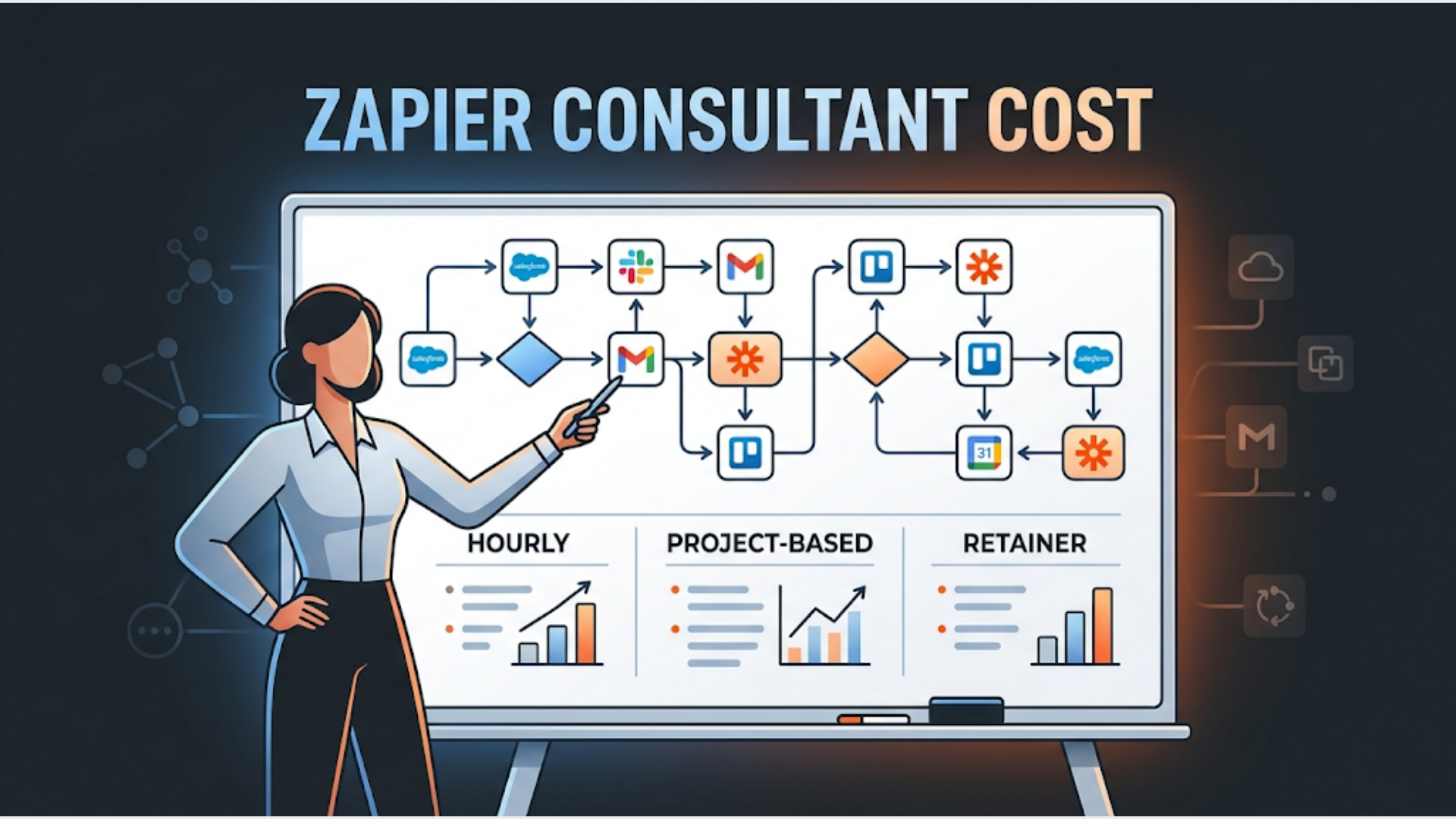
Zapier consultants charge $50-200/hr for hourly work, $500-5,000 per project, or $500-2,000/month on retainer. The wide range exists because “Zapier consultant” covers everything from someone who connects two apps in ten minutes to someone who architects a 50-Zap system that runs your entire operations.
I build automation systems for a living. Some on Zapier, most on n8n. The honest truth: many businesses hire Zapier consultants for problems that don’t need a consultant. And some hire a cheap one for problems that absolutely do.
Here’s how to spend wisely.
What Zapier Consultants Actually Charge
The pricing model matters as much as the rate itself. Different models fit different situations.
| Pricing Model | Range | Best For | Watch Out For |
|---|---|---|---|
| Hourly | $50-200/hr | Ongoing optimization, ad-hoc fixes | Hours add up fast on undefined scopes |
| Per Project | $500-5,000 | Defined builds with clear deliverables | Scope creep eats into quality |
| Monthly Retainer | $500-2,000/mo | Active Zap management, monitoring, updates | Paying for unused hours if volume is low |
| Audit Only | $300-1,500 | One-time review of existing automations | No implementation included |
The hourly range is wide for a reason. A Zapier Certified Expert with five years of complex builds charges $150-200/hr. A freelancer with basic Zapier knowledge and a Fiverr profile charges $50-75/hr. The certification matters less than the portfolio, but it’s a useful initial filter.
Project-based pricing dominates the market. Most businesses want a specific outcome (“automate our lead routing from Typeform to HubSpot with Slack notifications”), not an open-ended hourly relationship. A good consultant scopes the project, quotes a fixed price, and delivers. Simple.
Retainers make sense when your Zap count exceeds 15-20 and you’re making changes monthly. At that scale, something is always breaking, updating, or needing optimization. A retainer gives you priority access without negotiating a new contract every time.
What You’re Actually Paying For
The build itself is maybe 40% of the value. Here’s the full breakdown of what a good Zapier consultant delivers.
Audit and architecture (20% of effort). Before building anything, a competent consultant maps your current tools, data flows, and pain points. They identify which processes should be automated, which shouldn’t, and in what order. Skipping this step is how you end up with 30 Zaps that conflict with each other.
Build and configuration (40% of effort). The actual Zap creation. This includes choosing the right triggers and actions, handling data mapping, setting up filters and paths, configuring error handling, and testing with real data. The complexity varies enormously. A two-step Zap takes 30 minutes. A multi-path Zap with conditional logic, formatters, and webhooks takes days.
Testing and validation (15% of effort). Running the automation through real scenarios, edge cases, and failure conditions. What happens when a required field is empty? When the API rate limits? When two Zaps fire simultaneously on the same record? Testing is where cheap consultants cut corners and expensive ones earn their rate.
Documentation and training (15% of effort). Documenting what was built, why decisions were made, and how to modify the Zaps. Training your team to handle basic changes without calling the consultant back. Many consultants skip this entirely. Insist on it. Written documentation is not optional.
Handoff and monitoring setup (10% of effort). Setting up error notifications, creating a monitoring dashboard, and ensuring someone on your team can respond to alerts. Automation without monitoring is a ticking time bomb.
Hourly vs Project vs Retainer: Which Model Works
Hourly works for exploratory work. You don’t know exactly what you need, the scope is fuzzy, or you want a consultant to poke around your systems and recommend improvements. Set a cap (say, 10 hours) to avoid surprise invoices.
Per project works when the scope is defined. You know the inputs, the outputs, and the systems involved. The consultant quotes a price, you agree, they deliver. Clean. Make sure the scope document is detailed enough that both sides agree on what “done” means.
Retainer works when you have ongoing automation needs. Your business runs on Zapier, things change monthly, and you need someone who knows your systems intimately. The math works when your ad-hoc needs exceed the retainer cost consistently. If you’re only using 3 hours of a 10-hour retainer, switch to per-project.
The most common mistake: starting with a retainer before you have enough Zaps to justify it. Build project-by-project first. Once you’re spending $1,500+/month on ad-hoc projects consistently, convert to a retainer.
When a Zapier Consultant Is Worth It (and When to Skip Zapier Entirely)
A Zapier consultant is worth the money when:
- You’re connecting 3+ business tools and need data flowing reliably between them.
- Your team spends more than 5 hours/week on manual data entry between systems.
- You’ve tried building Zaps yourself and they keep breaking or producing wrong data.
- The automation touches revenue (lead routing, payment processing, customer onboarding). Getting it wrong costs more than the consultant.
Skip the Zapier consultant (and possibly skip Zapier) when:
- Your automation needs are complex, high-volume, or require custom logic. Zapier’s per-task pricing makes it expensive at scale. A workflow that costs $50/month on Zapier’s Business plan might cost $0 on self-hosted n8n. At 10,000+ tasks/month, the platform cost alone exceeds what you’d pay an n8n developer to build the same workflow.
- You need data to stay on your own servers. Zapier processes data through their cloud. If compliance or data sovereignty matters, self-hosted n8n or Make’s on-premise option are better fits.
- You need branching logic, loops, or sub-workflows. Zapier handles linear workflows well. Complex orchestration with conditional branches, retry loops, and parallel processing is where it struggles. n8n was built for this.
- You’re already hitting Zapier’s limitations. If your consultant’s first recommendation is to work around Zapier’s constraints, you’re paying someone to fight the tool instead of use it.
I tell clients this directly. Sometimes the right answer isn’t “hire a Zapier consultant.” It’s “switch platforms.” That honesty costs me Zapier projects. It saves my clients thousands in long-term platform costs.
India-Specific Rates
The Indian market for Zapier consultants is active and growing. Most Indian automation consultants work across Zapier, Make, and n8n rather than specializing in one platform.
| Pricing Model | Rate (INR) | Rate (USD Equivalent) |
|---|---|---|
| Hourly | Rs 3,000-12,000/hr | $35-145/hr |
| Per Project | Rs 30,000-3,00,000 | $360-3,600 |
| Monthly Retainer | Rs 25,000-1,00,000/mo | $300-1,200/mo |
| Audit Only | Rs 15,000-75,000 | $180-900 |
Indian consultants who specialize in automating Indian business tools (Zoho suite, Razorpay, Shiprocket, WhatsApp via WATI) deliver significantly faster than foreign consultants unfamiliar with these ecosystems. The context advantage is real.
For Indian businesses, the math often favors hiring a local automation consultant who understands your tech stack natively. You’re not paying for someone to learn what GST invoicing looks like or how Indian payment gateways handle UPI callbacks.
The quality range is wide. Certified Zapier experts from India charge Rs 6,000-12,000/hr and deliver work comparable to US consultants at 40-60% of the cost. Generalists on freelancing platforms at Rs 1,500-3,000/hr are a gamble.
How to Evaluate a Zapier Consultant
Don’t rely on self-reported skills. Here’s how to actually evaluate.
Check their Zapier Expert profile. Zapier maintains a directory of certified experts. Certification requires passing a technical exam and demonstrating completed projects. It’s not a guarantee of quality, but it filters out complete beginners. Look at their listed specialties and client reviews.
Review complexity of past work. Ask for examples of their most complex Zapier builds. A consultant whose best example is “I connected Typeform to Google Sheets” can’t handle a multi-path lead routing system. Look for projects involving webhooks, custom API calls, data transformation, and error handling.
Ask about failures. Good consultants can describe a Zap that broke in production and how they diagnosed and fixed it. If they claim nothing ever breaks, they either haven’t built anything complex or they’re not being honest. Both are disqualifying.
Request a mini-audit. Pay for 2-3 hours of audit on your existing setup. The quality of their observations tells you everything about their expertise. A good consultant spots inefficiencies, security issues, and optimization opportunities within hours. A mediocre one confirms everything looks fine.
Check if they recommend alternatives. A consultant who only recommends Zapier, regardless of your needs, is selling a tool, not solving your problem. The best consultants tell you when Zapier is the wrong choice. That honesty signals expertise and integrity.
FAQ
Is a Zapier Certified Expert worth the higher rate? Usually yes for complex projects. The certification confirms baseline technical knowledge and Zapier ecosystem familiarity. For simple two-step Zaps, certification doesn’t matter. For multi-system architectures with webhooks and conditional logic, the certified expert’s experience with Zapier’s specific quirks and limitations saves significant debugging time.
How many Zaps does a typical business need? Most small businesses run 5-15 active Zaps. Companies with complex operations (multiple CRMs, e-commerce platforms, support systems) might run 30-50. The number matters because Zapier’s pricing tiers and task limits directly impact your monthly cost. A good consultant optimizes Zap count to keep you in a lower pricing tier.
Can I build Zaps myself instead of hiring a consultant? Absolutely, and you should start there. Zapier’s interface is designed for non-technical users. Simple automations (new form submission to email notification, new lead to CRM) are straightforward. Hire a consultant when you hit complexity: multi-step logic, error handling, API integrations, or data transformation that goes beyond Zapier’s built-in formatters.
How long does a typical Zapier consulting project take? Simple projects (5-10 Zaps, standard integrations) take 1-2 weeks. Complex projects (20+ Zaps, custom webhooks, multiple systems) take 3-6 weeks. Add 1 week for audit and 1 week for documentation and training. Consultants who promise enterprise-level automation in 3 days are cutting corners somewhere.
Should I switch from Zapier to n8n? Consider switching if you’re spending over $100/month on Zapier’s task-based pricing, need complex branching or looping logic, require data to stay on your servers, or want to avoid vendor lock-in. The migration has a one-time cost but reduces ongoing platform fees to near zero on self-hosted n8n. I’ve written a detailed migration guide if you’re evaluating the switch.
Need help implementing this?
Book a free 30-minute discovery call. We'll map your current setup, identify quick wins, and outline what automation can do for your business.
Book a Free Discovery Call