When to Leave GoHighLevel: The 5 Signs
GoHighLevel works for agencies under 50 clients. Beyond that, the limitations stack up. Here are 5 signs it's time to switch and what to move to instead.
When to Leave GoHighLevel: The 5 Signs
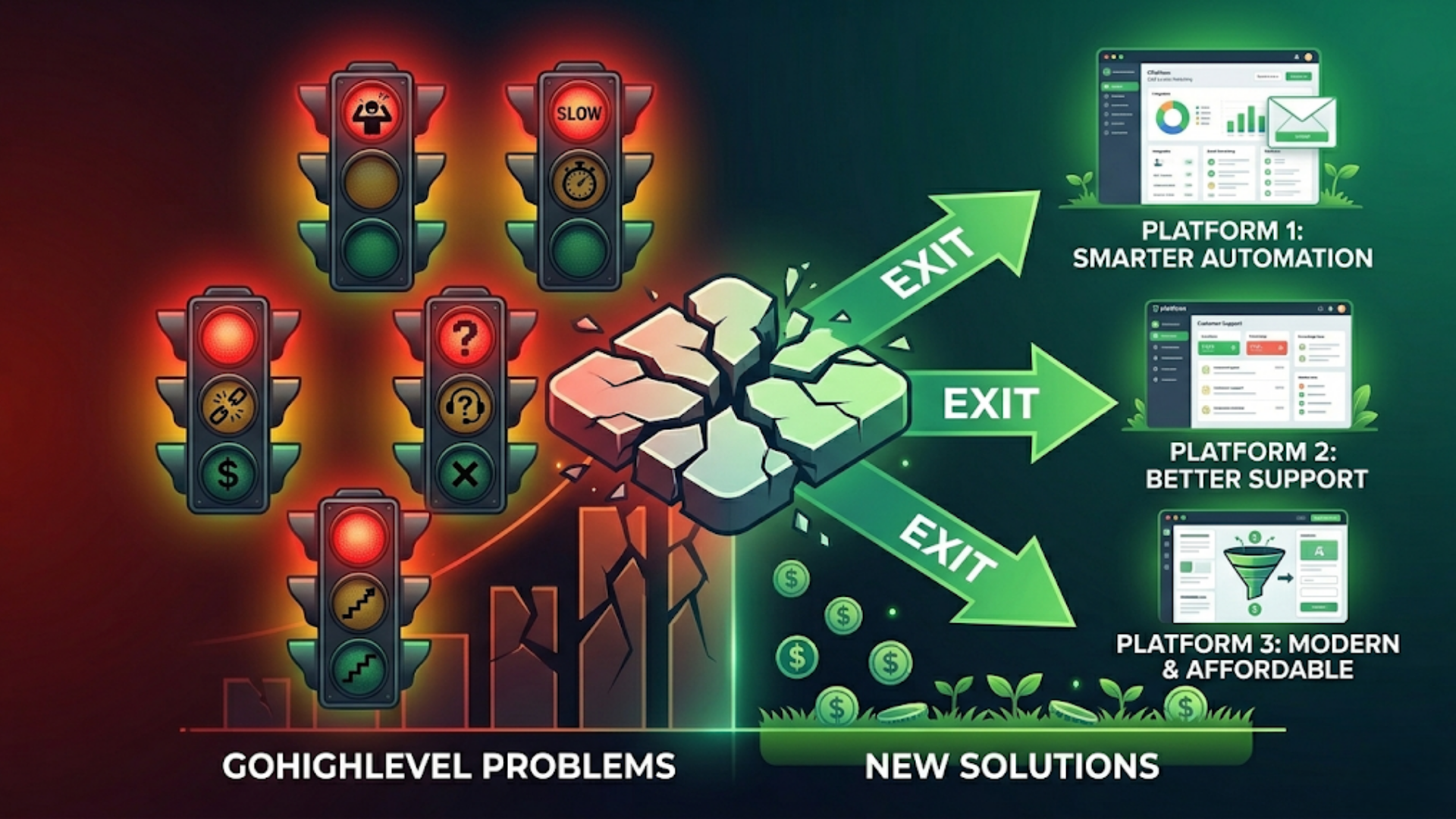
GoHighLevel stops making sense when you hit these 5 signs: your automations hit platform limits, your team spends more time on workarounds than actual work, clients need integrations GHL doesn’t support, your data lives in silos you can’t connect, and your per-client cost keeps rising as you scale. Most agencies hit 2 to 3 of these signs between 30 and 50 active clients.
I don’t have anything against GoHighLevel. It solves a real problem for agencies in the early stages. But Agencies outgrowing GHL follow a consistent pattern. Here’s how to know when you’ve crossed that line.
Sign 1: Your Automations Hit Platform Limits
GHL’s workflow builder handles straightforward automations well. New lead comes in, send SMS, wait 2 days, send email, assign to rep. That works.
But try to build anything with conditional branching that goes 3 to 4 levels deep, and the workflow builder starts fighting you. Loop logic? Not natively supported. Complex data transformations? You’ll need custom webhooks hitting external tools.
The tell: your team starts building “automation workarounds.” A webhook that calls a Google Sheet that triggers a Zapier Zap that pushes data back to GHL. When your automations require external tools to compensate for platform limitations, you’re not using GHL. You’re working around it.
Specific limits that trigger this:
- No native loop/iteration in workflows
- Limited conditional logic depth
- No direct database queries or custom SQL
- Webhook payload size limits
- Rate limiting on API calls that throttles high-volume automations
- Custom value (variable) limits that cap complex data handling
If you’re building 3+ external workarounds per month, you’ve outgrown the automation layer.
Sign 2: Your Team Spends More Time on Workarounds Than Work
This is the cultural version of Sign 1.
When your team’s Slack channels are full of messages like “does anyone know a workaround for X in GHL?” and your internal documentation has a growing “GHL Workarounds” section, you’re past the inflection point.
Quantify it. Track how many hours per week your team spends on GHL workarounds versus productive client work. If it’s over 5 hours per week across the team (very common at 40+ clients), that’s $15,000 to $30,000 per year in lost productivity at typical agency billing rates.
The insidious part: workaround culture normalizes. Your team stops questioning whether GHL is the right tool and starts treating “find a workaround” as a standard operating procedure. That’s how a platform that’s supposed to save time starts costing it.
Sign 3: Clients Need Integrations GHL Doesn’t Support
GHL integrates well with the basics: Stripe, Twilio, Mailgun, Facebook, Google. For agencies serving small local businesses (dentists, contractors, gyms), this covers 90% of needs.
But when your client roster expands to include businesses with specialized tech stacks, GHL’s integration library falls short.
Common requests GHL can’t handle natively:
- Enterprise CRMs: Salesforce, Dynamics 365, custom CRM systems
- Industry-specific tools: Practice management software (legal, medical), property management systems, restaurant POS systems
- Advanced e-commerce: Shopify Plus features, custom WooCommerce setups, inventory management systems
- Accounting integrations: QuickBooks (limited), Xero, Zoho Books
- Custom APIs: Any proprietary client system with a REST or GraphQL API
When a client says “can you connect GHL to our [specific tool]?” and the answer is “not natively, but we can build a workaround with Zapier,” you’re stacking middleware costs on top of GHL costs. At 3 to 4 custom integrations per client, the Zapier bill alone can exceed $200/month.
Sign 4: Your Data Lives in Silos
GHL stores contacts, opportunities, and conversations in its own database. That’s fine when GHL is your only platform.
But agencies at scale typically have data in GHL, Google Sheets (because GHL’s reporting is limited), a project management tool (ClickUp, Monday, Asana), an accounting tool (QuickBooks, Xero), and sometimes a separate email marketing platform for clients who need features beyond GHL’s email builder.
The problem: no single source of truth. Your client’s contact exists in GHL, their project status is in ClickUp, their invoice is in QuickBooks, and their campaign performance is in a Google Sheet you manually update weekly.
GHL’s reporting dashboard is improving, but it’s still designed for marketing metrics (calls, SMS, emails, pipeline stages). It doesn’t give you operational visibility across your business.
When you catch yourself manually copying data between systems more than once a week, or when a client asks for a report that requires pulling data from 3 platforms, your data architecture has outgrown GHL’s capabilities.
Sign 5: Your Cost Per Client Is Rising
GHL’s pricing is attractive at first. The Agency Unlimited plan at $497/month gives you unlimited sub-accounts. Sounds great when you have 10 clients. That’s ~$50/client/month for a full CRM, funnel builder, appointment scheduler, and communication platform.
But hidden costs accumulate.
Twilio/Mailgun costs scale with clients. Every SMS, call, and email goes through your connected Twilio and Mailgun accounts. At 50+ clients with active campaigns, communication costs can reach $500 to $1,500/month on top of GHL’s subscription.
Middleware costs for workarounds. Zapier, Make, or custom webhook services to compensate for GHL’s integration gaps. $50 to $300/month depending on volume.
Staff time on workarounds. As covered in Sign 2, this is the biggest hidden cost.
Premium add-ons. GHL’s marketplace of add-on features (premium triggers, advanced reporting) comes with per-feature costs.
At 50 clients, realistic total cost of ownership:
| Cost Component | Monthly |
|---|---|
| GHL Agency Unlimited | $497 |
| Twilio/Mailgun | $500 to $1,200 |
| Zapier/middleware | $100 to $300 |
| Staff time on workarounds (est.) | $500 to $1,500 |
| Premium add-ons | $50 to $200 |
| Total | $1,647 to $3,697 |
That’s $33 to $74 per client per month in real cost. Compare that to what clients are paying you. If your margins are thinning as you scale, the platform is part of the problem.
What to Switch To: 3 Paths
There’s no single “GHL replacement.” The right move depends on your agency’s focus.
Path 1: Custom Stack (n8n + Zoho CRM)
Best for: agencies that need maximum flexibility and want to own their infrastructure.
Build your own stack using n8n for automation and Zoho CRM (or any CRM) for client management. Add Zoho Desk for support, Zoho Campaigns for email, and n8n for everything else.
| Component | Cost/Month |
|---|---|
| n8n self-hosted | $15 to $50 |
| Zoho CRM (10 users) | $230 |
| Zoho Desk | $140 |
| Twilio (direct) | Same as before |
| Total | ~$435 to $470 + Twilio |
You lose GHL’s all-in-one simplicity. You gain unlimited automation power, full data ownership, and no per-feature limitations. This path requires technical confidence or a partner who builds these stacks (like triggerAll).
Path 2: HubSpot (Marketing-Heavy Agencies)
Best for: agencies where content marketing, email nurture, and inbound lead generation are the core deliverable.
HubSpot’s Marketing Hub + CRM gives you better email marketing, superior reporting, blog hosting, and landing pages. The ecosystem is more mature than GHL’s for marketing-centric agencies.
| Component | Cost/Month |
|---|---|
| HubSpot Starter (CRM + Marketing) | $20/mo base + $500/mo Marketing Hub |
| Additional seats | $20/user/month |
| Total (5 users) | ~$600 |
You gain: better reporting, stronger email deliverability, more integrations. You lose: built-in SMS/calling, funnel builder (need separate tool), white-label capabilities.
Path 3: Pipedrive + n8n (Sales-Heavy Agencies)
Best for: agencies focused on outbound sales, appointment setting, and pipeline management.
Pipedrive’s sales pipeline is genuinely better than GHL’s. Pair it with n8n for automation, and you have a stack that handles high-volume outbound operations without GHL’s limitations.
| Component | Cost/Month |
|---|---|
| Pipedrive Professional (10 users) | $490 |
| n8n self-hosted | $15 to $50 |
| Twilio (direct) | Same as before |
| Total | ~$555 + Twilio |
You gain: best-in-class pipeline management, unlimited automation, better sales reporting. You lose: built-in funnel builder, white-label, all-in-one simplicity.
India: GHL vs Indian Alternatives
GHL’s $497/month Agency plan is approximately ₹41,500/month. For Indian digital marketing agencies billing clients ₹15,000 to ₹30,000/month, that’s a significant chunk of margin.
Zoho One at ₹2,000/user/month gives Indian agencies CRM, email campaigns, project management, helpdesk, invoicing (with GST), and 40+ more tools. For a 5-person agency, that’s ₹10,000/month total. Add n8n self-hosted on DigitalOcean Bangalore for ₹1,000/month and you have a stack that’s more powerful than GHL at 73% lower cost.
The Zoho ecosystem advantage in India: INR billing, Chennai/Mumbai data centers, IST support hours, native GST invoicing, and UPI payment integration through Zoho Books. None of these exist in GHL.
The custom stack math for a 30-client Indian agency:
| Stack | Monthly Cost (INR) | Per Client Cost |
|---|---|---|
| GHL Agency | ~₹41,500 + Twilio | ~₹1,380 + comms |
| Zoho One (5 users) + n8n | ~₹11,000 + Twilio | ~₹367 + comms |
That’s ₹30,000/month saved. ₹3,60,000/year. For a bootstrapped Indian agency, that’s meaningful capital you can reinvest in hiring, marketing, or client delivery.
The tradeoff is real though. GHL gives you one platform to learn. A custom stack requires technical knowledge or a technical partner. Indian agencies without a technical cofounder or in-house developer should factor in the cost of ongoing n8n management (either learning it or outsourcing it).
FAQ
Q1: Is GoHighLevel bad? A: No. GHL solves a real problem for agencies serving local businesses with fewer than 30 clients. It’s an excellent starting platform. The issues emerge at scale when automation limits, integration gaps, and hidden costs start compounding. The platform isn’t bad. It just has a ceiling.
Q2: Can I migrate my GHL contacts and pipelines to another CRM? A: Yes. GHL allows CSV exports of contacts and opportunities. Export your data, map fields to your new CRM, and import. The data migration is the easy part. Rebuilding automations and funnels takes more time since those don’t export.
Q3: How long does it take to leave GoHighLevel? A: Plan for 4 to 6 weeks for a full migration including data export, new stack setup, automation rebuilds, team training, and a 2-week parallel run. Agencies with 50+ clients and complex automations may need 6 to 8 weeks.
Q4: What happens to my white-labeled client portals? A: GHL’s white-label feature doesn’t transfer. If you’ve built branded client portals in GHL, you’ll need to recreate them in your new platform or use a separate white-label solution. This is one of GHL’s genuine advantages that’s hard to replicate cheaply.
Q5: Can I use n8n to replace GHL’s automation features? A: n8n replaces and exceeds GHL’s automation builder. It handles complex branching, loops, custom API calls, data transformations, and multi-system orchestration that GHL’s workflow builder cannot. The tradeoff is that n8n is an automation platform, not an all-in-one CRM. You’ll pair it with a dedicated CRM.
Krishna is the founder of triggerAll, where he builds custom automation stacks for agencies that have outgrown all-in-one platforms and need systems that scale with their client roster.
Need help implementing this?
Book a free 30-minute discovery call. We'll map your current setup, identify quick wins, and outline what automation can do for your business.
Book a Free Discovery Call