Razorpay vs Stripe for Indian Businesses: Complete 2026 Comparison
Razorpay vs Stripe for Indian businesses in 2026. Pricing, UPI support, settlement times, API quality, GST handling, and automation integration compared side by side.
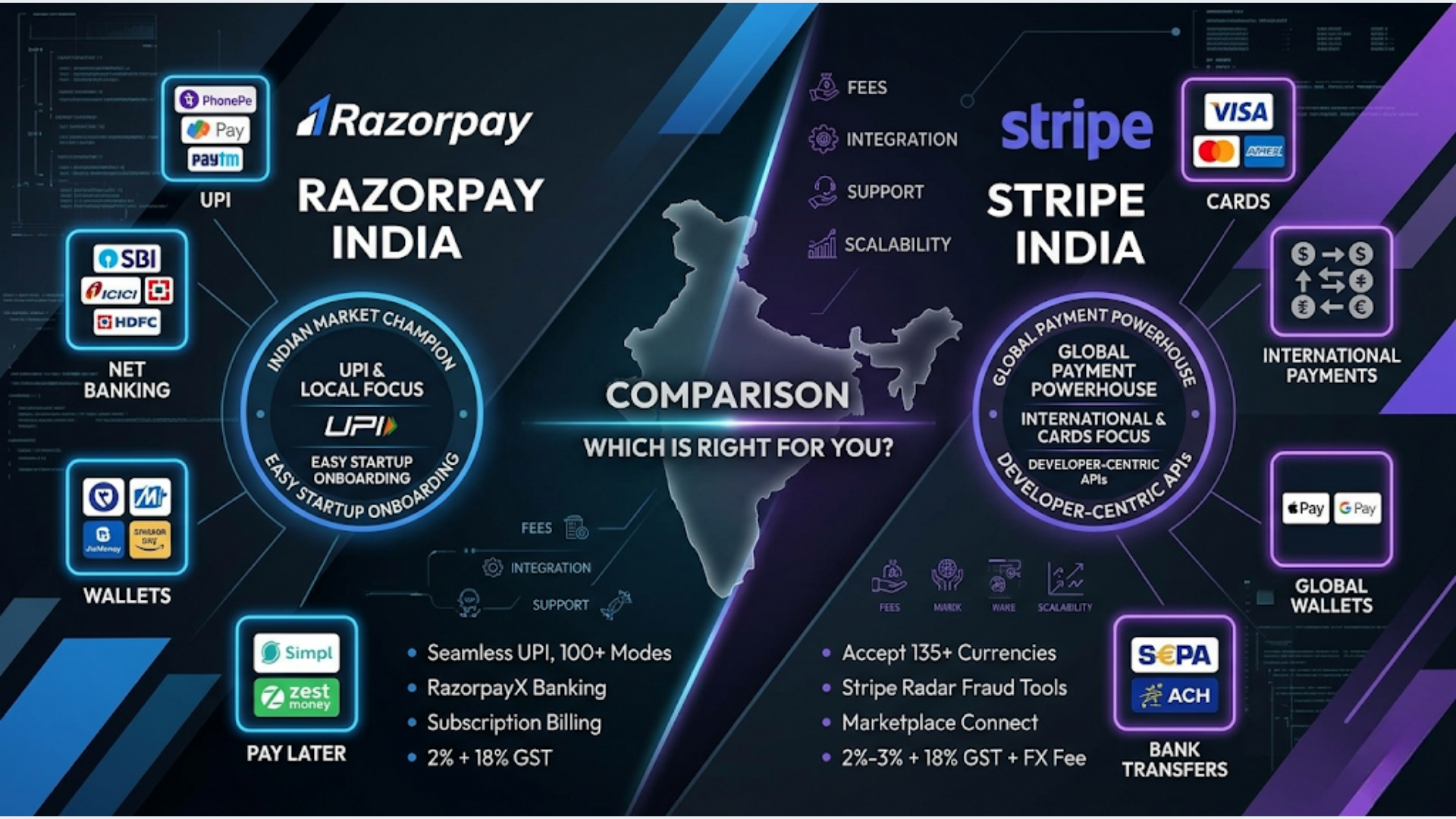
Razorpay vs Stripe for Indian Businesses: Complete 2026 Comparison
Razorpay processes over $180 billion annually for Indian businesses. Stripe entered India in 2017 and has been growing steadily. Both work. Both are competent. The right choice depends on what you sell, who you sell to, and how much automation you need around payments.
I build payment automation systems for businesses. I’ve integrated both extensively. This isn’t a spec-sheet comparison you can find anywhere. It’s a practitioner’s take on where each one actually performs better and where each one will waste your time.
Pricing: The Real Numbers
Everyone quotes the headline rate. The actual cost involves more math.
Razorpay pricing (2026):
| Payment Method | Fee | GST on Fee |
|---|---|---|
| UPI | 0% (transactions up to Rs 2,000) | N/A |
| UPI (above Rs 2,000) | 2% | + 18% GST on fee |
| Debit Cards (up to Rs 2,000) | 0.4% | + 18% GST on fee |
| Debit Cards (above Rs 2,000) | 0.9% | + 18% GST on fee |
| Credit Cards (domestic) | 2% | + 18% GST on fee |
| Credit Cards (international) | 3% | + 18% GST on fee |
| Net Banking | 2% | + 18% GST on fee |
| Wallets | 2% | + 18% GST on fee |
| EMI | 2.5-3% | + 18% GST on fee |
Stripe pricing (India, 2026):
| Payment Method | Fee | GST on Fee |
|---|---|---|
| Domestic cards | 2% | + 18% GST on fee |
| International cards | 3% + Rs 2 | + 18% GST on fee |
| UPI | 2% | + 18% GST on fee |
| Net Banking | 2% + Rs 5 | + 18% GST on fee |
| Wallets | 2% | + 18% GST on fee |
The UPI difference is significant. Razorpay offers 0% on UPI transactions under Rs 2,000 (following NPCI’s MDR waiver). Stripe charges 2% on all UPI transactions. For a business where 60-70% of transactions are UPI (common in India), this changes the math substantially.
Example: D2C brand with Rs 10,00,000/month in revenue:
| Metric | Razorpay | Stripe |
|---|---|---|
| UPI transactions (60%, avg Rs 800) | Rs 0 (under Rs 2,000 limit) | Rs 12,000 |
| Card transactions (30%, avg Rs 1,500) | Rs 6,000 | Rs 6,000 |
| Net banking (10%) | Rs 2,000 | Rs 2,500 |
| Total gateway fees | Rs 8,000 | Rs 20,500 |
| GST on fees (18%) | Rs 1,440 | Rs 3,690 |
| Total cost | Rs 9,440 | Rs 24,190 |
Razorpay saves Rs 14,750/month in this scenario. Rs 1,77,000/year. That’s the UPI pricing advantage alone.
When Stripe wins on pricing: If most of your revenue comes from international customers paying with credit cards, Stripe’s rates are competitive. And Stripe’s international card processing is smoother, with better acceptance rates for non-Indian cards.
Payment Methods: What Your Customers Actually Use
India’s payment landscape is unique. The gateway that supports local preferences wins.
| Payment Method | Razorpay | Stripe |
|---|---|---|
| UPI (QR + intent) | Excellent. Deep integration | Available but basic |
| UPI Autopay (recurring) | Yes | Yes (via Stripe mandate) |
| Credit Cards | All networks | All networks |
| Debit Cards | All banks | Major banks |
| Net Banking | 58+ banks | 25+ banks |
| Wallets (Paytm, PhonePe, etc.) | All major wallets | Limited |
| Cardless EMI (Simpl, LazyPay) | Yes | No |
| Pay Later (Razorpay) | Built-in | No |
| UPI QR for offline | Razorpay POS | No |
| International cards | Good | Excellent |
| Google Pay / Apple Pay | Via UPI | Native integration |
| NACH / eMandate (recurring) | Yes | Yes |
Razorpay has broader domestic payment coverage. Wallets, cardless EMI, Pay Later, and extensive net banking support. For a D2C brand selling to Indian consumers, Razorpay covers more payment preferences.
Stripe has better international payment support. If you’re a SaaS company selling globally but incorporated in India, Stripe handles multi-currency, 3D Secure, and international card networks better.
UPI intent flow matters. When a customer taps “Pay with UPI” on mobile, the best experience is the UPI intent flow: the UPI app opens directly with the payment pre-filled. One tap to confirm. Razorpay handles this seamlessly. Stripe’s UPI flow works but with an extra step in some implementations.
Settlement Times: When You Get Your Money
Cash flow matters. Especially for small businesses.
| Settlement Type | Razorpay | Stripe |
|---|---|---|
| Standard settlement | T+2 business days | T+2 business days |
| Instant settlement | Available (additional 0.5-1% fee) | Not available in India |
| Weekend settlements | Friday payments settle Monday | Same |
| Holiday impact | Delayed by bank holidays | Same |
| Refund timeline | 5-7 business days | 5-10 business days |
Razorpay’s instant settlement is a real advantage. For an extra 0.5-1%, you get your money the same day. For businesses with thin cash flow (restaurants, small retailers), this can be the difference between making payroll and not. Stripe doesn’t offer instant settlements in India.
Payout frequency: Razorpay supports daily, weekly, and on-demand payouts to your bank account. Stripe settles on a rolling T+2 basis. For most businesses, this is functionally the same.
Dashboard and UX
You’ll spend time in your payment gateway’s dashboard. The experience matters.
Razorpay dashboard:
- Clean design. Easy to navigate. Indian business context (GST reports, TDS certificates, payment link management)
- Built-in invoicing with GST compliance
- Payment links (shareable URLs for collecting payments without a website)
- Comprehensive filter and search for transactions
- Route (smart routing) for optimizing payment success rates
- Capital (business loans based on payment history)
Stripe dashboard:
- Developer-first design. Excellent for technical teams
- Global standard. If you’ve used Stripe in the US or EU, same experience
- Superior webhook management and event logs
- Test mode is seamless (Razorpay’s test mode also works well)
- Less India-specific tooling (no GST invoice generation natively)
For non-technical business owners, Razorpay is more approachable. The dashboard speaks in Indian business language (GST, TDS, FSSAI for food businesses). Stripe assumes technical literacy and global business context.
For developers, Stripe’s dashboard is better organized for debugging. Event logs, webhook histories, and API request logs are cleaner.
API Quality and Developer Experience
This is where Stripe has historically dominated. But Razorpay has closed the gap significantly.
| Factor | Razorpay | Stripe |
|---|---|---|
| API documentation | Good | Excellent (industry benchmark) |
| SDK languages | Python, Node, PHP, Java, Ruby, Go, .NET | Python, Node, PHP, Java, Ruby, Go, .NET |
| Webhook reliability | Good | Excellent |
| Idempotency support | Yes | Yes (native in all endpoints) |
| API versioning | Date-based | Date-based |
| Test mode | Good | Excellent |
| Error messages | Adequate | Detailed and actionable |
| Rate limits | 20 requests/second | 100 requests/second |
Stripe’s documentation is still the gold standard. Every endpoint has copy-paste examples in 7+ languages. Error codes are well-documented with suggested fixes. The Stripe CLI for local webhook testing is excellent.
Razorpay’s API is functional but less polished. Documentation has improved significantly in the last year but still has gaps, especially for edge cases. Some endpoints return inconsistent error formats. The rate limit (20 req/sec) can be restrictive for high-volume automations.
For n8n and automation integration: Both have HTTP Request integration in n8n (no dedicated node needed for most operations). Razorpay’s webhook payloads are well-structured. Stripe’s webhook signatures use HMAC-SHA256 (n8n handles this natively). Both work well in production n8n workflows.
Automation-specific comparison:
| Automation Task | Razorpay | Stripe |
|---|---|---|
| Create payment link | 1 API call | 1 API call |
| Subscription management | Subscription API | Subscription API (more flexible) |
| Refund processing | 1 API call | 1 API call |
| Customer management | Basic | Advanced (full CRM-like) |
| Invoice generation | Built-in (GST) | Built-in (no GST) |
| Webhook retry on failure | 3 retries | Configurable retries |
| Dispute/chargeback handling | Manual | Automated response via API |
Subscription Billing
If you’re running a subscription business (SaaS, membership, recurring services), subscription billing is critical.
Razorpay Subscriptions:
- Plan creation with fixed or quantity-based pricing
- UPI Autopay and NACH mandate for recurring charges
- Proration on plan changes
- Trial periods
- GST handling on invoices
- Dunning management (failed payment retries)
Stripe Billing:
- Everything Razorpay does, plus:
- Usage-based billing (metered pricing)
- Multi-tier pricing with graduated rates
- Revenue recognition
- Subscription schedules (start in future, automatic upgrades)
- Customer portal for self-serve plan management
- Tax calculation via Stripe Tax
Stripe wins on subscription billing flexibility. If you’re building a SaaS with complex pricing (per-seat + usage-based + add-ons), Stripe handles it natively. Razorpay handles simple recurring billing well but struggles with complex pricing models.
India-specific: UPI Autopay. Both support UPI Autopay for recurring payments. This is critical because many Indian customers don’t have credit cards. UPI Autopay lets you charge their bank account on a recurring basis (with their mandate). Maximum limit: Rs 1,00,000 per transaction (raised from Rs 15,000 in 2024).
GST, TDS, and Indian Compliance
Indian businesses deal with tax complexity that global payment gateways weren’t designed for.
GST invoicing:
| Feature | Razorpay | Stripe |
|---|---|---|
| Auto-generate GST invoice | Yes | No (manual setup) |
| GSTIN on invoices | Configurable | Manual |
| HSN/SAC codes | Supported | Manual |
| B2B vs B2C invoice format | Auto-detected | Manual |
| GST report export | Monthly downloadable | Not available |
| E-invoicing (for turnover > Rs 5 Cr) | Supported | Not supported |
TDS (Tax Deducted at Source): Razorpay provides TDS certificates (Form 16A/26AS) for the fees they charge you. Stripe provides similar documentation but the format is less aligned with Indian filing requirements. Your CA will have an easier time with Razorpay’s tax documents.
RBI compliance: Both gateways comply with RBI’s PA-PG (Payment Aggregator - Payment Gateway) guidelines. Both are licensed. Razorpay has an RBI authorization for payment aggregator operations. Stripe operates under an equivalent license.
Data localization: RBI requires that all payment data related to Indian transactions be stored in India. Both Razorpay and Stripe comply. Stripe stores a copy of Indian transaction data on Indian servers (they maintain global infrastructure with an India data residency layer).
When to Choose Razorpay
Pick Razorpay if:
- Your customers are primarily Indian
- UPI is a significant payment method (most B2C businesses in India)
- You need instant settlements
- You want built-in GST invoicing and Indian tax compliance
- Your business is offline + online (Razorpay POS)
- You sell via payment links (no website needed)
- You want access to Razorpay Capital (business lending)
- You need cardless EMI or Pay Later options
Razorpay’s sweet spot: D2C brands, local businesses, offline retail, Indian SaaS with domestic customers, any business where UPI is the dominant payment method.
When to Choose Stripe
Pick Stripe if:
- You have significant international revenue
- You’re building a SaaS with complex subscription pricing
- Your team is developer-heavy and values API quality
- You need multi-currency support (collecting in USD, EUR, GBP)
- You want Stripe’s ecosystem (Atlas for incorporation, Tax for compliance, Connect for marketplace payments)
- You’re planning to expand globally
- You need advanced fraud detection (Stripe Radar)
Stripe’s sweet spot: Indian SaaS companies with global customers, marketplaces, platforms with connect/split payments, developer tool companies, any business where international card payments dominate.
The Hybrid Approach
Many Indian businesses use both. Razorpay for domestic payments (UPI advantage, GST invoicing). Stripe for international payments (better acceptance, multi-currency). n8n can route payment creation to the appropriate gateway based on customer location or currency.
Architecture:
- Customer selects currency at checkout
- If INR: route to Razorpay (UPI, domestic cards, net banking)
- If USD/EUR/GBP: route to Stripe (international cards)
- n8n webhooks from both gateways feed into a unified order management system
- Single source of truth for all payment data regardless of gateway
This costs more to build and maintain but optimizes for both domestic and international customers. Makes sense if international revenue is 15%+ of total.
Frequently Asked Questions
Can I switch from Razorpay to Stripe (or vice versa) later? Yes, but it’s not trivial. Subscription data, customer tokens, and payment history don’t transfer. You’ll need to re-collect payment information from subscription customers. For one-time payments, the switch is easier. Plan for 2-4 weeks of migration work.
Which one has better fraud protection? Stripe Radar is more sophisticated with ML-based fraud detection and customizable rules. Razorpay has Thirdwatch (acquired) for fraud prevention but it’s less configurable. For high-risk transactions (international cards, first-time buyers), Stripe’s fraud tools are superior.
Do I need a website to use either gateway? No. Both offer payment links (shareable URLs). Razorpay’s payment link feature is more polished for Indian use cases (QR code generation, UPI deep links, WhatsApp sharing). Stripe’s payment links also work but are more geared toward product/subscription checkouts.
What about Cashfree, PayU, and other Indian alternatives? Cashfree offers competitive UPI pricing and faster settlements (T+1). PayU is strong in EMI and BNPL. Both are viable alternatives. But neither matches Razorpay’s ecosystem breadth or Stripe’s developer experience. For most businesses, Razorpay or Stripe (or both) covers all needs.
How do refunds work for UPI payments? Razorpay processes UPI refunds back to the customer’s bank account. Timeline: 5-7 business days. Stripe’s UPI refund process is similar but can take up to 10 days. Neither supports instant UPI refunds yet.
Which one integrates better with accounting software? Razorpay integrates natively with Zoho Books, Tally, and other Indian accounting software. Stripe integrates with QuickBooks, Xero, and global tools. For Indian businesses using Tally or Zoho, Razorpay has a clear integration advantage.
Is there a minimum transaction volume requirement? Razorpay has no minimum volume but charges a setup fee for some features (Route, Smart Collect). Stripe has no minimum volume and no setup fees. Both are accessible to startups from day one.
Need help implementing this?
Book a free 30-minute discovery call. We'll map your current setup, identify quick wins, and outline what automation can do for your business.
Book a Free Discovery Call