ManyChat vs WATI: Which WhatsApp Platform Wins in 2026?
Honest comparison of ManyChat vs WATI for WhatsApp Business API in 2026. Pricing, features, chatbot builder, Shopify integration, broadcast capabilities. India-specific analysis included.
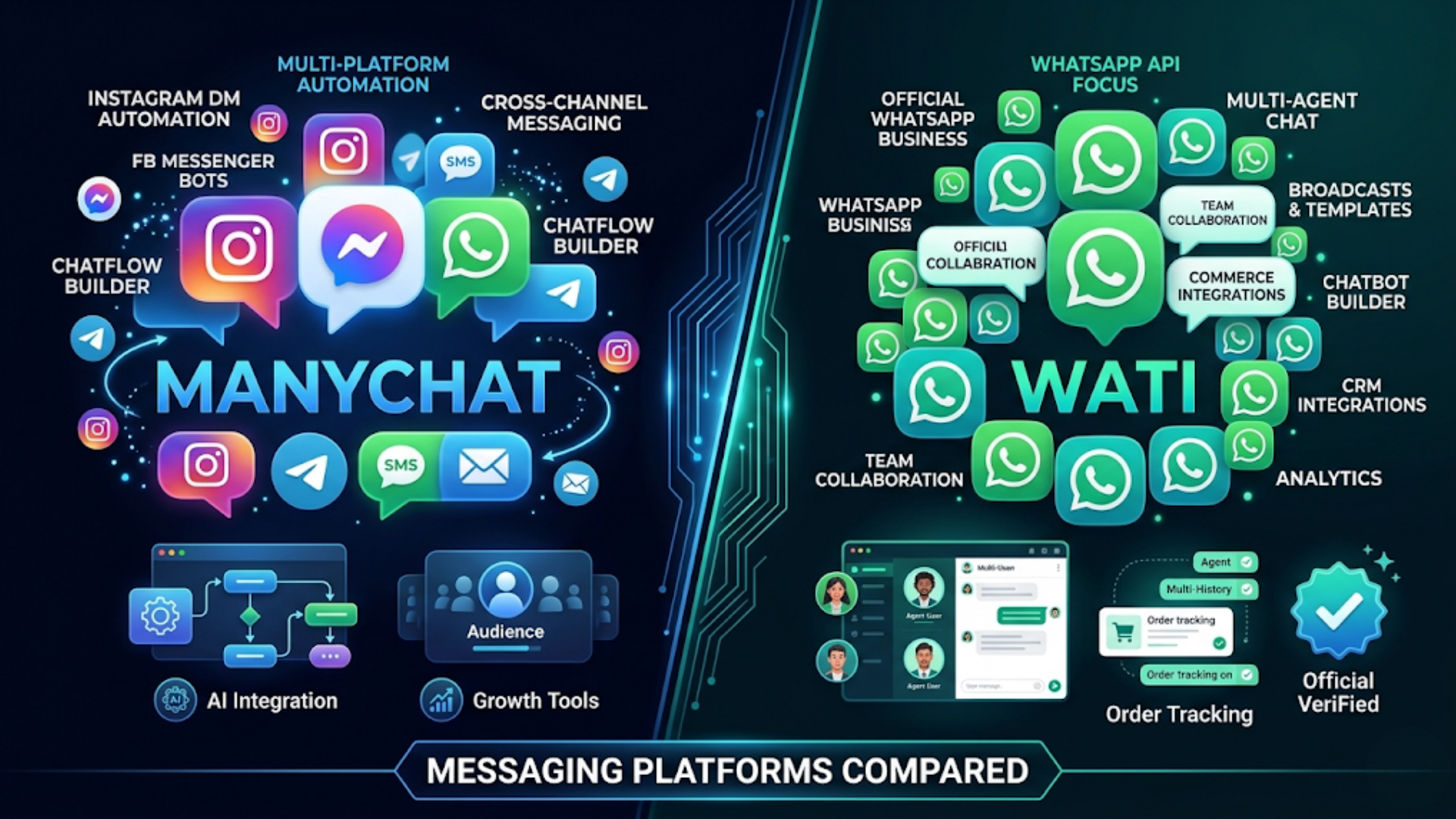
ManyChat vs WATI: Which WhatsApp Platform Wins in 2026?
Two platforms. Same WhatsApp Business API underneath. Very different philosophies about how to use it.
WATI is a WhatsApp-first platform built for businesses that live on WhatsApp. ManyChat is a multi-channel automation platform that added WhatsApp to its existing Instagram and Facebook Messenger capabilities.
I build WhatsApp automation systems for clients. I have worked with both platforms. The answer to “which one should I pick” depends on exactly two things: where your customers are and what else you need beyond WhatsApp.
Here is the honest breakdown.
Pricing: The Real Comparison
Pricing on both platforms is confusing on purpose. Both charge a platform fee plus WhatsApp conversation charges (set by Meta, not by the platform). Let me break down what you actually pay.
WATI pricing (2026):
- Growth plan: $39/month (5 users, 1,000 conversations included)
- Pro plan: $79/month (unlimited users, 2,000 conversations included)
- Business plan: $199/month (custom limits, priority support)
- Additional conversations: charged at Meta’s rates ($0.005-0.08 per conversation depending on category and country)
ManyChat pricing (2026):
- Free plan: limited to 1,000 contacts, basic automation, Instagram and Facebook only (no WhatsApp)
- Pro plan: $15/month for 500 contacts, scales with contact count
- WhatsApp add-on: included in Pro at no extra charge
- Additional conversations: Meta’s rates apply
At first glance, ManyChat looks cheaper. $15/month versus $39/month. But the comparison is misleading.
ManyChat charges per contact. At 5,000 contacts, you are paying $65/month. At 10,000, it is $115/month. At 25,000, you hit $200/month. WATI charges per conversation, not per contact. A large contact list that you rarely broadcast to costs less on WATI.
The math for an Indian D2C brand with 15,000 WhatsApp contacts sending 4 broadcasts per month: ManyChat Pro at 15,000 contacts is approximately $145/month. WATI Pro with roughly 8,000-10,000 monthly conversations is $79/month plus $40-60 in Meta fees. Total: roughly $120-140/month on WATI versus $145/month on ManyChat (plus Meta fees on top).
Roughly comparable. The deciding factor is not pricing. It is features.
WhatsApp-Specific Features
This is where the platforms diverge sharply.
WATI advantages:
- Shared team inbox. Multiple agents can handle WhatsApp conversations simultaneously. WATI’s inbox is built for this. Agent assignment, routing, labels, quick replies. It is a proper help desk for WhatsApp.
- Broadcast segmentation. Filter contacts by tags, custom attributes, last message date. Send targeted broadcasts to segments. WATI handles this natively with a visual builder.
- Template management. Submit, track, and manage WhatsApp message templates directly from the dashboard. View approval status, rejection reasons, and template analytics.
- Catalog integration. Connect your WhatsApp Business catalog for product browsing within chat.
- Green tick verification. WATI assists with the WhatsApp green tick (official business account) verification process.
ManyChat advantages:
- Visual flow builder. ManyChat’s chatbot builder is significantly more intuitive than WATI’s. Drag-and-drop, visual canvas, conditional logic. If you are building complex conversational flows, ManyChat is easier to work with.
- AI features. ManyChat’s AI-powered intent detection and response generation is more mature. Their AI Step lets you inject ChatGPT-style responses into flows without external API calls.
- Keyword triggers. Set up automated responses triggered by specific keywords in incoming messages. WATI has this too but ManyChat’s implementation is more flexible.
Where both are equal: Message scheduling, contact management, basic analytics, webhook integrations, Zapier/Make connectivity.
For pure WhatsApp operations (support + marketing), WATI wins. The team inbox alone justifies it. For sophisticated chatbot flows with AI capabilities, ManyChat wins.
Multi-Channel: ManyChat’s Real Advantage
Here is where ManyChat pulls ahead for certain businesses.
ManyChat supports Instagram DMs, Facebook Messenger, WhatsApp, SMS, and email from a single platform. One chatbot flow can span all channels. A lead comes in via Instagram comment, gets followed up on WhatsApp, receives a confirmation email. One automation.
WATI does WhatsApp and nothing else.
If your business runs Instagram ads that drive DM conversations, ManyChat is the obvious choice. You cannot replicate that cross-channel flow with WATI without adding another tool.
The specific scenario where this matters most: Indian D2C brands running Instagram Reels and Stories with CTAs that drive DMs. The comment-to-DM automation on Instagram (someone comments a keyword, they get an automatic DM with a link or offer) is ManyChat’s killer feature. This drives serious revenue for fashion, beauty, and food brands.
WATI’s counter-argument: WhatsApp is where transactions happen in India. Instagram gets attention. WhatsApp closes sales. If your funnel is Instagram ads pointing to a WhatsApp click-to-chat link, you do not need ManyChat’s Instagram automation. You need WATI’s WhatsApp depth.
Both arguments are valid. It depends on your funnel.
Chatbot Builder Comparison
I have built bots on both platforms. Here is the honest assessment.
ManyChat’s builder:
- Visual canvas with drag-and-drop nodes
- Easy conditional branching (if/else, switch)
- Built-in delays, randomizers, and A/B splits
- AI Step for GPT-powered responses
- Reusable “blocks” (template flows you can reference across bots)
- Learning curve: 2-3 hours to build your first useful bot
WATI’s builder:
- Flow-based but less visual than ManyChat
- Supports conditional logic and keyword triggers
- Template-message focused (designed around WhatsApp’s template approval system)
- API-first approach for complex logic
- Better integration with external data sources via webhooks
- Learning curve: 4-6 hours for your first useful bot
For a restaurant order bot, appointment booking flow, or FAQ handler, both platforms get the job done. ManyChat is faster to set up. WATI is more flexible when you need to pull data from external systems.
For complex enterprise flows (multi-language support, CRM data lookups mid-conversation, dynamic product recommendations), neither platform is ideal. You need n8n or a custom backend orchestrating the conversation logic and using WATI or ManyChat purely for message delivery.
Shopify Integration
Both platforms offer Shopify integrations. Quality varies.
ManyChat + Shopify:
- Abandoned cart recovery via WhatsApp and Instagram
- Order confirmation and shipping updates
- Product recommendation flows based on purchase history
- Shopify coupon code generation within chat flows
- Direct checkout links from chat
WATI + Shopify:
- Order notification templates (shipped, delivered, etc.)
- Abandoned cart recovery via WhatsApp
- Catalog sync for in-chat product browsing
- COD order confirmation (critical for India)
- Return and exchange initiation via chat
For Indian Shopify stores, WATI’s COD confirmation feature is a significant advantage. Cash-on-delivery orders have a 25-40% RTO (return to origin) rate. Sending a WhatsApp confirmation asking “Confirm your order of Rs X? Reply YES to confirm” reduces RTO by 15-20%. WATI built this flow specifically for the Indian market. ManyChat does not have a native COD confirmation template.
API Access and Custom Development
ManyChat API: Available on Pro plans. Lets you create and update contacts, send messages, trigger flows, and read flow data. Well-documented. Rate limits are generous (10 requests per second on Pro).
WATI API: Available on all paid plans. Full messaging API, contact management, template management, and webhook callbacks. Documentation is comprehensive. Rate limits depend on your plan tier.
For developers building custom integrations, both APIs are adequate. WATI’s API is more WhatsApp-focused (template submission, conversation tracking). ManyChat’s API is broader (cross-channel flow triggers).
If you are using n8n for orchestration (which I recommend for anything complex), both platforms integrate via HTTP Request nodes. WATI has a community n8n node. ManyChat requires raw API calls but the endpoints are straightforward.
India-Specific Analysis
This section matters if you are building for the Indian market.
WATI’s India advantages:
- Founded by a team that understands Indian business communication
- INR pricing available (removes forex fluctuation risk)
- Razorpay integration for in-chat payments
- COD confirmation flows (built for India’s delivery challenges)
- Regional language template support (Hindi, Tamil, etc.)
- Indian customer support team in IST timezone
- Popular with Indian D2C brands (Sugar Cosmetics, Lenskart, boAt have used WATI or similar platforms)
ManyChat’s India challenges:
- USD-only pricing
- No native INR payment gateway integration
- Instagram DM automation works well in India but WhatsApp features feel secondary
- Support is US-timezone weighted (response delays for IST business hours)
- Less understanding of India-specific flows like COD confirmation, UPI payment links in chat
My recommendation for Indian businesses: If WhatsApp is your primary customer communication channel (and for most Indian D2C brands, it is), start with WATI. If Instagram is your primary acquisition channel and you need cross-channel automation, ManyChat.
For businesses that need both, the pragmatic answer is ManyChat for Instagram acquisition and WATI for WhatsApp operations. Yes, two platforms. But each does its core job better than the other’s secondary feature.
Who Should Pick What
Pick WATI if:
- WhatsApp is your primary customer communication channel
- You need a shared team inbox for customer support
- You are an Indian business wanting INR pricing and local support
- You sell on Shopify with COD orders
- You primarily do broadcasts and support, not complex chatbot flows
Pick ManyChat if:
- You run Instagram and Facebook as primary acquisition channels
- You need cross-channel automation (Instagram to WhatsApp to email)
- You want the best visual chatbot builder
- You need AI-powered conversation handling
- Your audience is global, not India-specific
Pick neither if:
- You need enterprise-grade WhatsApp automation with custom AI (look at Gupshup, Infobip, or build on the WhatsApp Cloud API directly)
- Your monthly conversation volume exceeds 100,000 (platform fees become a significant line item; direct API access is cheaper)
- You need deep CRM integration beyond basic contact sync (use n8n as an orchestration layer instead)
FAQ
Can I use both ManyChat and WATI on the same WhatsApp number? No. WhatsApp Business API allows only one BSP (Business Solution Provider) per phone number. You cannot connect the same number to both platforms. You would need two different numbers, which is confusing for customers. Pick one for WhatsApp.
Which platform has better message deliverability? Both use the same WhatsApp Business API. Deliverability is identical because Meta handles the actual message delivery. The difference is in template approval speed (WATI is slightly faster in my experience) and error handling when messages fail.
Does ManyChat support WhatsApp in India? Yes. ManyChat supports WhatsApp globally including India. The features work. But India-specific functionality (INR payments, COD flows, regional language optimization) is where WATI has an edge.
What are the WhatsApp conversation charges from Meta? As of 2026: Marketing conversations cost $0.025 per conversation in India. Utility conversations (order updates, shipping) cost $0.005. Service conversations (customer-initiated) are free for the first 1,000 per month, then $0.01 each. These charges apply regardless of which platform you use.
Can I migrate from WATI to ManyChat (or vice versa)? You can export your contact list and re-import it. But your chatbot flows, templates, and conversation history do not transfer. Template approvals need to be re-submitted. Plan 1-2 weeks for a full migration including template re-approval.
Which platform is better for a small business just starting with WhatsApp? WATI’s Growth plan at $39/month. It gives you everything you need: broadcast, basic automation, team inbox. ManyChat’s $15/month looks cheaper but WhatsApp features on the lower tiers are limited. Scale from there.
The platform debate is less important than the strategy behind it. A mediocre chatbot on the right platform still outperforms a brilliant chatbot that nobody uses.
If you are unsure which platform fits your business or need help setting up WhatsApp automation, triggerAll can help you decide and build.
Need help implementing this?
Book a free 30-minute discovery call. We'll map your current setup, identify quick wins, and outline what automation can do for your business.
Book a Free Discovery Call