Loyalty + Inventory Automation for Multi-Location Retailers
Automate loyalty point tracking, cross-store inventory sync, reorder alerts, and WhatsApp customer engagement for multi-location retail. Complete stack with Shopify POS, Zoho Inventory, and n8n.
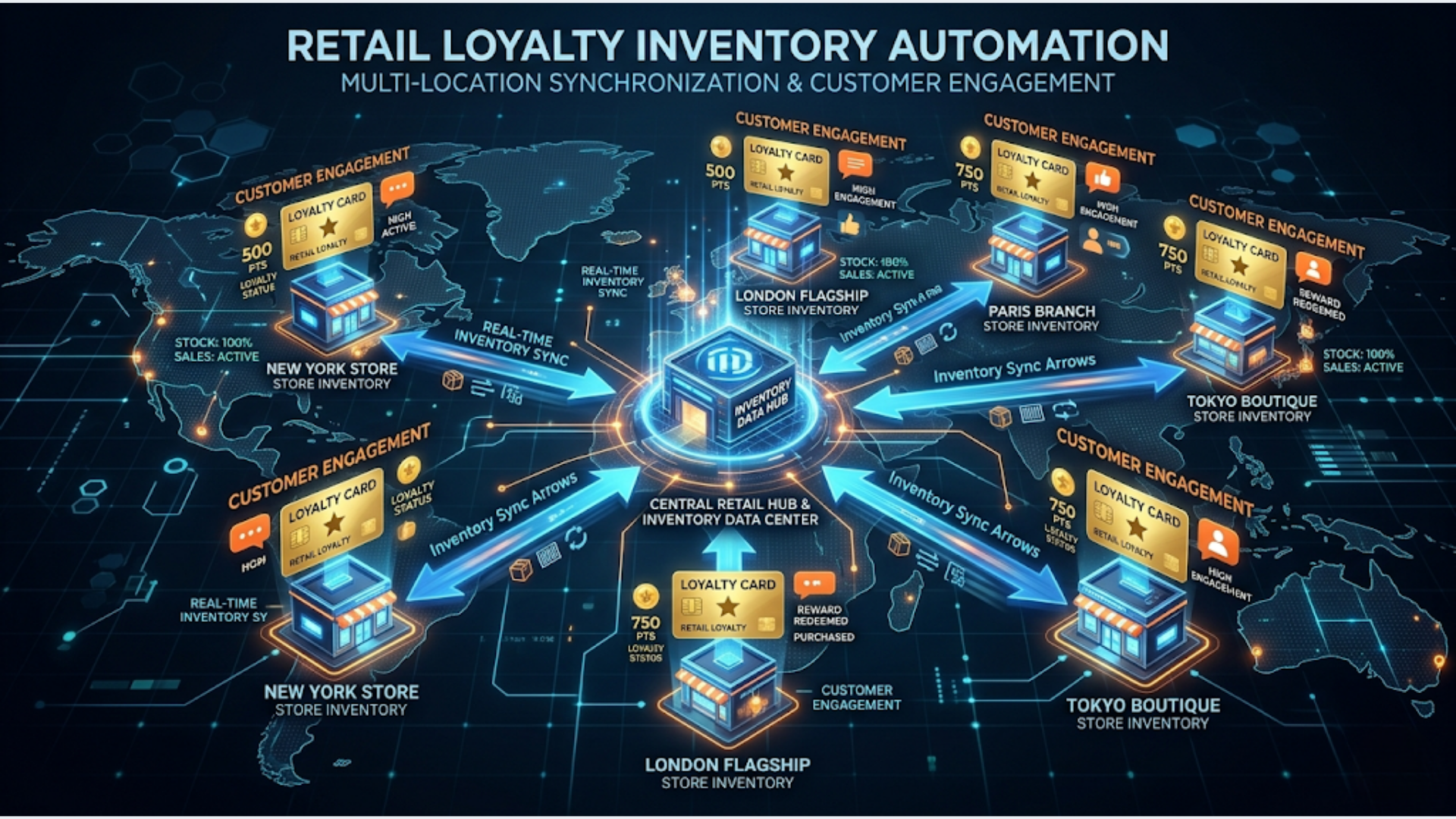
Loyalty + Inventory Automation for Multi-Location Retailers
Automated loyalty + inventory systems for multi-location retail reduce stockouts by 40-60%, increase repeat purchase rates by 25-35%, and cut inventory management labor by 15-20 hours per week per store. The core stack: Shopify POS or Zoho Inventory for cross-store sync, n8n for orchestration, WhatsApp for customer engagement, and a loyalty engine (Smile.io, Yotpo, or custom-built). Total setup cost: $2,000-10,000. Monthly operating cost: $200-800.
Retail chains with 5 to 40 locations share the same problem: inventory data lives in silos (each store has its own count), loyalty programs are manual (staff forget to ask for the loyalty number), and customer engagement is limited to “please come again.” Meanwhile, the brand down the street is sending personalized WhatsApp messages about products their customers actually want, based on purchase history the system tracks automatically.
The gap between automated and manual retail operations isn’t gradual. It’s a cliff. Here’s how to close it.
Cross-Store Inventory Sync: The Foundation
Nothing else works if your inventory counts are wrong. A customer checks your website, sees an item in stock at a nearby store, drives there, and it’s sold out. That’s not a technology problem. It’s a trust problem you just created.
What needs to happen in real-time:
Every sale at any location decrements inventory at that location and updates the central count. Every return adds inventory back. Every transfer between stores updates both locations. Every new shipment from a supplier adds to the receiving store’s count. Online orders reserved from a specific store’s inventory are deducted immediately, not when they’re picked.
The reality at most multi-location retailers:
Inventory is reconciled once a day (end of day sync). Sometimes once a week. During that gap, customers see ghost inventory online, staff make transfer decisions based on stale data, and reorder points trigger too late because the system thinks you still have stock that sold 3 hours ago.
The automation architecture:
POS system (Shopify POS, Square, or Zoho POS) fires a webhook on every transaction. n8n receives the webhook, updates the central inventory database, and propagates the change to all connected channels (website, marketplace listings, other store dashboards). Latency target: under 30 seconds from sale to updated count across all channels.
Shopify POS + Shopify Inventory sync handles this natively for Shopify-based retailers. It’s real-time, supports multiple locations, and the inventory API is solid. If you’re already on Shopify, you don’t need a separate inventory system for basic multi-location sync.
Zoho Inventory works better for retailers not on Shopify. It supports multi-warehouse management, batch tracking, serial number tracking, and integrates with multiple sales channels. The API allows n8n to orchestrate complex flows like automatic inter-store transfers and reorder triggers.
Cost comparison:
| Solution | Monthly Cost | Locations Supported | Real-time Sync |
|---|---|---|---|
| Shopify POS + Inventory | $89/location/mo | Unlimited | Yes (native) |
| Zoho Inventory (Standard) | $79/mo (total) | 5 warehouses | Via webhooks |
| Zoho Inventory (Professional) | $129/mo (total) | 10 warehouses | Via webhooks |
| Square for Retail | $60/location/mo | Unlimited | Yes (native) |
| Custom (n8n + database) | $50-150/mo hosting | Unlimited | Yes |
Automated Reorder Alerts and Purchase Orders
Manual reorder process: store manager eyeballs the shelves, checks a spreadsheet, calls the supplier, negotiates, and places an order. Time per SKU: 15-30 minutes. For a store with 500 SKUs, reorder management alone is a full-time job.
Automated flow:
Set a reorder point and reorder quantity for every SKU. When inventory drops below the reorder point, the system generates a purchase order. But smart reorder isn’t just “stock hits 10, order 50.” It factors in:
- Velocity: How fast is this SKU selling? A product selling 5 units/day needs a different reorder point than one selling 5 units/month.
- Lead time: If your supplier takes 7 days to deliver, your reorder point must account for 7 days of expected sales plus a safety buffer.
- Seasonality: Certain products spike during festivals, holidays, or weather changes. Your reorder algorithm should look at same-period sales from last year, not just the last 30 days.
- Multi-location demand: If Store A is out of stock and Store B has excess, the system should trigger an inter-store transfer before ordering from the supplier.
The n8n workflow:
A scheduled workflow runs daily (or twice daily for fast-moving inventory). It queries current stock levels, calculates days-of-stock remaining based on 30-day sales velocity, identifies SKUs below their reorder threshold, checks if a purchase order already exists for that SKU, and if not, creates a draft PO in your inventory system. The store manager reviews and approves with one click instead of building the PO from scratch.
For high-confidence reorders (staple products with predictable demand), the system can auto-approve and send the PO directly to the supplier via email. No human in the loop. I’ve seen this save 10-15 hours per week for retailers managing 300+ SKUs.
Supplier integration:
If your supplier accepts orders via email (most do), the automation sends a formatted PO as a PDF attachment. If they have an API or a portal, n8n can submit the order programmatically. Some suppliers use WhatsApp (common in India). The automation sends the order via WhatsApp Business API with product names, quantities, and expected delivery date.
Loyalty Program Automation
Most retail loyalty programs fail because they rely on staff remembering to ask for the loyalty number and manually crediting points. The system should capture loyalty data automatically without requiring any action from the cashier.
Three approaches:
1. Phone number as loyalty ID (simplest): Customer provides their phone number at checkout. POS looks up the loyalty profile. Points are credited automatically. No card, no app, no barcode. This works for 90% of retail loyalty programs. The phone number is already captured for WhatsApp communication, so you’re not adding friction.
2. App-based loyalty: Customer scans a QR code at the counter or the cashier scans their in-app barcode. More data capture (browsing behavior, wish lists, location), but higher friction. Adoption rates for retail loyalty apps: 15-25% of customers. For phone number-based: 60-80%.
3. Payment-linked loyalty: Link the loyalty program to the customer’s credit/debit card or UPI ID. Every purchase on that card automatically earns points. Zero friction. But requires a payment processor that supports this (Stripe, Razorpay, or a dedicated loyalty platform like Capillary).
The automation flow (phone number approach):
Customer gives phone number at POS. System matches to existing loyalty profile or creates a new one. Points calculated based on purchase amount and any multipliers (double points on Tuesdays, bonus points on specific categories). Points credited. WhatsApp message sent within 60 seconds: “Hi [Name], you earned 150 points on today’s purchase! Total balance: 2,340 points. You’re 660 points away from a ₹500 reward.”
That message does three things: confirms the transaction, shows progress toward a reward, and gives a reason to come back. It’s automated. It costs ₹2-3 to send. And it drives repeat visits better than any email campaign.
Tier-based loyalty:
| Tier | Annual Spend | Benefits | Auto-Upgrade |
|---|---|---|---|
| Bronze | ₹0-10,000 | 1 point per ₹100 spent | Default |
| Silver | ₹10,001-30,000 | 1.5 points per ₹100, early access to sales | When threshold crossed |
| Gold | ₹30,001-75,000 | 2 points per ₹100, free delivery, birthday bonus | When threshold crossed |
| Platinum | ₹75,001+ | 3 points per ₹100, personal shopper, exclusive events | When threshold crossed |
Tier upgrades and downgrades should be automated. When a customer crosses the Silver threshold, the system upgrades them instantly and sends a congratulatory WhatsApp message with their new benefits. Tier reviews happen quarterly. Customers who haven’t maintained spending thresholds get a “you’re close to keeping your status” nudge before downgrade.
Loyalty platform options:
- Smile.io: $49-999/mo. Best for Shopify-based retailers. Easy setup. Limited customization.
- Yotpo Loyalty: Custom pricing. More features (VIP tiers, referral programs). Better for larger operations.
- Capillary Technologies: Enterprise pricing. Indian company, strong in APAC market. Supports UPI-linked loyalty.
- Custom (n8n + database): $0-50/mo operating cost. Full control. Requires development ($3,000-8,000 to build). Best for retailers wanting unique mechanics.
WhatsApp Customer Engagement Automation
Email marketing for retail has a 15-20% open rate. WhatsApp: 85-95%. For Indian retailers, WhatsApp isn’t a nice-to-have channel. It’s the primary communication channel.
Automated WhatsApp flows for retail:
Post-purchase engagement (triggered automatically):
- Purchase confirmation + loyalty points update (immediate)
- Product care tips or usage suggestions (Day 3)
- Review request (Day 7)
- Replenishment reminder for consumable products (based on estimated usage cycle)
- Cross-sell recommendation based on purchase history (Day 14)
Loyalty-triggered messages:
- Points earned notification (after every purchase)
- Points expiry warning (30 days before expiry)
- Reward available notification (when enough points accumulated)
- Tier upgrade congratulations
- Tier downgrade warning (2 weeks before quarterly review)
Inventory-triggered messages:
- Back-in-stock notification for products the customer previously asked about
- New arrival notification in categories the customer shops frequently
- Price drop alert for items in the customer’s browsing/wishlist history
Segmented campaigns:
Not every customer gets every message. Segmentation based on purchase history, loyalty tier, and engagement level. Your Gold customers get exclusive early access to a new collection. Your lapsed customers (no purchase in 60+ days) get a “we miss you” offer. First-time buyers get a “thank you + here’s a reason to come back” sequence.
Cost per customer per month: 5-8 automated WhatsApp messages at ₹2-4 each = ₹10-32/customer/month ($0.12-0.38). For 1,000 active loyalty members, that’s ₹10,000-32,000/month ($120-380). Compare that to the revenue increase from even a 10% lift in repeat purchases.
The India Stack: UPI Cashback and Regional Warehouse Management
Indian multi-location retailers face specific challenges that global platforms don’t address natively.
UPI cashback integration:
UPI is how India pays. For retail loyalty programs, linking points to UPI cashback is powerful. Instead of “earn 150 points,” you offer “get ₹15 cashback to your UPI.” It’s tangible. Customers understand it immediately.
The technical flow: customer pays via UPI at POS. Razorpay or Cashfree processes the payment and returns the UPI ID. Your loyalty system calculates the cashback amount. An automated refund is initiated to the customer’s UPI ID. Customer gets ₹15 directly in their bank account within minutes.
This approach has 2-3x higher perceived value than abstract “points” for Indian consumers, especially in Tier-2 and Tier-3 cities. The cost is the same (you’re paying the cashback either way), but the conversion to repeat visits is measurably higher.
Implementation note: UPI cashback refunds through Razorpay cost ₹0 in transaction fees (refunds are free). You only pay the original payment processing fee (typically 0% for UPI at POS). Your only cost is the cashback amount itself.
Regional warehouse management:
Indian retailers with 10+ stores across multiple cities need regional warehouse hubs. A store in Bengaluru shouldn’t wait for replenishment from a Mumbai warehouse when there’s excess stock in the Chennai warehouse.
The automation handles: demand forecasting per region, optimal stock allocation across stores within a region, inter-warehouse transfer triggers when regional stock is imbalanced, and dynamic reorder points that adjust based on local demand patterns (festival seasons vary by region in India).
GST complications for inter-store transfers:
In India, transferring inventory between your own stores in different states triggers GST implications (stock transfer under same PAN). Your inventory system must generate delivery challans (not invoices) for inter-state transfers and track the associated IGST impact. Zoho Inventory handles this natively for Indian businesses. Custom systems need to build this compliance layer.
Regional language for customer communication:
A store in Tamil Nadu should send WhatsApp messages in Tamil. A store in Gujarat should communicate in Gujarati. n8n + WATI supports language-based routing: detect the customer’s preferred language from their profile or store location and send the appropriate template. This isn’t cosmetic. Tamil-language WhatsApp messages from a Chennai store have 20-30% higher engagement than English messages for the same offers.
Implementation Roadmap: 6-Week Plan
Week 1-2: Inventory foundation Connect all POS systems to central inventory. Set up real-time sync via webhooks. Verify counts match physical stock at all locations. This is boring but critical. Bad data in means bad decisions out.
Week 3: Reorder automation Set reorder points for top 100 SKUs (80/20 rule: these account for most of your revenue). Build the daily reorder workflow in n8n. Start with draft POs requiring approval. Move to auto-approve for predictable SKUs after 2 weeks of validation.
Week 4: Loyalty program launch Set up phone number-based loyalty. Configure point rules and tiers. Train staff on the 5-second loyalty capture flow at POS. Launch with a “sign up and get 2x points on your first purchase” promotion to build the member base quickly.
Week 5: WhatsApp engagement Connect loyalty system to WhatsApp via WATI + n8n. Start with transactional messages (purchase confirmation, points update). Add marketing messages (back-in-stock, recommendations) in Week 6 after building initial engagement data.
Week 6: Optimization and expansion Review first month of data. Adjust reorder points based on actual velocity. Refine loyalty messaging based on open/engagement rates. Expand reorder automation to all SKUs. Set up inter-store transfer automation.
Total build cost: $4,000-10,000 depending on store count and complexity. Monthly operating cost: $200-800 (platform subscriptions + WhatsApp messaging). Expected ROI timeline: 2-3 months to break even on build cost through reduced stockouts, increased repeat purchases, and labor savings.
If you’re running multiple retail locations and managing inventory in spreadsheets, we build these systems at triggerAll.
FAQ
How much does inventory automation cost for multi-location retail? Shopify POS with built-in inventory sync costs $89/location/month. Zoho Inventory covers up to 10 warehouses for $129/month total. A fully custom system with n8n orchestration costs $4,000-10,000 to build with $200-800/month in operating costs. The right choice depends on whether you’re already on Shopify and how complex your inter-store transfer needs are.
What is the best loyalty program for retail stores in India? For Indian retailers, a phone number-based loyalty program with UPI cashback rewards outperforms traditional points systems. Customers understand ₹15 cashback instantly. Abstract “150 points” requires mental math. Use Capillary Technologies for enterprise-scale or build custom with n8n for full control. The phone-number approach achieves 60-80% customer adoption vs 15-25% for app-based loyalty.
How do I sync inventory across multiple store locations in real-time? Connect each POS to a central inventory system via webhooks. Every sale, return, and transfer fires a webhook that updates the central count within 30 seconds. Shopify POS does this natively. For non-Shopify setups, use Zoho Inventory or a custom n8n workflow that receives POS webhooks and propagates changes to all connected channels (website, marketplace, other store dashboards).
How do I automate reorder alerts for retail inventory? Set a reorder point for each SKU based on sales velocity and supplier lead time. An n8n workflow runs daily, checks current stock against reorder thresholds, and generates draft purchase orders for items below threshold. Factor in seasonality (same-period last year), not just recent velocity. Start with auto-draft POs for review, then move to auto-approve for predictable SKUs.
Can I use WhatsApp for retail loyalty program notifications? Yes, and you should. WhatsApp loyalty notifications (points earned, tier upgrades, reward available) have 85-95% open rates vs 15-20% for email. Use WATI or the WhatsApp Business API with n8n to send automated messages triggered by purchase events. Cost: ₹2-4 per message. For 1,000 loyalty members receiving 5-8 messages/month, budget ₹10,000-32,000/month.
What is UPI cashback integration for retail loyalty? Instead of awarding abstract loyalty points, you refund a percentage of the purchase amount directly to the customer’s UPI ID as cashback. Technical flow: customer pays via UPI, Razorpay captures the UPI ID, your loyalty engine calculates cashback, and an automated refund is sent to their bank account within minutes. UPI refunds are free on Razorpay. This has 2-3x higher perceived value than points for Indian consumers.
How long does it take to set up inventory automation for a retail chain? A complete system (real-time sync, reorder automation, loyalty program, WhatsApp engagement) takes 6 weeks to implement. Week 1-2: inventory sync. Week 3: reorder automation. Week 4: loyalty launch. Week 5-6: WhatsApp engagement and optimization. The inventory sync must be accurate before building anything else on top of it.
Need help implementing this?
Book a free 30-minute discovery call. We'll map your current setup, identify quick wins, and outline what automation can do for your business.
Book a Free Discovery Call