Loan Application Pipeline Automation: KYC, Credit Checks, Status Updates
Automate your entire loan application pipeline from intake to disbursement. KYC verification, credit score checks, approval workflows, and status notifications with real costs and tool stacks.
Loan Application Pipeline Automation: KYC, Credit Checks, Status Updates
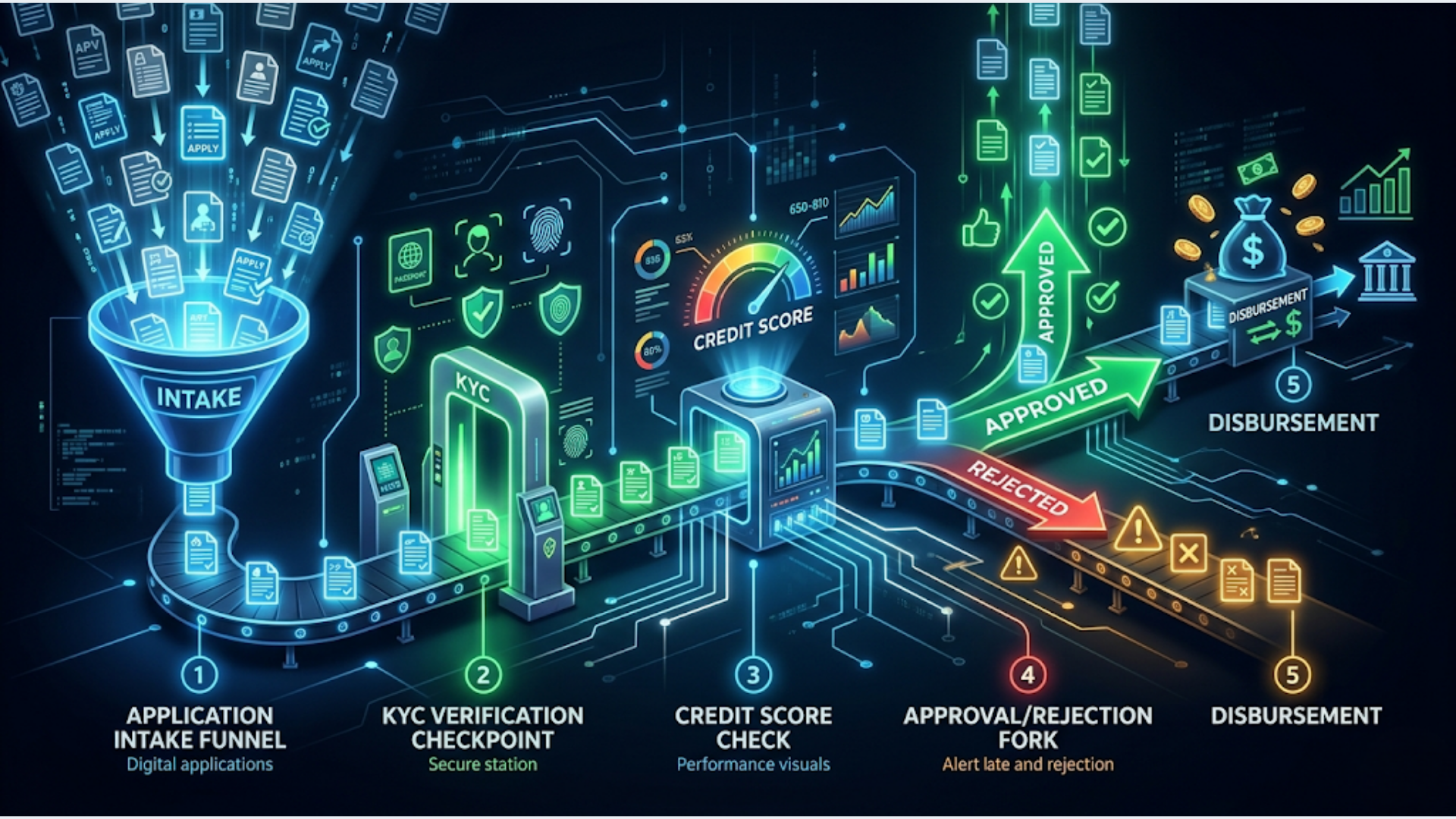
A fully automated loan pipeline processes applications from intake to disbursement in 4-24 hours instead of 5-15 days. It cuts processing cost per application by 60-75% (from $30-50 to $8-15) and reduces manual touchpoints from 12-15 to 2-3. The stack: a form builder for intake, OCR for documents, KYC/credit APIs, a workflow engine for decisions, and WhatsApp/SMS for status updates.
NBFCs and fintech lenders processing 200 to 8,000 applications per month share the same bottleneck. The bottleneck is never the decision to approve or reject. It’s the 47 manual steps between receiving an application and reaching that decision. Document collection alone accounts for 3-5 days of the typical processing time. KYC verification adds another 1-2 days. Status updates to applicants? Most lenders don’t send any until the final decision.
Every one of those delays is automatable. Here’s the complete architecture.
The End-to-End Loan Pipeline: 7 Stages
A loan application moves through seven stages. Each one is either automated or it’s a person copying data between systems and making phone calls.
Stage 1: Application Intake
The application form collects personal details, employment information, income data, loan amount requested, and purpose. Most lenders use a web form, but smart ones also accept applications via WhatsApp (conversational intake) and partner APIs (for embedded lending).
Automated flow: Applicant submits form. System validates required fields in real-time. Duplicate check runs against existing applications and customers. If duplicate found, routes to existing application handler. If new, creates a loan application record in your LMS (Loan Management System) with a unique application ID. Applicant receives instant confirmation via WhatsApp/SMS: “Application #LA-20260426-001 received. We’ll update you within 24 hours.”
What breaks without automation: Applications sit in email inboxes. Duplicates aren’t caught until a credit officer notices the same PAN number halfway through processing. Applicants call customer service asking “did you get my application?” because they never got a confirmation.
Stage 2: Document Collection and OCR
This is where most loan processing time is wasted. Applicants submit blurry photos of their Aadhaar, PAN, salary slips, and bank statements. Someone manually reviews each document, requests re-uploads, and enters data into the system by hand.
Automated flow: Applicant receives a WhatsApp message with a document upload link. They upload photos of required documents. OCR extracts text from each document. AI validates: Is this actually an Aadhaar card? Does the name match the application? Is the PAN number in the correct format? Is the salary slip from the last 3 months?
If a document fails validation (blurry, wrong document type, expired), the system immediately requests a re-upload with specific instructions: “Your Aadhaar photo is too blurry. Please retake in good lighting.” No waiting 2 days for a human to review and send the same request.
OCR tools that work: Google Document AI ($1.50 per 1,000 pages), AWS Textract ($1.50 per 1,000 pages), or Azure Form Recognizer. For Indian documents specifically, Hyperverge and Digio specialize in Aadhaar, PAN, and Indian bank statements with higher accuracy than generic OCR.
Cost: $0.50-2.00 per application for document processing. Compare that to $5-10 in labor cost for manual data entry per application.
Stage 3: KYC Verification
KYC is where automation delivers the most dramatic time savings. Manual KYC takes 1-3 days. Automated KYC takes 30-90 seconds.
Automated flow: System extracts Aadhaar number and PAN number from uploaded documents. Calls Aadhaar verification API to confirm identity (name, DOB, address match). Calls PAN verification API to confirm tax registration. Cross-references Aadhaar and PAN to ensure they belong to the same person. Runs sanctions/watchlist screening. Results logged to the application record.
If KYC fails (name mismatch, expired ID, sanctions hit), the application is flagged for manual review with specific failure reasons. No blanket rejection. A human reviews edge cases only.
Verification APIs: NSDL (PAN verification), UIDAI/Digilocker (Aadhaar), Karza or Signzy (unified KYC platform covering PAN, Aadhaar, GST, bank account verification). Cost: ₹2-10 ($0.02-0.12) per verification call.
Stage 4: Credit Score and Risk Assessment
Once KYC passes, the system pulls the applicant’s credit history and calculates a risk score.
Automated flow: System calls credit bureau API (Experian, Equifax, or CIBIL/TransUnion in India). Retrieves credit score, outstanding loans, repayment history, and credit utilization. Internal scoring model applies: combines bureau score with income-to-EMI ratio, employment stability, and loan amount relative to income. Application is categorized: auto-approve, manual review, or auto-reject based on configurable thresholds.
For auto-approve applications (typically 30-40% of volume), the pipeline moves directly to approval without human intervention. For auto-reject (typically 15-25%), the system sends a polite rejection with the reason and suggestions for improving eligibility. The remaining 35-55% go to human underwriters with all data pre-compiled. The underwriter sees a single dashboard with the application, documents, KYC results, credit report, and risk score. Decision time: 5-10 minutes instead of 2-3 hours.
Credit bureau API costs:
| Bureau | Cost per Pull (India) | Cost per Pull (Global) |
|---|---|---|
| CIBIL/TransUnion | ₹30-50 ($0.36-0.60) | $1.00-3.50 |
| Experian | ₹25-45 ($0.30-0.54) | $0.80-3.00 |
| Equifax | ₹25-40 ($0.30-0.48) | $0.80-2.50 |
| CRIF High Mark | ₹20-35 ($0.24-0.42) | N/A (India only) |
Most lenders pull from 2 bureaus per application to get a complete picture. Budget ₹50-90 ($0.60-1.08) per application for credit checks.
Stage 5: Approval Workflow and Decision Engine
This is the stage where human judgment intersects with automated data. The goal isn’t to remove humans from the decision. It’s to give them everything they need to decide in minutes instead of hours.
Automated flow: Auto-approved applications bypass this stage entirely. For manual review, the underwriter opens a pre-compiled dossier: applicant profile, verified documents, KYC status, credit report summary, risk score, and recommended decision. The underwriter approves, rejects, or requests additional information. If additional info is requested, the system generates a specific checklist and sends it to the applicant via WhatsApp.
Approval triggers: loan agreement generation (pre-filled with all terms), e-signature request via Aadhaar eSign or DocuSign, and an SMS/WhatsApp notification to the applicant.
Decision rules engine: Build this in n8n, Camunda, or a simple rules table in your database. The rules should be configurable by business users, not hardcoded. Example: “If credit score > 750 AND income-to-EMI ratio < 40% AND employment tenure > 2 years AND loan amount < ₹5,00,000, then auto-approve.” This lets your credit team adjust thresholds without engineering involvement.
Stage 6: Disbursement
After the applicant signs the loan agreement, disbursement should be automated.
Automated flow: eSignature completion triggers the disbursement workflow. System verifies bank account details (IFSC lookup, account holder name match via Penny Drop verification in India). Initiates NEFT/IMPS/UPI transfer for the approved amount. Confirms successful disbursement. Updates LMS with disbursement date and transaction reference. Sends WhatsApp confirmation: “₹3,00,000 has been credited to your account ending 4521. Your first EMI of ₹8,750 is due on 26-May-2026.”
Penny Drop verification (India-specific): Before disbursing, send ₹1 to the applicant’s bank account via API. This confirms the account exists, is active, and the holder name matches. Cost: ₹3-5 per verification. Saves you from disbursing to wrong accounts, which is a surprisingly common problem with manual data entry.
Stage 7: Ongoing Status Notifications
Most lenders treat status updates as an afterthought. The applicant submits their application and hears nothing until approval or rejection. Sometimes not even then. This generates enormous call center volume.
Automated flow: Every stage transition triggers a notification. Application received (instant). Documents verified (within hours). KYC completed. Credit check done. Under review. Approved/Rejected. Disbursed. Each message is specific: “Your KYC verification is complete. Your application is now under credit review. Expected decision: within 24 hours.”
Channel priority: WhatsApp first, SMS as fallback, email as archive. In India, WhatsApp reaches 90%+ of applicants. SMS catches the rest. Email is for record-keeping, not communication.
Cost of notifications: ₹0.15-0.25 per SMS, ₹2-4 per WhatsApp message. For 7 status updates per application, that’s ₹15-30 ($0.18-0.36) per applicant. Compare that to a single customer service call (₹50-100) asking “what’s the status of my application?”
The India Stack: CIBIL, Aadhaar, RBI Compliance
Loan automation in India has specific regulatory and technical requirements that make generic automation tools insufficient.
CIBIL integration specifics:
CIBIL (now TransUnion CIBIL) is the dominant credit bureau. Integration requires a direct commercial relationship. You can’t just call an API. There’s a certification process, a sandbox testing period, and compliance requirements. Budget 4-6 weeks for onboarding. Cost: ₹30-50 per credit pull plus a monthly minimum commitment of ₹5,000-15,000.
Alternative: Use aggregator platforms like Karza, Signzy, or Perfios that provide unified access to multiple bureaus through a single API. Faster onboarding (1-2 weeks), slightly higher per-pull cost (₹40-70), but you get access to CIBIL, Experian, Equifax, and CRIF through one integration.
Aadhaar eKYC vs DigiLocker:
Aadhaar eKYC (biometric or OTP-based) is the gold standard for identity verification. But RBI mandates that Aadhaar data must be stored in encrypted format and cannot be used as the sole basis for KYC. You need at least one additional verification (PAN, voter ID, passport).
DigiLocker integration allows applicants to share verified documents directly from the government repository. No physical documents needed. No OCR errors from blurry photos. The API pulls verified data directly. This is the most reliable and cheapest verification method in India. Cost: free for the verification, though the API integration takes 2-3 weeks.
RBI compliance considerations:
For NBFCs and banks, RBI’s digital lending guidelines (updated 2024) require: loan agreement must be provided before disbursement, all fees and charges disclosed upfront, a cooling-off period for certain loan types, and grievance redressal mechanism details in every communication. Your automation must build these compliance steps into the workflow. It’s not optional. Skipping any of these creates regulatory risk.
Recommended India tool stack: n8n or Camunda (workflow orchestration) + Karza or Signzy (unified KYC/credit bureau) + Razorpay or Cashfree (disbursement) + WATI (WhatsApp notifications) + Zoho Creator or Retool (underwriter dashboard). Total build cost: ₹5,00,000-15,00,000 ($6,000-18,000). Monthly operating cost: ₹15,000-40,000.
Complete Tool Stack and Costs
Here’s the full stack comparison for building a loan automation pipeline:
| Component | Budget Option | Mid-Range | Enterprise |
|---|---|---|---|
| Workflow Engine | n8n self-hosted ($0) | n8n Cloud ($50/mo) | Camunda ($500+/mo) |
| Document OCR | Google Document AI ($1.50/1K pages) | Hyperverge (₹5-15/doc) | Digio (custom pricing) |
| KYC/Credit | Direct bureau APIs (₹50-90/app) | Karza (₹40-70/app) | Signzy (custom pricing) |
| E-Signature | Aadhaar eSign (₹10-15/sign) | Leegality (₹25-50/sign) | DocuSign ($25/mo+) |
| Notifications | SMS (₹0.15/msg) + WhatsApp (₹2-4/msg) | WATI ($49/mo) | Twilio (volume pricing) |
| LMS | Custom on Zoho Creator (₹2K/mo) | LendFoundry (custom) | Nucleus Software (enterprise) |
| Dashboard | Retool ($10/user/mo) | Metabase ($85/mo) | Custom build ($5K-15K) |
Total cost per loan application (fully automated):
- Document processing: $0.50-2.00
- KYC verification: $0.50-1.00
- Credit bureau pulls: $0.60-1.50
- E-signature: $0.15-0.60
- Notifications (7 messages): $0.20-0.40
- Total: $1.95-5.50 per application
Compare to manual processing: $30-50 per application. At 1,000 applications/month, that’s $25,000-45,000/month in savings.
Implementation Timeline
A realistic timeline for building a loan automation pipeline from scratch:
Weeks 1-2: Application intake + document collection + OCR. This is the easiest part. Connect your form to n8n, set up document upload, configure OCR.
Weeks 3-4: KYC integration + credit bureau onboarding. Bureau onboarding takes the longest. Start this immediately. Build the KYC flow while waiting for bureau access.
Weeks 5-6: Decision engine + approval workflow + underwriter dashboard. Define your auto-approve/reject rules. Build the dashboard for manual reviews.
Weeks 7-8: Disbursement + notifications + end-to-end testing. Connect to your payment system. Set up all notification templates. Test the complete flow with real data.
Total: 8 weeks for a production-ready system. Some lenders try to do this in 4 weeks. They always miss edge cases in document processing and KYC that cause problems in production. Budget 8 weeks and you’ll be glad you did.
If you’re processing loan applications manually and want to cut processing time from days to hours, we build these pipelines at triggerAll.
FAQ
How long does it take to automate a loan application pipeline? A production-ready automated loan pipeline takes 6-8 weeks to build. The bottleneck is usually credit bureau onboarding (4-6 weeks for direct integration) and regulatory compliance testing. Using an aggregator like Karza or Signzy cuts bureau integration to 1-2 weeks.
What is the cost of automating loan processing? Build cost: $6,000-18,000 depending on complexity and compliance requirements. Operating cost: $2-5.50 per application (document OCR, KYC, credit checks, notifications). For context, manual processing costs $30-50 per application. At 500+ applications/month, the automation pays for itself in 1-2 months.
Can loan KYC verification be fully automated? About 70-85% of KYC verifications can be fully automated using Aadhaar eKYC, PAN verification, and DigiLocker document pull. The remaining 15-30% require human review due to name mismatches, expired documents, or data inconsistencies. The goal is to automate the clear cases and route only genuine edge cases to humans.
How do I integrate CIBIL credit checks into my loan workflow? Either integrate directly with TransUnion CIBIL (requires commercial agreement, 4-6 week onboarding, ₹30-50 per pull) or use an aggregator platform like Karza or Signzy that provides unified credit bureau access via a single API. The aggregator route is faster to implement and gives you access to multiple bureaus (CIBIL, Experian, CRIF) through one integration.
What are the RBI compliance requirements for automated loan processing? Key requirements: digital loan agreements must be provided before disbursement, all fees disclosed upfront, a cooling-off period for certain loan types, data stored with encryption, Aadhaar data handled per UIDAI guidelines, and a grievance redressal mechanism in every borrower communication. Your automation workflow must enforce these as mandatory steps, not optional add-ons.
How do I send loan status updates automatically via WhatsApp? Connect your LMS to WhatsApp Business API (via WATI, Twilio, or direct API) through n8n or any workflow engine. Each loan pipeline stage transition triggers a pre-approved WhatsApp template message. You need WhatsApp Business API approval for financial services templates, which takes 1-3 business days. Cost: ₹2-4 per message.
What is the best tool stack for loan automation in India? n8n for workflow orchestration, Karza for unified KYC and credit bureau access, Razorpay for disbursement, WATI for WhatsApp notifications, and Zoho Creator or Retool for the underwriter dashboard. This stack handles Indian regulatory requirements (Aadhaar, PAN, CIBIL, GST) natively and costs ₹15,000-40,000/month to operate at scale.
Need help implementing this?
Book a free 30-minute discovery call. We'll map your current setup, identify quick wins, and outline what automation can do for your business.
Book a Free Discovery Call