Hire n8n Developer: Rates, Skills, and Red Flags to Watch
Hiring an n8n developer? Expect $25-100/hr depending on experience. Learn what skills to look for, where to find them, and 7 red flags that signal trouble.
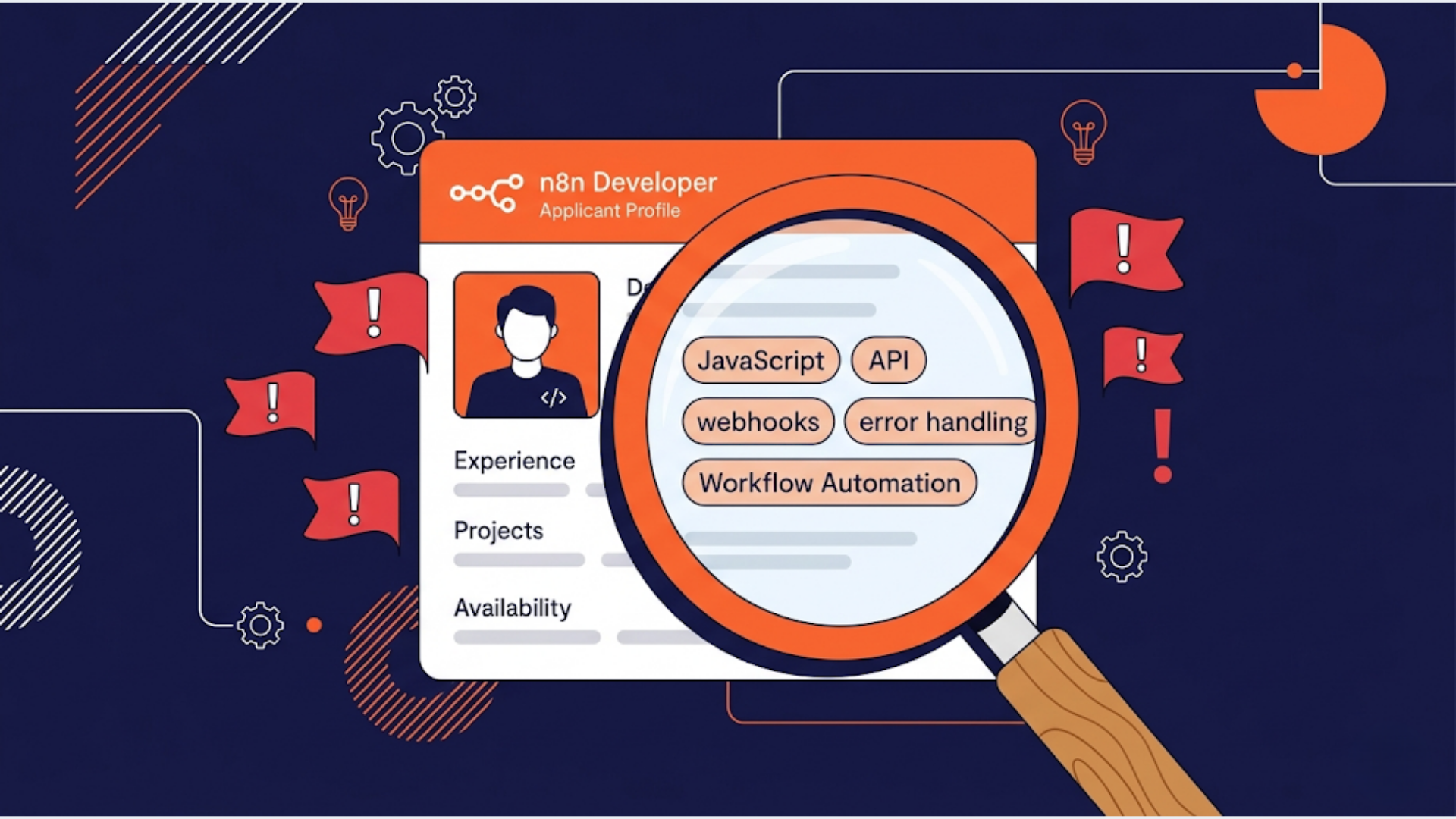
Hire n8n Developer: Rates, Skills, and Red Flags to Watch
Hiring an n8n developer costs $25-50/hr for junior freelancers, $50-100/hr for experienced specialists, and $100-150/hr through agencies. The bigger cost isn’t the hourly rate. It’s hiring the wrong person and paying twice to fix what they built.
I’ve hired, managed, and replaced n8n developers across dozens of client projects. The gap between a developer who “knows n8n” and one who builds production-grade automation is enormous. It shows up three months later when workflows start failing silently and nobody can figure out why.
Here’s how to hire right the first time.
What to Expect Rate-Wise
Rates depend on geography, experience, and engagement type. Here’s what the market looks like in 2026.
| Experience Level | Hourly Rate | Typical Project Cost | Best For |
|---|---|---|---|
| Junior (0-1 yr) | $25-40/hr | $500-2,000 | Simple integrations, form-to-CRM, notifications |
| Mid-Level (1-3 yr) | $40-75/hr | $2,000-8,000 | Multi-system workflows, error handling, APIs |
| Senior (3+ yr) | $75-100/hr | $5,000-20,000 | Complex architectures, self-hosted, custom nodes |
| Agency | $100-150/hr | $5,000-30,000+ | Enterprise builds, SLAs, ongoing maintenance |
A few nuances the table doesn’t capture.
Project-based pricing is common and usually better for both sides. A developer who quotes $3,500 for a defined scope is betting on their efficiency. If they’re good, they finish fast and earn a higher effective hourly rate. You get a predictable cost.
Retainer arrangements ($500-2,000/month) make sense once you have 10+ active workflows that need monitoring, updates, and optimization. One-off project pricing falls apart when you’re calling the developer back every two weeks for “just a quick fix.”
The market is maturing fast. Two years ago, anyone who’d opened n8n once could charge $50/hr. Now clients are more educated. They ask about error handling, testing, and documentation. The developers who invested in these skills command higher rates. The ones who didn’t are racing to the bottom.
The 8 Skills Every n8n Developer Needs
Not every developer who lists “n8n” on their profile actually knows what they’re doing. Here’s the checklist I use when evaluating candidates.
1. JavaScript/TypeScript fluency. n8n’s Function nodes and custom nodes require real coding ability. If a developer can only use pre-built nodes, they’ll hit a wall the moment your requirements get specific. Ask them to write a Function node during the interview. You’ll know in five minutes.
2. REST API knowledge. Most n8n workflows connect to external services via HTTP Request nodes. The developer needs to understand authentication methods (OAuth2, API keys, bearer tokens), request/response structures, pagination, and rate limiting. This isn’t optional. It’s the foundation.
3. Webhook architecture. Webhooks trigger the majority of real-time n8n workflows. Your developer should understand webhook security (signature verification, IP whitelisting), idempotency, and how to handle webhook failures without losing data. If they can’t explain the difference between a webhook and a polling trigger, keep looking.
4. Error handling and retry logic. This separates amateurs from professionals. Every API call can fail. Every data transformation can receive unexpected input. A skilled developer builds workflows that catch errors, retry intelligently, alert when something needs human attention, and never lose data silently. Ask candidates to describe their error handling approach. If the answer takes less than 30 seconds, it’s not thorough enough.
5. Database query skills. Many workflows read from or write to PostgreSQL, MySQL, or MongoDB. Your developer should write efficient queries, understand transactions, and know how to avoid the classic pitfalls (N+1 queries, missing indexes, unescaped inputs). Even if your current project doesn’t touch a database, the next one will.
6. Credential management. n8n handles API keys, OAuth tokens, and database passwords. A developer who hardcodes credentials into Function nodes is a security risk. They should use n8n’s built-in credential management, understand token refresh flows, and know how to handle credential rotation without workflow downtime.
7. Self-hosting competence. If you run n8n on your own infrastructure (and many businesses do for data sovereignty or cost reasons), the developer should understand Docker, reverse proxies, SSL, database backups, and n8n version upgrades. This isn’t DevOps. It’s baseline competence for anyone building production workflows on self-hosted n8n.
8. Documentation discipline. Every workflow should have a README explaining what it does, why key decisions were made, what the expected inputs and outputs are, and how to troubleshoot common failures. A developer who doesn’t document is a developer who’s creating a dependency on themselves. Sometimes that’s intentional. Usually it’s just lazy.
Where to Find n8n Developers
The talent pool is growing but still concentrated in a few places.
n8n Community Forum. The official community (community.n8n.io) is the best place to find developers who actually use n8n daily. Look at who’s answering complex questions. Those people understand the platform deeply. Post a job in the community and you’ll get responses from practitioners, not generalists who added n8n to their Upwork profile yesterday.
Upwork. Largest pool of n8n freelancers. Filter by “n8n” in their skills, check for completed projects (not just listed skills), and look at client reviews specifically mentioning n8n work. The platform has a lot of noise. Use fixed-price contracts for defined scopes and hourly for ongoing work.
Toptal. Pre-vetted talent, higher rates ($80-150/hr), but you skip the screening process. Worth it if your time is more valuable than the rate premium. Toptal’s n8n talent pool is smaller than Upwork’s but generally more experienced.
LinkedIn. Search for “n8n developer” or “n8n automation specialist.” Many experienced developers don’t use freelancing platforms. They get work through referrals and direct outreach. A LinkedIn message with a clear project scope gets responses. A vague “we need automation help” gets ignored.
Automation agencies. Agencies like triggerAll specialize in workflow automation and maintain teams of n8n developers. Higher cost, but you get project management, quality assurance, documentation, and ongoing support. The agency route makes sense for complex, business-critical automation.
GitHub. Search for n8n-related repositories. Developers who build custom n8n nodes or contribute to the n8n codebase demonstrate deep platform knowledge. Check their code quality, commit history, and whether they document their work.
7 Red Flags When Hiring
I’ve cleaned up enough bad n8n builds to recognize the warning signs early. Watch for these.
1. No error handling in their portfolio. Ask to see a workflow they’ve built. If there are no Error Trigger nodes, no try/catch patterns in Function nodes, and no alerting for failures, this developer builds workflows that work in demos and break in production. Every serious n8n workflow needs error handling. No exceptions.
2. No testing process. Ask how they test workflows before handoff. The right answer involves testing with real data (not just sample payloads), testing edge cases (empty fields, unexpected formats, API timeouts), and testing failure scenarios. “I run it a few times and check the output” is not a testing process.
3. Copy-paste nodes everywhere. Open one of their workflows. If you see the same logic duplicated across multiple nodes instead of using sub-workflows or Function nodes with shared logic, the developer doesn’t understand DRY principles. These workflows become maintenance nightmares. One change needs to be made in twelve places.
4. No version control. Ask how they manage workflow versions. If the answer is “I export the JSON sometimes,” they’re one bad edit away from losing your entire workflow with no way to roll back. Serious developers use Git for workflow JSON files, tag releases, and can revert to any previous version.
5. Can’t explain their own workflows. During the interview, ask them to walk through a workflow they built. If they struggle to explain why they made specific decisions (why this node type, why this error handling approach, why this data transformation), they likely copied the pattern from somewhere without understanding it. Understanding matters when something breaks.
6. No documentation delivered. Look at their past project deliverables. If they hand over workflows without documentation (what the workflow does, how to modify it, what can go wrong, how to monitor it), you’re buying a black box. Three months from now, nobody will remember how it works. Including the developer.
7. Suspiciously low rates. An n8n developer charging $15-20/hr is almost certainly learning on your project. That’s fine for non-critical tasks. It’s a liability for workflows that handle customer data, financial transactions, or business-critical processes. The cost to fix a badly built workflow often exceeds the cost of building it correctly the first time.
India Hiring Landscape
India has one of the fastest-growing n8n developer communities globally. The rates are compelling, but understanding the landscape matters more than chasing the cheapest option.
| Developer Type | Rate (INR) | Rate (USD Equivalent) | Notes |
|---|---|---|---|
| Junior Freelancer | Rs 1,200-2,500/hr | $15-30/hr | Basic integrations, needs supervision |
| Mid-Level Freelancer | Rs 2,500-4,500/hr | $30-55/hr | Can handle multi-system workflows independently |
| Senior Freelancer | Rs 4,500-7,000/hr | $55-85/hr | Architects solutions, mentors junior devs |
| Agency (project) | Rs 40,000-3,00,000 | $500-3,600 | End-to-end delivery with documentation |
| Agency (retainer) | Rs 20,000-80,000/mo | $250-1,000/mo | Ongoing maintenance and optimization |
The talent pool is concentrated in Bangalore, Hyderabad, Pune, and Delhi NCR. Remote work has spread it further, but these cities still produce the most experienced automation developers.
Timezone advantage. Indian developers overlap with European business hours (IST is UTC+5:30) and can cover US East Coast morning hours. For companies in the US or EU, this means your automation issues get addressed while you sleep. That’s not a gimmick. It’s genuinely useful when a workflow breaks at 3 AM your time.
What to watch for. The Indian freelancer market has a wide quality range. Developers with experience in Indian business systems (GST invoicing, UPI integrations, WhatsApp Business API via WATI) deliver faster for India-focused projects. They understand the specific APIs, data formats, and compliance requirements.
Hiring a local automation specialist who understands both the technical and business context of Indian operations saves weeks of context-building compared to hiring globally and explaining Indian business workflows from scratch.
Freelancer vs Agency: Decision Framework
This decision isn’t about budget. It’s about risk tolerance and project scope.
| Factor | Freelancer | Agency |
|---|---|---|
| Best for | Defined, isolated projects | Complex, multi-system builds |
| Cost | Lower hourly, but watch scope creep | Higher total, but predictable |
| Availability risk | Single point of failure | Team coverage |
| Documentation | Often skipped unless required | Usually standard |
| Maintenance | Separate negotiation | Often bundled |
| Quality assurance | Self-reviewed | Peer-reviewed |
| Accountability | Personal reputation | Business reputation + SLAs |
Choose a freelancer when: You have a clearly defined project with a fixed scope, the workflow isn’t business-critical, you can evaluate their work yourself, and you don’t need ongoing maintenance.
Choose an agency when: The project involves multiple systems, requires high reliability, you can’t evaluate n8n work quality yourself, or you need ongoing support with SLAs. The premium is insurance against the workflow breaking when nobody knows how to fix it.
The hybrid approach works too. Use a freelancer for the initial build and an agency retainer for ongoing maintenance and monitoring. Many businesses start exactly this way. They hired a freelancer, the workflow broke, they called us to fix and maintain it.
FAQ
How long does it take to hire an n8n developer? Expect 1-2 weeks for a freelancer (posting, screening, test project) and 2-4 weeks through an agency (scoping, proposal, contract). Rushing the hiring process is how you end up with the red flags listed above. A small paid test project ($200-500) before committing to a larger engagement saves significant pain.
Do I need a full-time n8n developer? Only if you have 15+ active workflows that change frequently or you’re building automation as a core product. Most businesses need 10-40 hours of n8n work per month, which is better handled by a freelancer or agency retainer than a full-time hire sitting idle between projects.
What’s the difference between an n8n developer and a general automation developer? An n8n developer specializes in the n8n platform specifically. A general automation developer might work across n8n, Zapier, Make, and custom code. Specialists build faster and handle edge cases better on their platform. Generalists are better when you’re still deciding which platform to use.
Should I hire someone who also knows Zapier or Make? It’s a bonus, not a requirement. Cross-platform knowledge helps during the architecture phase (choosing the right tool for the job) but doesn’t improve the actual n8n build quality. Don’t pay a premium for Zapier knowledge if you’re committed to n8n.
Can I hire an n8n developer to fix a workflow someone else built? Yes, and it’s common. Budget 2-4 hours just for the developer to understand the existing workflow before any fixes begin. If there’s no documentation (and there usually isn’t), expect the discovery phase to take longer. Poorly built workflows sometimes cost more to fix than to rebuild.
What should I include in an n8n developer job posting? Be specific. List the systems involved (CRM, payment gateway, email platform), the data volume, whether it’s self-hosted or cloud, and your reliability requirements. Mention error handling and documentation expectations upfront. Vague postings attract vague developers.
Need help implementing this?
Book a free 30-minute discovery call. We'll map your current setup, identify quick wins, and outline what automation can do for your business.
Book a Free Discovery Call