Fractional Automation Engineer: Rates and When to Hire One
Fractional automation engineers charge $2,000-8,000/month for 10-20 hours/week. Learn when this model beats full-time hires or project-based agencies.
Fractional Automation Engineer: Rates and When to Hire One
A fractional automation engineer costs $2,000 to $4,000 per month for 10 hours/week, $4,000 to $8,000 per month for 20 hours/week, and $8,000 to $15,000 per month for enterprise-level engagements with dedicated availability.
Those are US market rates. India-based fractional engineers run 50 to 65% less. More on that below.
The fractional model exists because most businesses need automation expertise constantly, but not full-time. You have 15 workflows to build, then 30 more pop up, then everything needs maintenance, then the team wants something new. It never stops. But it’s also never 40 hours a week of work.
The fractional model works because both sides benefit. It’s the most efficient model for everyone involved.
What a Fractional Automation Engineer Actually Does
This isn’t a freelancer who builds one thing and disappears. A fractional engineer embeds in your operations. Week to week, the work shifts across five areas:
Audit and Discovery
Map your current processes. Identify manual bottlenecks. Score each by time wasted, error frequency, and automation feasibility. Produce a ranked backlog of automation opportunities.
This usually takes the first 2 to 3 weeks of an engagement. Most businesses have 20 to 40 automatable processes they haven’t even identified yet.
Build
Design and implement automation workflows. Connect tools, build logic, handle edge cases, test under load. This is the core work and typically consumes 50 to 60% of hours.
A good fractional engineer doesn’t just build. They build with documentation, monitoring, and handoff in mind. Every workflow should survive if the engagement ends tomorrow.
Maintain
Fix broken workflows. Update integrations when APIs change. Adjust logic when business processes evolve. This is the work that project-based agencies don’t cover, and it’s the reason most automations degrade within 6 months.
Plan for 15 to 25% of monthly hours going to maintenance. More in the first few months as new automations stabilize.
Optimize
Review workflow performance. Reduce execution times. Cut unnecessary API calls. Consolidate redundant automations. Replace expensive tool subscriptions with cheaper alternatives.
Most clients save 20 to 40% on tool costs within the first quarter just from an experienced engineer reviewing what’s running.
Train
Teach your team to manage simple automations. Build internal documentation. Create runbooks for common issues. The goal: your team handles day-to-day operations, the fractional engineer handles complex builds and architecture decisions.
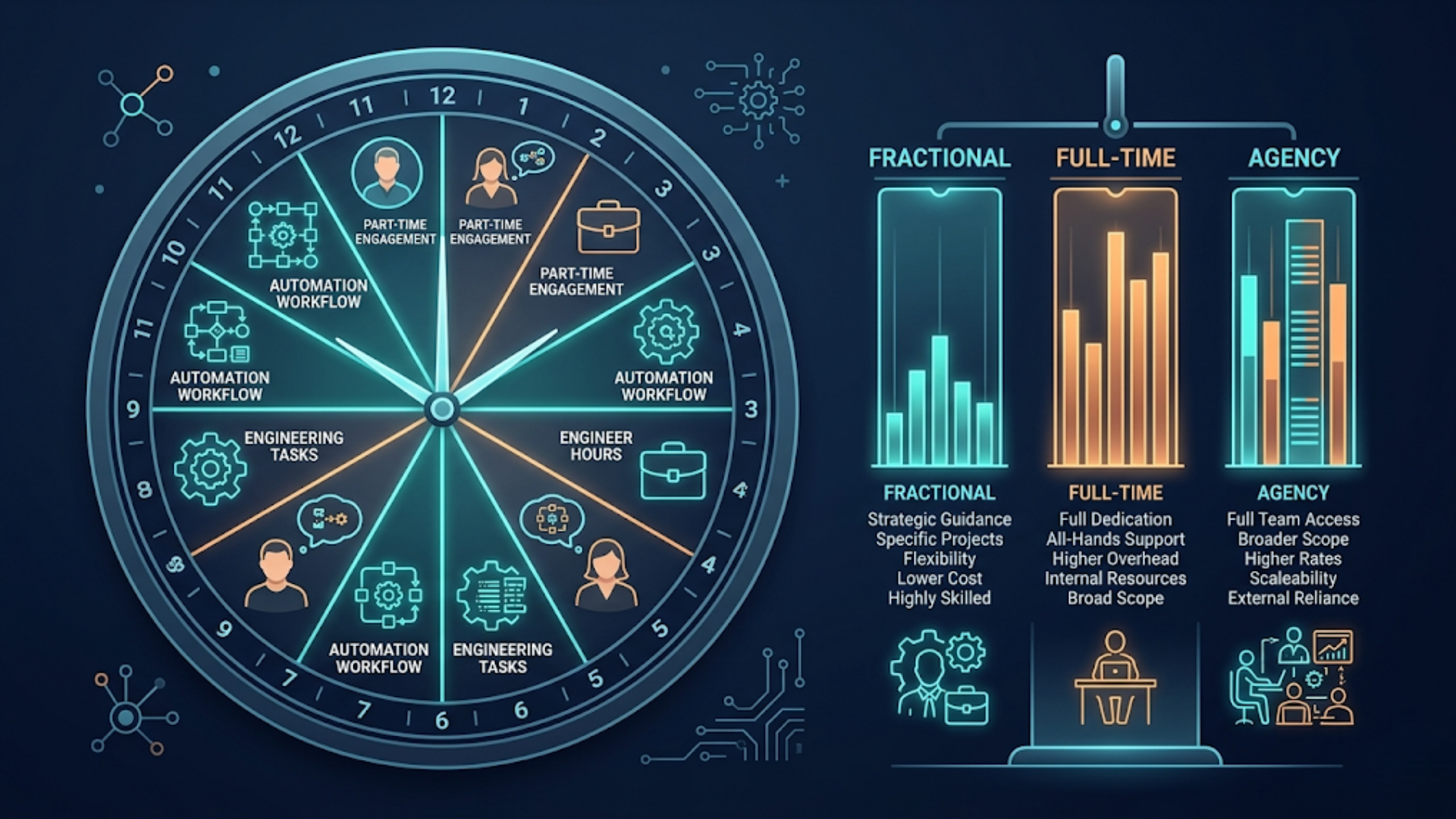
Fractional vs Full-Time vs Agency
| Factor | Fractional Engineer | Full-Time Hire | Project-Based Agency |
|---|---|---|---|
| Monthly Cost | $2,000 - $8,000 | $8,000 - $15,000+ (salary + benefits) | $2,000 - $10,000 per project |
| Commitment | Month-to-month (typically 3-month minimum) | Full employment relationship | Per project, no ongoing |
| Hours/Week | 10 - 20 | 40 | Varies by project |
| Expertise Breadth | High (works across many clients/industries) | Narrow (learns one company deeply) | Medium (agency specialists) |
| Speed to Start | 1 - 2 weeks | 4 - 12 weeks (hiring process) | 2 - 4 weeks (scoping + SOW) |
| Maintenance | Included | Included | Not included (separate retainer) |
| Scalability | Scale hours up/down monthly | Fixed cost regardless of workload | New SOW per project |
| Institutional Knowledge | Builds over time | Deep | Minimal |
| Risk | Low (easy to end) | High (employment obligations) | Medium (scope lock-in) |
The full-time hire trap: I’ve watched companies hire a full-time automation engineer at $120,000/year who’s legitimately busy for the first 4 months, then spends 50% of their time on light maintenance and waiting for new projects. That’s $60,000/year in underutilization. A fractional engagement at $5,000/month ($60,000/year) would have covered the same output.
The agency trap: Agencies deliver the project and leave. Three months later, a workflow breaks and nobody knows how it was built. The agency charges $150/hour for support. You’re now paying more for maintenance than the original build cost.
When Fractional Makes Sense
The fractional model is right for you if:
-
You have 5 to 15 automations to build and the list keeps growing. One-off projects don’t justify a retainer. An endless backlog does.
-
Your automations need ongoing maintenance. If you run 10+ workflows in production, something breaks every week. An API updates, a field name changes, a business rule shifts. Without dedicated maintenance, your automations rot.
-
You don’t need 40 hours/week of automation work. If you do, hire full-time. But most businesses in the 10 to 50 employee range need 10 to 20 hours/week of automation support, not 40.
-
You want to move fast. Hiring full-time takes 2 to 3 months. A fractional engineer starts in 1 to 2 weeks and brings cross-industry experience from day one.
-
Your budget is $2,000 to $8,000/month for automation. Below $2,000, project-based freelancing makes more sense. Above $8,000, consider a full-time hire or a senior fractional with part-time junior support.
The model doesn’t work if you need someone in the office daily, if your automation needs are truly 40 hours/week, or if you have strict compliance requirements that demand a full-time employee with background checks and clearances.
India-Specific Rates
Indian fractional automation engineers are increasingly in demand globally, not just for Indian companies.
India Market Rates (INR)
| Hours/Week | Monthly Rate (INR) | Equivalent USD |
|---|---|---|
| 10 hrs/week | ₹80,000 - ₹1,50,000 | $950 - $1,800 |
| 20 hrs/week | ₹1,50,000 - ₹3,00,000 | $1,800 - $3,600 |
| 30 hrs/week | ₹2,50,000 - ₹5,00,000 | $3,000 - $6,000 |
Why Indian fractional engineers are in high demand globally:
The tools are the same everywhere. n8n, Zapier, Make, HubSpot, Salesforce. A fractional engineer in Bangalore uses the exact same tech stack as one in San Francisco. The time zone overlap with European businesses (3.5 to 5.5 hours) makes IST a natural fit for EU clients. US clients get async coverage with morning handoffs.
Indian automation talent has a depth advantage in certain ecosystems. Zoho (Indian company), Razorpay, WhatsApp Business API, and the broader Indian SaaS stack are second nature to Indian engineers. For any business operating in or selling to India, an India-based fractional engineer understands the local tool landscape inherently.
For Indian businesses hiring fractional automation engineers: Budget ₹1,00,000 to ₹2,00,000/month for 10 to 15 hours/week from a mid-level engineer with 3 to 5 years of automation experience. Senior engineers with 7+ years and architecture capability charge ₹2,00,000 to ₹3,50,000/month for the same hours.
How to Structure the Engagement
A fractional engagement that works follows a clear structure. I’ve done this enough times to know what falls apart and why.
Scope
Define it in writing before the first invoice. Not “help us automate stuff.” Instead: “Build and maintain order processing automation (Shopify to CRM to fulfillment), support up to 3 new automation requests per month, maintain existing 12 workflows.”
Scope creep is the number one killer of fractional engagements. Both sides end up frustrated. The engineer feels overworked. The client feels underserved. Clear scope prevents both.
Communication
Weekly async update (15 minutes to write, covers what was done, what’s next, any blockers). One live call per week or every two weeks (30 minutes). Slack or Teams channel for urgent issues.
Don’t over-meet. The value of a fractional engineer drops if 25% of their hours go to status meetings.
Deliverables
Every workflow delivered must include: the automation itself, a one-page runbook (what it does, what to check if it breaks), and monitoring/alerting setup. No undocumented workflows. Period.
Monthly deliverables report: workflows built, workflows maintained, hours logged, recommendations for next month.
Exit Clauses
30-day notice for either side. All workflows documented and transferable. Source access (n8n exports, Zapier transfers) included. No vendor lock-in to the engineer.
If your fractional engineer builds workflows that only they can manage, they’re building job security, not business value. Everything should be transferable from day one.
Typical Engagement Timeline
Month 1: Audit, quick wins (2 to 3 high-impact automations), monitoring setup. Month 2 to 3: Build phase. 5 to 8 workflows delivered. Team training begins. Month 4+: Shift to 60% build, 25% maintenance, 15% optimization. Steady state.
Most engagements stabilize at month 4. If you’re still in pure build mode after 6 months, either the scope was underestimated or the backlog is genuinely large (both happen).
FAQ
Q1: What’s the difference between a fractional automation engineer and a freelance Zapier expert? A: A Zapier expert builds workflows on one platform. A fractional automation engineer designs automation architecture across your entire tool stack, chooses the right platform for each workflow, handles complex integrations, builds monitoring, and maintains everything long-term. The scope and depth are fundamentally different. Freelancers are great for single workflows. Fractional engineers manage your automation program.
Q2: How many hours per week should I start with? A: Start with 10 hours/week for the first month. This covers the audit, quick wins, and establishes working rhythm. Scale to 15 to 20 hours/week during the build phase (months 2 to 4). Then evaluate whether to scale back to 10 hours/week for ongoing maintenance and incremental builds. Most businesses in the 10 to 50 employee range settle at 10 to 15 hours/week long-term.
Q3: Can a fractional automation engineer work with my existing IT team? A: Yes, and they should. The best fractional engagements have the engineer working alongside your IT or ops team, not in isolation. They handle the automation-specific work (workflow design, API integrations, prompt engineering) while your team handles infrastructure, security, and day-to-day tool management. Clear role boundaries prevent overlap.
Q4: What tools should a fractional automation engineer know? A: At minimum: one enterprise automation platform (n8n, Make, or Zapier), one CRM (HubSpot, Salesforce, or Zoho), API integration patterns, basic scripting (Python or JavaScript), and LLM prompt engineering. Nice to have: database knowledge (SQL), cloud infrastructure basics (AWS/GCP), and industry-specific tools relevant to your business.
Q5: How do I evaluate if the fractional model is working? A: Track three metrics: automation hours saved per month (should exceed the engineer’s cost within 3 months), workflow uptime (target 99%+), and backlog velocity (are you building faster than new requests come in?). If your automation backlog is growing despite the engagement, you need more hours or a different engineer.
triggerAll offers fractional automation engineering for growing businesses. Month-to-month, fully documented, always transferable.
Need help implementing this?
Book a free 30-minute discovery call. We'll map your current setup, identify quick wins, and outline what automation can do for your business.
Book a Free Discovery Call