How Much to Automate Your E-commerce Order Flow?
E-commerce order automation costs $500-8,000 to set up. Full pricing for Shopify + Razorpay + WhatsApp + CRM flows with real implementation benchmarks.
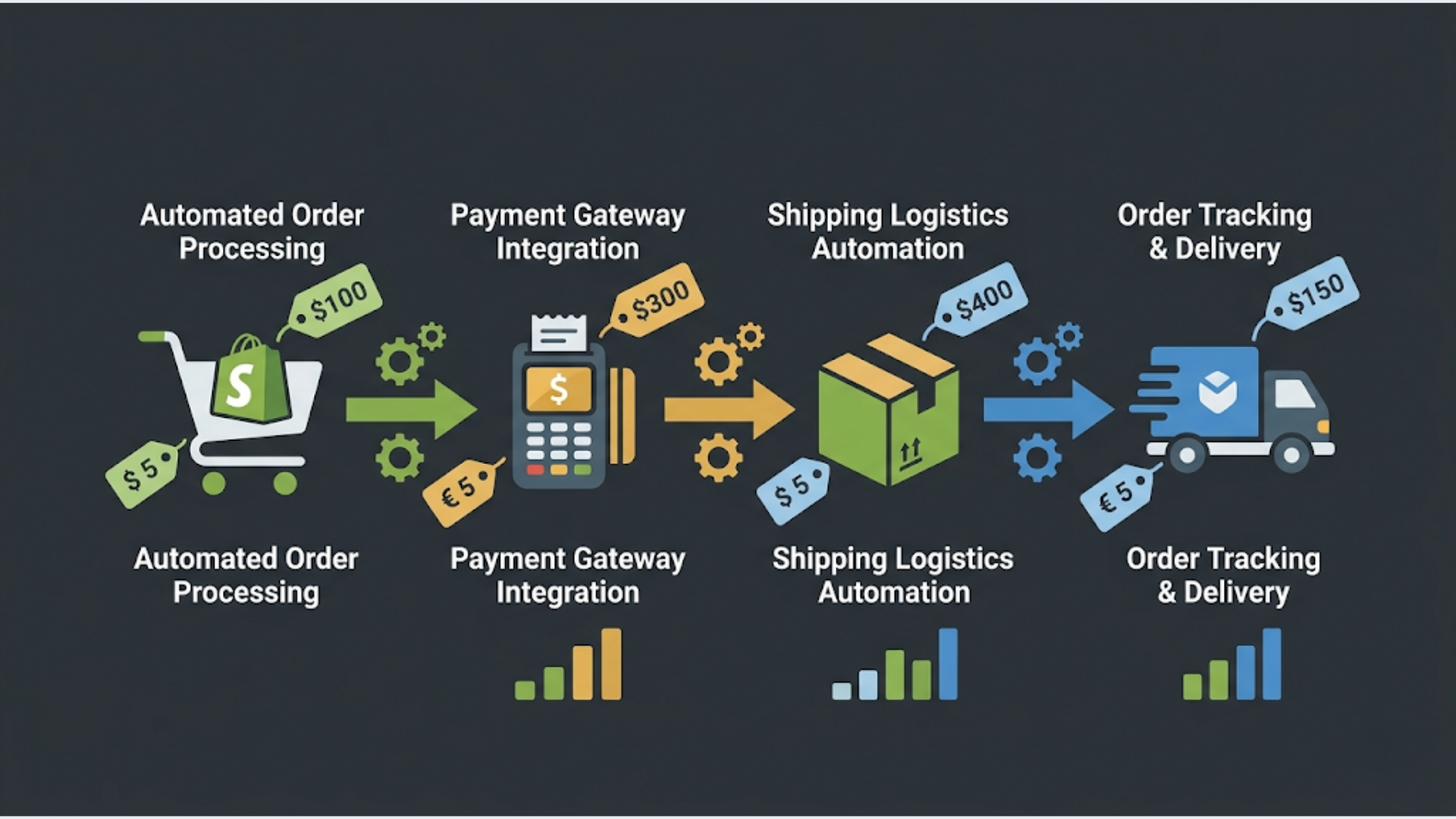
How Much to Automate Your E-commerce Order Flow?
Basic order notification automation runs $500 to $1,500. Mid-complexity flows (payment + shipping + CRM) cost $1,500 to $4,000. A full stack with inventory sync, returns, and review automation sits at $4,000 to $8,000+.
Those are setup costs. Monthly tool subscriptions add $50 to $500 depending on volume and stack complexity.
Whether a store processes 100 orders a month or 4,000, the automation architecture is surprisingly similar. The cost difference isn’t linear. A store processing 200 orders/month and a store processing 2,000 orders/month often need the same automation. The workflows are identical. Volume just changes which pricing tier you land on for tools.
Cost by Scope: Three Tiers of Order Automation
Tier 1: Basic Order Notifications ($500 to $1,500 setup)
This is where most stores should start.
You get: order confirmation emails, shipping notification triggers, and basic customer communication. The automation connects your store platform to your email/SMS tool and fires messages at each order status change.
Setup takes 1 to 2 weeks. Most of the work is mapping your order statuses to the right message templates.
Tier 2: Mid-Complexity Flows ($1,500 to $4,000 setup)
This is the sweet spot for stores doing 200+ orders per month.
You get everything in Tier 1 plus: payment reconciliation with your gateway, CRM contact creation, abandoned cart recovery sequences, and basic inventory alerts. The automation now talks to 4 to 6 tools instead of 2.
Setup takes 2 to 4 weeks. The complexity jump comes from error handling. What happens when a payment fails but the order was created? What happens when inventory hits zero mid-checkout? These edge cases are where the real work lives.
Tier 3: Full Stack ($4,000 to $8,000+ setup)
For stores where order processing is the business bottleneck.
You get everything in Tier 2 plus: real-time inventory sync across channels, automated return/refund processing, review request sequences, loyalty point calculations, and warehouse/fulfillment integration. We’re talking 8 to 12 connected tools.
Setup takes 4 to 8 weeks. At this level, you’re essentially building a custom operations layer on top of your store.
The Complete Order Automation Stack
Every e-commerce automation I build connects some combination of these tools:
Store Platform: Shopify, WooCommerce, or BigCommerce. This is your source of truth for orders.
Payment Gateway: Stripe, Razorpay, PayPal. Needs webhook integration for real-time payment status updates.
Communication: WhatsApp Business API (via WATI or Interakt), email (SendGrid, Mailchimp), SMS (Twilio, MSG91). Most stores need at least two channels.
CRM: HubSpot, Zoho, or a spreadsheet for smaller stores. Every customer who orders should land in your CRM with purchase history attached.
Inventory: The store platform handles basic inventory. For multi-channel, you need something like Zoho Inventory, TradeGecko, or a custom sheet sync.
Fulfillment: Shiprocket, Delhivery, or ShipStation depending on geography. API integration for automatic label generation and tracking updates.
Automation Engine: n8n (self-hosted, cheapest at scale), Zapier (easiest to start), or Make (middle ground). This is the glue connecting everything.
Cost Breakdown Table
| Component | Tier 1 (Basic) | Tier 2 (Mid) | Tier 3 (Full) |
|---|---|---|---|
| Setup/Implementation | $500 - $1,500 | $1,500 - $4,000 | $4,000 - $8,000+ |
| Automation Platform | $0 - $30/mo | $30 - $100/mo | $100 - $300/mo |
| Communication Tools | $0 - $50/mo | $50 - $150/mo | $100 - $300/mo |
| CRM | $0 (free tier) | $0 - $50/mo | $50 - $150/mo |
| Fulfillment Integration | N/A | $0 - $30/mo | $30 - $100/mo |
| Total Monthly (tools) | $0 - $80/mo | $80 - $330/mo | $280 - $850/mo |
| Maintenance | $0 - $100/mo | $100 - $300/mo | $200 - $500/mo |
| Connected Tools | 2 - 3 | 4 - 6 | 8 - 12 |
| Setup Time | 1 - 2 weeks | 2 - 4 weeks | 4 - 8 weeks |
Maintenance covers broken workflows, API changes, and optimization. Budget for it. Stores that skip maintenance had at least one critical workflow break within 6 months.
5 Order Workflows That Save the Most Time
1. Order Confirmation + Payment Receipt (saves 2-5 hrs/week)
Trigger: new order created. Action: send branded confirmation via email AND WhatsApp with order details, expected delivery date, and tracking info when available.
Most stores do this manually or with basic Shopify email. A proper automation personalizes by product category, includes upsell recommendations, and handles failed payment retries.
2. Shipping Updates (saves 3-8 hrs/week)
Trigger: fulfillment status change. Action: send real-time updates at each milestone (packed, shipped, out for delivery, delivered).
The key insight: customers who get proactive shipping updates file 60% fewer “where’s my order” support tickets. That’s the real ROI.
3. Abandoned Cart Recovery (recovers 5-15% of abandoned carts)
Trigger: cart created, no order within 1 hour. Action: 3-message sequence across email and WhatsApp over 72 hours.
The math is simple. If you have 500 abandoned carts/month with a $50 average cart value, recovering even 8% means $2,000/month in recovered revenue. The automation pays for itself in week one.
4. Return/Refund Processing (saves 5-10 hrs/week)
Trigger: return request submitted. Action: auto-approve if within policy, generate return label, send instructions, track return shipment, process refund when received.
Manual return processing is where most stores hemorrhage support hours. Automating the happy path (item within return window, standard reason) handles 70% of cases without human touch.
5. Review Request Sequences (increases review rate 3-5x)
Trigger: order delivered + 3 day delay. Action: send review request with direct link to product page. Follow up once if no response.
Timing matters more than message. Three days post-delivery is the sweet spot. Too early and they haven’t used it. Too late and the excitement is gone.
India-Specific: Razorpay + WhatsApp + Shiprocket Stack
For Indian e-commerce stores, the automation stack looks different. And costs significantly less.
Razorpay replaces Stripe. Webhook integration works the same way, but you get UPI, netbanking, and wallet support built in. Razorpay charges 2% per transaction (no monthly fee for standard). Their API is clean and well-documented.
WhatsApp via WATI or Interakt is non-negotiable for Indian e-commerce. Open rates on WhatsApp are 85-95% compared to 15-25% for email. WATI starts at ₹2,499/month. Interakt starts at ₹999/month for basic.
Shiprocket handles fulfillment for most Indian D2C brands. Starts at ₹20/order for their basic plan. API integration for automated order creation and tracking updates.
India Cost Breakdown (INR)
| Component | Basic | Mid | Full |
|---|---|---|---|
| Setup | ₹40,000 - ₹1,20,000 | ₹1,20,000 - ₹3,20,000 | ₹3,20,000 - ₹6,50,000 |
| WATI/Interakt | ₹999 - ₹2,499/mo | ₹2,499 - ₹5,999/mo | ₹5,999 - ₹14,999/mo |
| Shiprocket | ₹20/order | ₹20/order | ₹15-18/order (volume) |
| n8n (self-hosted) | Free | Free | Free |
| Zoho CRM | Free (3 users) | ₹800/user/mo | ₹1,400/user/mo |
The biggest cost advantage for Indian stores: self-hosted n8n eliminates the automation platform fee entirely. A ₹500/month VPS handles thousands of workflow executions. Compare that to Zapier at $50+/month for the same volume.
Indian D2C brands processing 500+ orders/month should budget ₹1,50,000 to ₹3,00,000 for a proper mid-tier automation setup. Monthly running costs land between ₹5,000 and ₹15,000 depending on WhatsApp message volume.
DIY vs Agency: Honest Tradeoffs
DIY (Zapier/Make, no-code)
Cost: $0 to $500 (just tool subscriptions) Time: 20 to 60 hours of your time Best for: Stores with a technical founder and fewer than 5 workflows Reality check: Most DIY automations break within 3 months because edge cases weren’t handled. You’ll spend more time debugging than you saved. DIY automations tend to break within 3 months because edge cases weren’t handled.
Freelancer
Cost: $500 to $3,000 Time: 1 to 4 weeks Best for: Specific workflows (abandoned cart, shipping notifications) where scope is clear Reality check: Quality varies wildly. Ask for references from other e-commerce stores. A Zapier expert is not an automation engineer. The difference shows up in error handling and monitoring.
Agency/Specialist
Cost: $2,000 to $8,000+ Time: 2 to 8 weeks Best for: Full stack automation, multi-channel stores, or stores where downtime costs real money Reality check: More expensive upfront, but a good agency builds monitoring, alerting, and documentation into the delivery. Your automations should survive without the agency. If they can’t hand over cleanly, that’s a red flag.
The honest answer: start with 1 to 2 high-impact workflows (abandoned cart + shipping updates), measure the ROI, then expand. Trying to automate everything at once is how $8,000 projects become $15,000 projects.
FAQ
Q1: How long does e-commerce order automation take to set up? A: Basic notification workflows take 1 to 2 weeks. Mid-complexity setups (payment + CRM + communication) take 2 to 4 weeks. Full stack automation with inventory sync and returns takes 4 to 8 weeks. The timeline depends more on how many tools need connecting than on order volume.
Q2: Can I automate Shopify orders with Zapier for free? A: Zapier’s free plan gives you 100 tasks/month with single-step workflows. That’s enough to test one automation with very low order volume. For anything production-ready, expect to pay $20 to $50/month on Zapier. Self-hosted n8n is free if you have a server, which is why most stores at scale migrate off Zapier.
Q3: What’s the ROI of abandoned cart automation? A: Average abandoned cart recovery rate with a good 3-message sequence is 5 to 15%. If your store has 500 abandoned carts/month with a $50 average value, recovering 10% means $2,500/month. Setup cost of $500 to $1,500 pays for itself in the first month.
Q4: Do I need a developer to set up order automation? A: Not for basic workflows. Shopify Flow (free on Shopify plans) handles simple triggers. Zapier and Make are no-code. But once you need custom logic, error handling, or more than 5 connected tools, a developer or automation specialist saves time and prevents fragile workflows.
Q5: How much does WhatsApp order notification automation cost? A: WhatsApp Business API access costs $0 (through a BSP like WATI or Interakt). WATI starts at ₹2,499/month or $30/month. Per-conversation charges from Meta run $0.005 to $0.08 depending on message category and country. For 500 orders/month, expect $50 to $100/month total for WhatsApp automation.
Q6: Should I use Shopify Flow or an external automation tool? A: Shopify Flow is free and handles basic triggers within the Shopify ecosystem. Use it for simple order tagging, internal notifications, and inventory alerts. Switch to an external tool (n8n, Zapier, Make) when you need to connect non-Shopify tools like a CRM, WhatsApp API, or custom fulfillment service. Most stores end up using both.
Need help automating your e-commerce order flow? triggerAll builds custom automation systems for stores doing 50 to 5,000+ orders per month.
Need help implementing this?
Book a free 30-minute discovery call. We'll map your current setup, identify quick wins, and outline what automation can do for your business.
Book a Free Discovery Call