Custom AI Chatbot Development Cost: Complete 2026 Guide
Custom AI chatbot development costs $1,000-25,000+ depending on features. Detailed pricing for rule-based, NLP, and LLM-powered chatbots with real examples.
Custom AI Chatbot Development Cost: Complete 2026 Guide
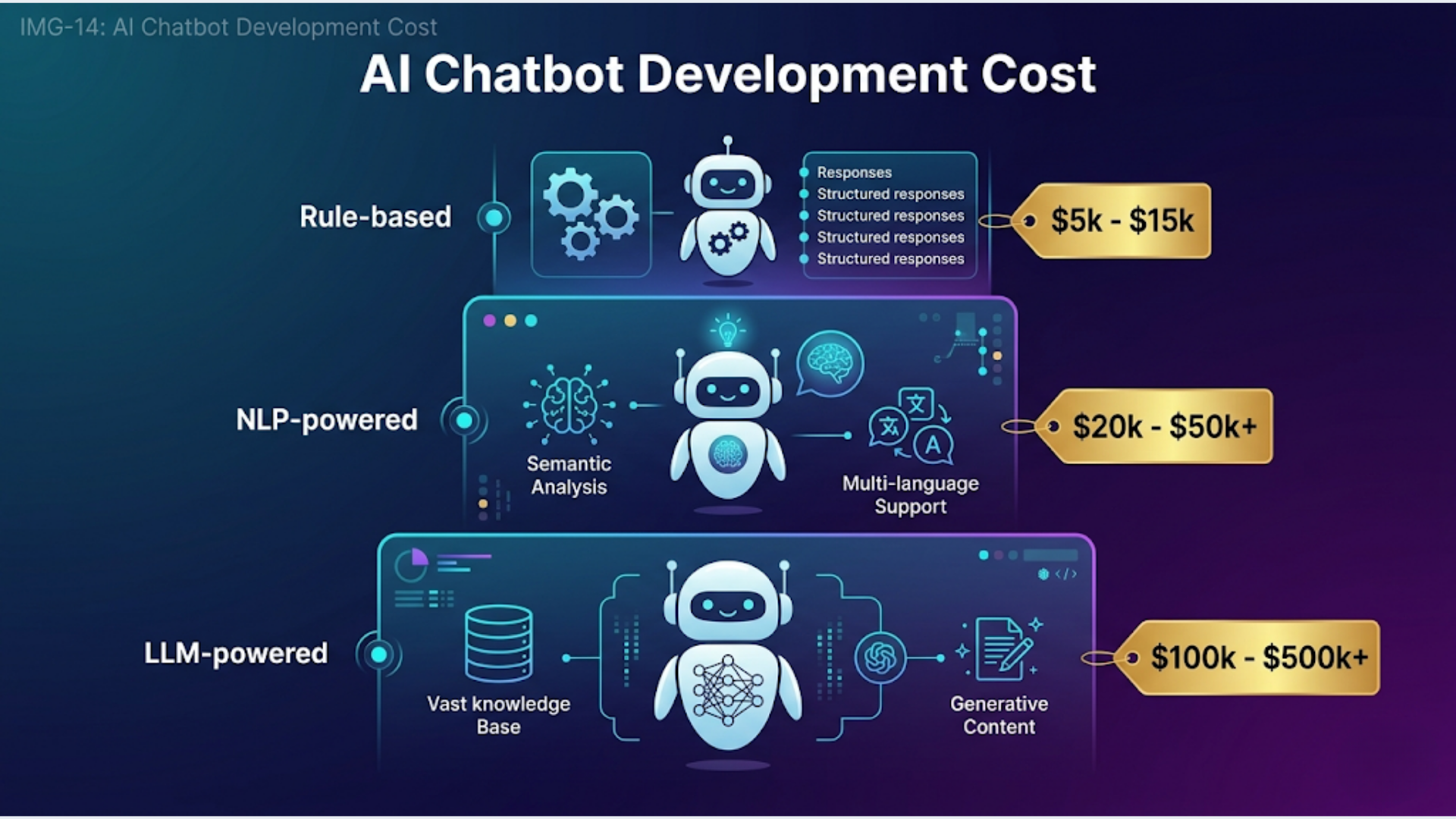
Custom AI chatbot development costs $1,000-3,000 for rule-based bots, $3,000-10,000 for NLP-powered bots, and $5,000-25,000+ for LLM-powered conversational agents. The price depends on what the chatbot actually does. A FAQ bot that matches keywords to canned responses is a different project than an AI agent that reads your knowledge base, handles nuanced customer questions, and books meetings.
I build AI chatbots and automation agents for clients. The pricing conversations have shifted dramatically in the last 18 months. LLMs (GPT-4, Claude, Gemini) made sophisticated conversational AI accessible to businesses that would’ve paid $100,000+ for the same capability three years ago. But “accessible” doesn’t mean “cheap” or “easy.” The models are commoditized. The hard part is everything around them.
Here’s what it actually costs.
Cost by Chatbot Type
Three distinct tiers exist, and they serve different needs.
Rule-Based Chatbots ($1,000-3,000)
These follow predefined decision trees. User says X, bot responds with Y. No understanding of intent, no flexibility, no learning.
| Component | Cost Range | Notes |
|---|---|---|
| Design and flow mapping | $300-800 | Mapping all conversation paths |
| Development | $500-1,500 | Building the decision tree logic |
| Integration | $200-700 | Connecting to website, WhatsApp, or Messenger |
| Testing | $100-300 | Path validation, edge cases |
| Total | $1,000-3,000 | Timeline: 1-2 weeks |
Rule-based bots work for narrow, predictable use cases. Restaurant menus. Appointment booking with fixed time slots. Order tracking with predefined status messages. They break the moment a customer asks something outside the scripted paths.
They’re cheap to build and cheap to maintain. No API costs, no model fees, no prompt engineering. If your use case fits neatly into a decision tree, this is the right choice. Most businesses think they need AI when they actually need a well-designed decision tree.
NLP-Powered Chatbots ($3,000-10,000)
These understand natural language intent. The user can phrase the same question ten different ways and the bot recognizes they’re asking the same thing. Built on platforms like Dialogflow, Rasa, or Amazon Lex.
| Component | Cost Range | Notes |
|---|---|---|
| Intent design and training | $1,000-3,000 | Defining intents, entities, training phrases |
| Development | $1,500-4,000 | Backend logic, fulfillment, context management |
| Integration | $500-1,500 | Multi-channel deployment, CRM connection |
| Training data | $300-1,000 | Curating and labeling conversation samples |
| Testing and tuning | $500-1,500 | Accuracy testing, intent confusion resolution |
| Total | $3,000-10,000 | Timeline: 3-6 weeks |
NLP bots handle variability better than rule-based. But they require training data. Lots of it. The accuracy depends directly on the quality and quantity of example phrases you feed the model during setup. A bot trained on 50 phrases per intent performs noticeably worse than one trained on 200+.
The ongoing cost includes retraining as new question patterns emerge. Budget $500-1,500/quarter for model tuning and new intent creation. The bot doesn’t learn on its own. Someone needs to review failed conversations, identify new patterns, and retrain.
LLM-Powered Chatbots ($5,000-25,000+)
This is where 2026 pricing gets interesting. LLM-powered chatbots use models like GPT-4, Claude, or Gemini to understand and respond to customer queries using your business knowledge. They don’t follow scripts. They reason.
| Component | Cost Range | Notes |
|---|---|---|
| Knowledge base preparation | $1,000-4,000 | Structuring docs, FAQs, product info for retrieval |
| RAG pipeline development | $2,000-8,000 | Vector database, embedding, retrieval logic |
| Prompt engineering | $1,000-3,000 | System prompts, guardrails, tone calibration |
| Integration | $1,000-4,000 | Channels, CRM, ticketing system, handoff logic |
| Testing and guardrails | $1,000-3,000 | Hallucination testing, safety filters, edge cases |
| Deployment and monitoring | $500-2,000 | Infrastructure, logging, analytics |
| Total | $5,000-25,000+ | Timeline: 4-10 weeks |
The $25,000+ range is for chatbots that do more than answer questions. They take actions. Booking appointments, updating CRM records, processing returns, escalating to human agents with full context. Every action the bot can take adds integration complexity and testing surface area.
LLM chatbots range from $7,000 (focused FAQ bot with RAG on a single knowledge base) to $22,000+ (multi-language customer service agent integrated with Shopify, Zendesk, and a custom order management system). The feature list determines the price.
What Drives the Cost
Six factors account for 90% of the cost variation.
Number of channels. A chatbot deployed on your website only is straightforward. Add WhatsApp, Facebook Messenger, Instagram DM, SMS, and a mobile app, and each channel has its own API, message format, and limitations. WhatsApp Business API alone adds $1,000-3,000 in integration work plus ongoing WATI or Twilio costs.
Number of languages. Each language requires separate testing, prompt engineering (for LLM bots), or intent training (for NLP bots). Two languages roughly doubles the testing effort. Supporting Hindi, English, and regional languages for Indian customers adds $2,000-5,000 to development and ongoing quality assurance.
Integration depth. A chatbot that only answers questions is simple. A chatbot that checks order status, updates addresses, initiates returns, and escalates to human agents needs API connections to your order system, CRM, helpdesk, and human handoff routing. Each integration is $500-2,000 in development and testing.
Conversation complexity. Multi-turn conversations (where context from three messages ago matters) are harder than single-turn Q&A. A bot that remembers the customer mentioned their order number in message 1 and uses it in message 5 requires session management and context windowing. This is where LLM bots shine and rule-based bots collapse.
Training data quality. For NLP bots, more training data means better accuracy. For LLM bots, cleaner knowledge base documents mean fewer hallucinations. Either way, preparing the data is unglamorous work that directly determines bot quality. Most businesses underinvest here.
Guardrails and compliance. Healthcare, finance, and legal chatbots need strict guardrails. The bot must never give medical advice, make claims about returns it can’t verify, or expose customer PII in logs. Guardrail development (prompt safety, response filtering, compliance testing) can add $2,000-5,000 for regulated industries.
Build vs Buy: Comparison Table
Should you build a custom chatbot or use a platform?
| Factor | Custom Build | Intercom | Drift | Tidio | Botpress |
|---|---|---|---|---|---|
| Setup Cost | $5,000-25,000 | $0 | $0 | $0 | $0 (open-source) |
| Monthly Cost | $50-500 (API + hosting) | $74-480/mo | $2,500+/mo | $29-394/mo | $0-495/mo |
| Customization | Unlimited | Moderate | Moderate | Limited | High |
| AI Quality | Depends on implementation | Good (Fin AI) | Good | Basic | Good |
| Data Ownership | Full | Platform-hosted | Platform-hosted | Platform-hosted | Self-hosted option |
| Integration Depth | Unlimited | Ecosystem-dependent | Ecosystem-dependent | Limited | API-based |
| Time to Deploy | 4-10 weeks | 1-2 weeks | 1-2 weeks | 1 day | 2-4 weeks |
| Best For | Unique requirements, scale | B2B SaaS, support teams | Enterprise sales | Small business, e-commerce | Developers, full control |
The honest take: Most businesses should start with a platform. Intercom’s Fin or Tidio’s AI handles 70-80% of common chatbot use cases at a fraction of the custom build cost. The monthly subscription is cheaper than the custom build’s initial investment for the first 12-18 months.
Build custom when: your use case doesn’t fit a platform, you need deep integration with proprietary systems, data sovereignty matters (healthcare, finance, government), or your conversation volume makes per-message platform pricing prohibitive.
I tell clients this upfront. Sometimes the right answer is a $29/month Tidio subscription, not a $15,000 custom build. When clients outgrow the platform (and some do), that’s when custom development makes sense.
Ongoing Costs
The development cost is one-time. These costs recur monthly.
| Cost Category | Rule-Based | NLP | LLM-Powered |
|---|---|---|---|
| LLM API costs | $0 | $0 | $50-500/mo |
| Hosting | $10-50/mo | $20-100/mo | $50-200/mo |
| Monitoring and logging | $0-20/mo | $20-50/mo | $50-150/mo |
| Model retraining/prompt updates | $0 | $500-1,500/quarter | $300-1,000/quarter |
| Conversation review | $0 | $200-500/mo | $200-500/mo |
| Total Monthly | $10-70 | $120-400 | $250-850 |
LLM API costs scale with conversation volume. A chatbot handling 100 conversations/day with GPT-4 costs roughly $150-300/month in API calls. Switch to a smaller model (GPT-4o-mini, Claude Haiku) for simpler queries and reserve the expensive model for complex ones. This routing approach cuts API costs by 50-70%.
Conversation monitoring is non-negotiable for LLM bots. The bot will hallucinate. It will occasionally provide wrong information. Someone needs to review flagged conversations weekly, identify patterns, and update the knowledge base or prompts. Skipping this is how you end up with a chatbot telling customers your return policy is 90 days when it’s 30.
Prompt engineering updates ($300-1,000/quarter) cover seasonal changes, new product launches, policy updates, and addressing new categories of customer questions. Your knowledge base isn’t static. Neither is the prompt that controls how the bot uses it.
India-Specific Pricing
India is one of the most cost-effective markets for chatbot development, with quality that matches international standards at the senior level.
| Chatbot Type | India Cost (INR) | India Cost (USD) | US/EU Cost (USD) |
|---|---|---|---|
| Rule-Based | Rs 50,000-1,50,000 | $600-1,800 | $1,000-3,000 |
| NLP-Powered | Rs 1,50,000-5,00,000 | $1,800-6,000 | $3,000-10,000 |
| LLM-Powered | Rs 3,00,000-15,00,000 | $3,600-18,000 | $5,000-25,000 |
| Enterprise Multi-Channel | Rs 10,00,000-20,00,000+ | $12,000-24,000+ | $25,000-50,000+ |
Indian development costs are 40-60% lower than US equivalents. The gap narrows at the senior end because experienced AI engineers in India command competitive rates, but the overall project cost stays lower due to team rates and lower infrastructure costs.
Why Indian development works especially well for chatbots:
WhatsApp dominance. In India, WhatsApp is the primary customer communication channel. Indian developers build WhatsApp chatbots daily. They understand the WhatsApp Business API’s quirks, WATI’s limitations, message template approval processes, and the specific patterns of how Indian customers interact with bots (Hindi-English code-switching, voice note fallbacks, regional language expectations).
Multilingual capability. India’s linguistic diversity means Indian development teams handle multilingual chatbots as a standard requirement, not an edge case. Building a bot that switches between English, Hindi, Tamil, and Marathi? An Indian team has done it before. A US team is researching how to start.
Cost-effective iteration. Chatbot development is inherently iterative. The first version never handles all edge cases. You need 2-3 rounds of conversation review, retraining, and prompt adjustment. At Indian rates, these iteration cycles cost $500-1,500 each. At US rates, they cost $1,500-4,000. Over three iterations, that difference compounds.
For Indian businesses specifically, a local AI automation partner who builds on Indian communication channels and understands Indian customer behavior delivers faster and cheaper than an international team learning your market from scratch.
The Chatbot That Pays for Itself: ROI Framework
Not every chatbot has clear ROI. Here’s how to calculate it for three common use cases.
Support ticket deflection. If your support team handles 500 tickets/month and a chatbot deflects 40% of them (common for FAQ-heavy industries), that’s 200 tickets/month resolved without human intervention. At a cost of $5-15 per human-handled ticket, you’re saving $1,000-3,000/month. An LLM-powered chatbot at $10,000 development plus $400/month ongoing pays for itself in 4-6 months.
Lead qualification. A chatbot that qualifies website visitors 24/7 captures leads your team misses outside business hours. If the bot qualifies 50 leads/month that would’ve bounced, and your close rate is 10% on a $2,000 average deal value, that’s $10,000/month in pipeline. The chatbot’s cost is noise relative to the revenue impact.
Appointment booking. A chatbot that books appointments directly (dentist, salon, consultant) eliminates phone tag and reduces no-shows by sending reminders. If it books 100 appointments/month that would’ve required a receptionist’s time (15 min each = 25 hours), you’re saving a significant chunk of a full-time salary. The bot costs $3,000-8,000 to build and $100-300/month to run.
The ROI framework is simple: estimate the number of conversations per month, the percentage the bot can handle without human intervention, and the cost per human-handled conversation. If the math shows payback within 6 months, build it. If payback takes 18+ months, start with a cheaper platform solution and upgrade when volume justifies custom.
FAQ
How long does it take to build a custom AI chatbot? Rule-based: 1-2 weeks. NLP-powered: 3-6 weeks. LLM-powered: 4-10 weeks. These timelines include design, development, testing, and deployment. Add 1-2 weeks for knowledge base preparation and 1 week for multi-channel integration. Rushing the timeline almost always results in a bot that handles the happy path and fails on everything else.
Which LLM model should I use for my chatbot? For most business chatbots, GPT-4o-mini or Claude Haiku handles 80% of queries at a fraction of the cost of GPT-4 or Claude Opus. Use a routing layer that sends complex queries to the more expensive model and handles simple ones with the cheaper model. This typically reduces API costs by 60-70% with minimal quality impact.
Can I build an AI chatbot without coding? Yes, using platforms like Botpress, Voiceflow, or Landbot. These drag-and-drop builders handle rule-based and basic NLP chatbots well. For LLM-powered chatbots with RAG, you’ll need some technical ability (or a developer) to set up the knowledge base, vector database, and retrieval pipeline. The “no-code AI chatbot” promise has limits that become apparent quickly with complex use cases.
How do I prevent my chatbot from hallucinating? Three layers: (1) Use RAG (Retrieval-Augmented Generation) to ground responses in your actual documents, not the model’s general knowledge. (2) Add guardrails in the system prompt (“only answer based on provided context, say ‘I don’t know’ otherwise”). (3) Implement response filtering that catches common hallucination patterns before the message reaches the customer. No approach is 100% effective. Human review of flagged conversations is still necessary.
What’s the difference between a chatbot and an AI agent? A chatbot answers questions. An AI agent takes actions. A chatbot tells you your order status. An AI agent checks your order status in the system, identifies it’s delayed, initiates a shipping inquiry, applies a discount to your account, and sends you a confirmation. The agent costs more because every action requires API integration, permission handling, error management, and audit logging.
Should I build one chatbot for everything or separate bots for each function? Start with separate bots for distinct functions (support bot, sales bot, booking bot). Each bot has a focused knowledge base, simpler prompt engineering, and easier testing. A single “do everything” bot requires more complex routing, larger context windows, and significantly more testing. Once individual bots are proven, you can consolidate with a routing layer on top.
How do I measure chatbot performance? Track five metrics: (1) Resolution rate: percentage of conversations resolved without human handoff. (2) Containment rate: percentage of users who don’t abandon the bot. (3) Accuracy: percentage of responses rated correct by human reviewers. (4) Average handle time: conversation duration from start to resolution. (5) Customer satisfaction: post-conversation rating. A good bot hits 70%+ resolution rate within 3 months of launch.
Need help implementing this?
Book a free 30-minute discovery call. We'll map your current setup, identify quick wins, and outline what automation can do for your business.
Book a Free Discovery Call