How to Build an AI-Powered Lead Qualification System
Build an AI lead qualification system with n8n, OpenAI, and your CRM. Automated lead scoring, intent detection, routing, and nurture workflows with accuracy benchmarks.
How to Build an AI-Powered Lead Qualification System
Most lead scoring systems are glorified point counters. Downloaded a whitepaper? +10 points. Visited the pricing page? +20 points. Opened an email? +5 points. The score hits a threshold and the lead gets tossed to sales.
That approach worked in 2018. In 2026, you can build a system that reads a lead’s company website, analyzes their LinkedIn presence, evaluates budget indicators from public data, assesses fit against your ideal customer profile, and routes qualified leads to the right rep with a summary of why they scored the way they did.
I build these systems using n8n, OpenAI’s API, and standard CRMs. The total cost is $50-200/month in API calls for most B2B companies processing 500-2,000 leads per month. Here’s the architecture and implementation.
System Architecture Overview
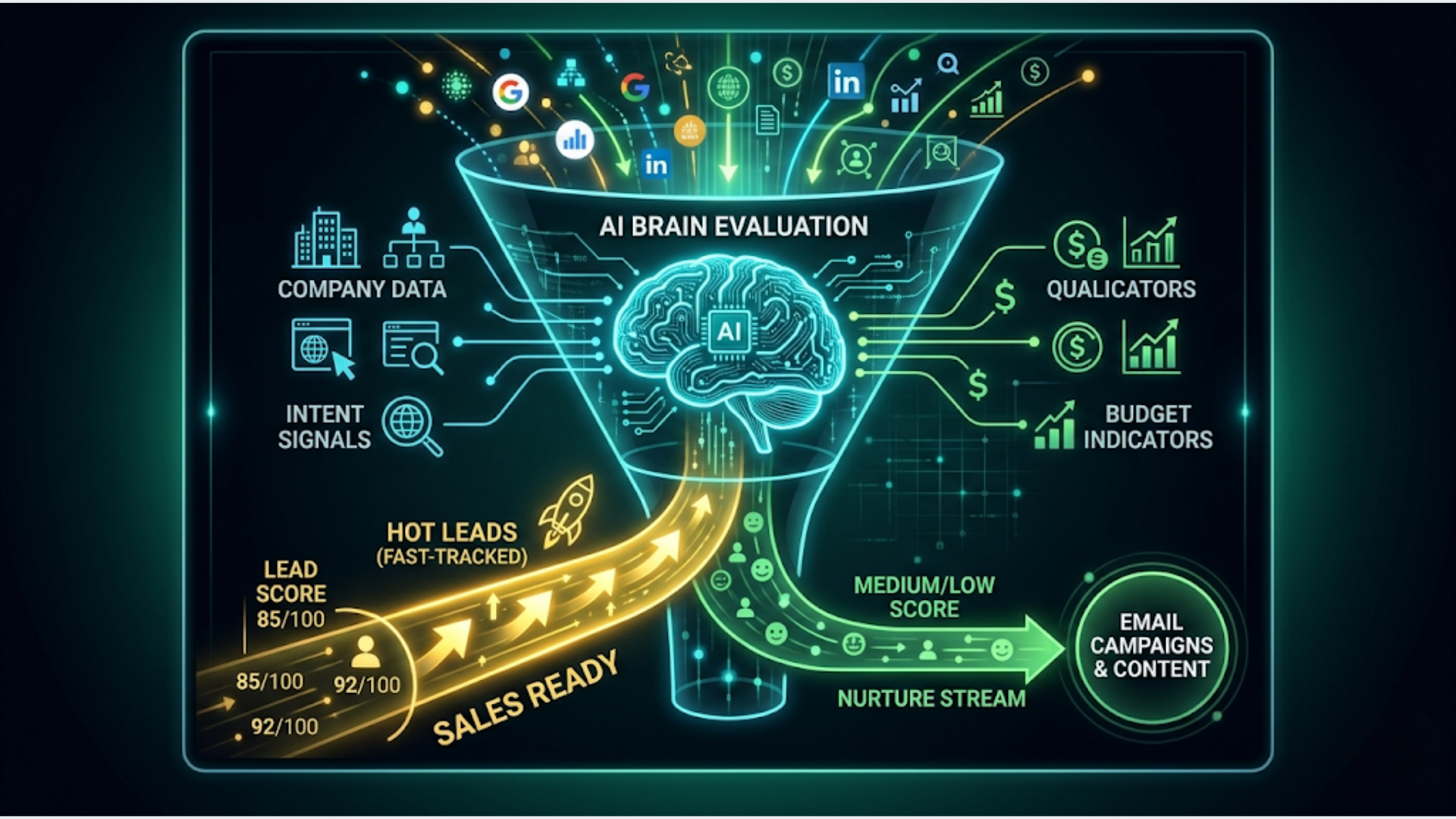
The system has 5 stages. Each stage runs as a separate n8n workflow, connected by triggers.
Stage 1: Lead Intake. Capture leads from all sources (web forms, LinkedIn, cold email replies, chatbot conversations, event signups) into a single processing queue.
Stage 2: Data Enrichment. Pull company data, LinkedIn profile data, technographic data, and public financial data to build a complete lead profile.
Stage 3: AI Scoring. Send the enriched profile to an LLM with your ICP criteria. The AI returns a qualification score, confidence level, and reasoning.
Stage 4: Routing. Route qualified leads to the appropriate sales rep based on territory, deal size, or industry. Route unqualified leads to nurture sequences.
Stage 5: Nurture and Re-score. Unqualified leads enter automated nurture workflows. After engagement signals (email opens, website visits, content downloads), they get re-scored.
The total processing time per lead is 15-30 seconds. From form submission to a sales rep getting a Slack notification with a qualified lead profile and AI-generated summary.
Stage 1: Lead Intake Pipeline
Every lead source needs to funnel into one processing queue. Scattered intake is why leads fall through cracks.
Sources to connect:
- Web forms (Typeform, HubSpot Forms, custom forms): Webhook trigger in n8n
- LinkedIn Lead Gen Forms: LinkedIn webhook or daily CSV export pull
- Cold email replies (Instantly, Lemlist, SmartLead): Webhook on reply event
- Chatbot conversations (Intercom, Drift, custom): Webhook on conversation closed
- Event signups (Eventbrite, Luma, Google Forms): Webhook or scheduled pull
- Manual entry: Google Form that pushes to the same pipeline
Standardize the data. Each source sends different field names. Use a Function node to normalize everything into a standard schema:
return [{
  json: {
    email: $input.first().json.email?.toLowerCase().trim(),
    name: $input.first().json.name || $input.first().json.full_name,
    company: $input.first().json.company || $input.first().json.organization,
    phone: $input.first().json.phone || null,
    source: 'webform', // or 'linkedin', 'cold_email', etc.
    source_detail: $input.first().json.form_name || null,
    raw_message: $input.first().json.message || null,
    captured_at: new Date().toISOString()
  }
}];
Deduplication. Before processing, check if this email already exists in your CRM. If it does, update the existing record with the new touchpoint instead of creating a duplicate. This single step prevents the “same lead contacted by 3 reps” disaster.
Stage 2: Data Enrichment
Raw form data tells you almost nothing useful for qualification. Enrichment builds the full picture.
Company data enrichment:
Use Apollo.io, Clearbit, or a custom enrichment workflow to pull:
- Company size (employees)
- Annual revenue estimate
- Industry classification
- Technology stack (what tools they use)
- Funding stage (for startups)
- Location and market
Apollo.io provides 95% of this data through their API at $49-99/month. For budget-conscious setups, you can build a partial enrichment using free sources: scraping the company website with n8n’s HTTP node, pulling LinkedIn company data via their API, and using public databases.
LinkedIn profile enrichment:
If the lead’s LinkedIn URL is available (from LinkedIn Lead Gen Forms or email-to-LinkedIn matching via Apollo):
- Job title and seniority level
- Time in current role
- Company affiliation confirmation
- Recent activity (posting about relevant topics is a strong intent signal)
Website analysis (AI-powered):
This is where the system gets interesting. Use n8n’s HTTP node to fetch the lead’s company website. Send the homepage content to OpenAI:
Analyze this company website and extract:
1. What the company does (one sentence)
2. Company size estimate based on website complexity
3. Industry vertical
4. Likely pain points that automation could solve
5. Technology clues (mentions of specific tools, platforms, integrations)

Website content: {scraped_text}
The AI returns structured data that a rules-based system could never produce. It reads context, infers business maturity, and identifies pain points from marketing copy.
Cost of enrichment: Apollo API calls cost roughly $0.01-0.05 per lead. OpenAI website analysis costs $0.02-0.05 per lead (using GPT-4o-mini). Total enrichment cost: $0.05-0.10 per lead. At 1,000 leads/month, that’s $50-100/month.
Stage 3: AI Scoring Engine
This is the core of the system. Instead of rigid point-based scoring, the AI evaluates each lead holistically against your ICP.
Define your ICP in a prompt:
Create a system prompt that describes your ideal customer:
You are a lead qualification AI for [Company Name]. Score each lead on a 1-100 scale.

Our Ideal Customer Profile:
- Company size: 10-200 employees
- Industries: SaaS, e-commerce, professional services, financial services
- Revenue: $500K-50M annually
- Pain signals: manual processes, scaling challenges, CRM complaints, hiring ops staff
- Technology: Uses Shopify, HubSpot, Salesforce, Zoho, or similar SaaS tools
- Decision maker: Director level or above, or founder/co-founder
- Budget indicators: Funded startup (Series A+), established business with growth trajectory

Scoring Guide:
- 80-100: Strong fit. Multiple ICP criteria match. Clear pain signal. Decision maker.
- 60-79: Good fit. Most criteria match. Some gaps in data.
- 40-59: Possible fit. Some criteria match but significant unknowns.
- 20-39: Weak fit. Few criteria match. Likely not a good customer.
- 1-19: Not a fit. Wrong industry, too small, no pain signals.

Return a JSON object with:
- score (1-100)
- confidence (low/medium/high)
- reasoning (2-3 sentences explaining the score)
- qualification_status (qualified/nurture/disqualify)
- recommended_action (specific next step for sales)
- icp_match_details (which criteria matched and which didn't)
Send the enriched lead data to the AI:
Score this lead based on our ICP:

Name: {name}
Title: {title}
Company: {company}
Company Size: {employees}
Industry: {industry}
Revenue Estimate: {revenue}
Technology Stack: {tech_stack}
Website Analysis: {ai_website_analysis}
Source: {lead_source}
Message/Inquiry: {raw_message}
LinkedIn Activity: {recent_linkedin_activity}
Parse the AI response. Use a Function node to extract the JSON from the AI’s response and add it to the lead record. Store the full AI reasoning alongside the score. This is critical for sales reps and for auditing the system’s accuracy later.
Accuracy benchmarks. AI scoring typically matches human sales qualification decisions about 78-85% of the time on initial deployment. After 30 days of feedback (marking leads as correctly or incorrectly scored), accuracy typically improves to 85-92%. The remaining 8-15% are edge cases where the AI lacks context that a human would know (like an existing relationship with the company or insider knowledge about a recent reorg).
Cost. Using GPT-4o-mini for scoring: approximately $0.01-0.03 per lead. Using GPT-4o for higher accuracy on borderline cases: $0.05-0.15 per lead. A tiered approach (mini for initial screen, full GPT-4o for leads scoring 40-70) balances cost and accuracy.
Stage 4: Lead Routing
Qualified leads need to reach the right rep within minutes, not hours.
Routing rules:
Define routing logic in a Google Sheet or directly in n8n:
| Criteria | Route To | Method |
|---|---|---|
| Score 80+, enterprise size | Senior AE | Slack DM + CRM task |
| Score 80+, SMB | SDR for immediate outreach | Slack channel + CRM task |
| Score 60-79 | SDR for discovery call | CRM task + email sequence |
| Score 40-59 | Nurture sequence | Auto-enroll in email drip |
| Score below 40 | Archive | Log and deprioritize |
The Slack notification for qualified leads:
New Qualified Lead (Score: 87/100)

Name: Priya Sharma
Title: Head of Operations
Company: FastGrowth SaaS (Series B, 120 employees)
Industry: SaaS / B2B
Estimated Revenue: $8M

AI Summary: Strong fit. Company is actively scaling operations with
manual processes across 3 CRMs. Decision maker with direct budget
authority. Recent LinkedIn posts about needing better automation.

Recommended Action: Schedule discovery call. Focus on CRM
consolidation and workflow automation pain points.

Source: Website form (pricing page)
That Slack message gives the rep everything they need to make a personalized first touch within minutes. No CRM research needed. No digging through LinkedIn. The AI did the prep work.
Round-robin assignment. For teams with multiple reps covering the same territory, use a simple counter in Google Sheets or n8n’s built-in variable storage to distribute leads evenly. Increment the counter after each assignment.
India-specific routing. For companies selling across India, route based on language preference and region. Leads from Tamil Nadu get assigned to reps who speak Tamil. Leads from Maharashtra get Marathi-speaking reps. This increases connection rates by 20-30% in my experience building these systems for Indian B2B companies.
Stage 5: Nurture and Re-score
Leads scoring 40-79 aren’t dead. They’re not ready. The nurture workflow keeps them warm until they are.
Automated nurture sequence:
Enroll leads scoring 40-79 into an email sequence tailored to their industry and pain points. Use the AI’s ICP match details to select the right sequence:
- SaaS leads: Send case studies about SaaS automation, invite to product demo
- E-commerce leads: Send Shopify/WooCommerce automation content, inventory management guides
- Professional services leads: Send CRM automation content, billing automation guides
Engagement-triggered re-scoring.
Set up tracking for nurture engagement:
- Email opens (3+ opens in a sequence = +signal)
- Link clicks (pricing page visit = strong signal)
- Content downloads
- Website return visits
- Reply to nurture email (strongest signal)
When engagement signals accumulate, trigger a re-score workflow. The AI receives the original lead data plus the new engagement signals. A lead that scored 55 originally but has now opened 4 emails, visited the pricing page twice, and downloaded a case study might re-score at 78 and get promoted to the qualified pipeline.
Re-score frequency. Don’t re-score on every email open. Batch engagement signals and re-score weekly, or when a high-value signal triggers (pricing page visit, reply email, demo request). This keeps API costs manageable and prevents score inflation from minor engagement.
Long-term nurture. Leads that stay below 60 after 90 days of nurture move to a low-frequency monthly newsletter. They’re not deleted. They’re deprioritized. Some of the best deals come from leads that weren’t ready 6 months ago but remembered you when the budget opened up.
Cost Breakdown and ROI
Monthly costs for 1,000 leads/month:
| Component | Cost |
|---|---|
| n8n Cloud (Pro) | $50/month |
| OpenAI API (enrichment + scoring) | $30-80/month |
| Apollo.io (enrichment) | $49-99/month |
| Email tool (Instantly/Lemlist) | $30-97/month |
| Slack | Free |
| Google Sheets | Free |
| Total | $160-326/month |
ROI math: If the AI scoring system improves your lead-to-meeting conversion rate by even 15% (because reps focus on actually qualified leads instead of wasting time on bad fits), and your average deal value is $5,000, qualifying 2 additional deals per month pays for the entire system 10x over.
The real ROI isn’t in cost savings. It’s in speed. A lead that gets a personalized response in 5 minutes converts at 8x the rate of one that waits 24 hours. The AI qualification system makes 5-minute responses possible without hiring more SDRs.
If you want to build a custom AI lead qualification system connected to your CRM and sales workflow, that’s exactly what I do at triggerAll.
Frequently Asked Questions
How accurate is AI lead scoring compared to human qualification? On initial deployment, 78-85% accuracy compared to human decisions. After 30 days of feedback, 85-92%. The AI misses context that humans know intuitively (existing relationships, recent company news not yet public). The trade-off is speed: AI scores 1,000 leads in the time a human scores 5.
Which LLM should I use for lead scoring? GPT-4o-mini for volume (cost-effective at $0.01-0.03 per lead). GPT-4o for borderline cases requiring deeper analysis. Claude (Anthropic) is an excellent alternative with strong reasoning capabilities. Use a tiered approach: fast model for initial screen, powerful model for leads in the uncertain range.
Can this work with HubSpot/Salesforce/Pipedrive? Yes. n8n has native nodes for all three CRMs. The scoring output writes directly to custom fields in your CRM (lead score, AI reasoning, qualification status). Your reps see the AI scoring inside their existing CRM workflow. No new tools to learn.
How do I prevent AI bias in lead scoring? Review scored leads weekly for the first month. Look for patterns: does the AI consistently underscore certain industries, company sizes, or geographies? If so, adjust your ICP prompt. Track false negatives (leads the AI rejected that became customers) to continuously improve the scoring criteria.
What about GDPR/privacy compliance? The system processes publicly available business data (company websites, LinkedIn profiles, business registrations). For EU leads, ensure your privacy policy covers automated profiling. Give leads the ability to opt out. Store enrichment data in your CRM (which should already be GDPR-compliant) rather than in intermediate tools.
How long does it take to build this system? A basic version (intake + enrichment + AI scoring + Slack routing) takes 8-15 hours to build in n8n. The full system with nurture sequences, re-scoring, and CRM integration takes 25-40 hours. Most of the time goes into defining your ICP criteria and testing the AI scoring accuracy, not the technical wiring.
Does this replace SDRs? No. It makes SDRs more effective. Instead of spending 60% of their time researching and qualifying leads, they spend 90% of their time on actual outreach to pre-qualified leads with AI-generated context. One SDR with this system outperforms 2-3 SDRs doing manual qualification.
Need help implementing this?
Book a free 30-minute discovery call. We'll map your current setup, identify quick wins, and outline what automation can do for your business.
Book a Free Discovery Call