How to Build an AI Content Briefing Generator with n8n
Build an AI content briefing generator using n8n, Claude, and web scraping. Automated competitor research, keyword extraction, and structured briefs delivered to Notion or Google Docs.
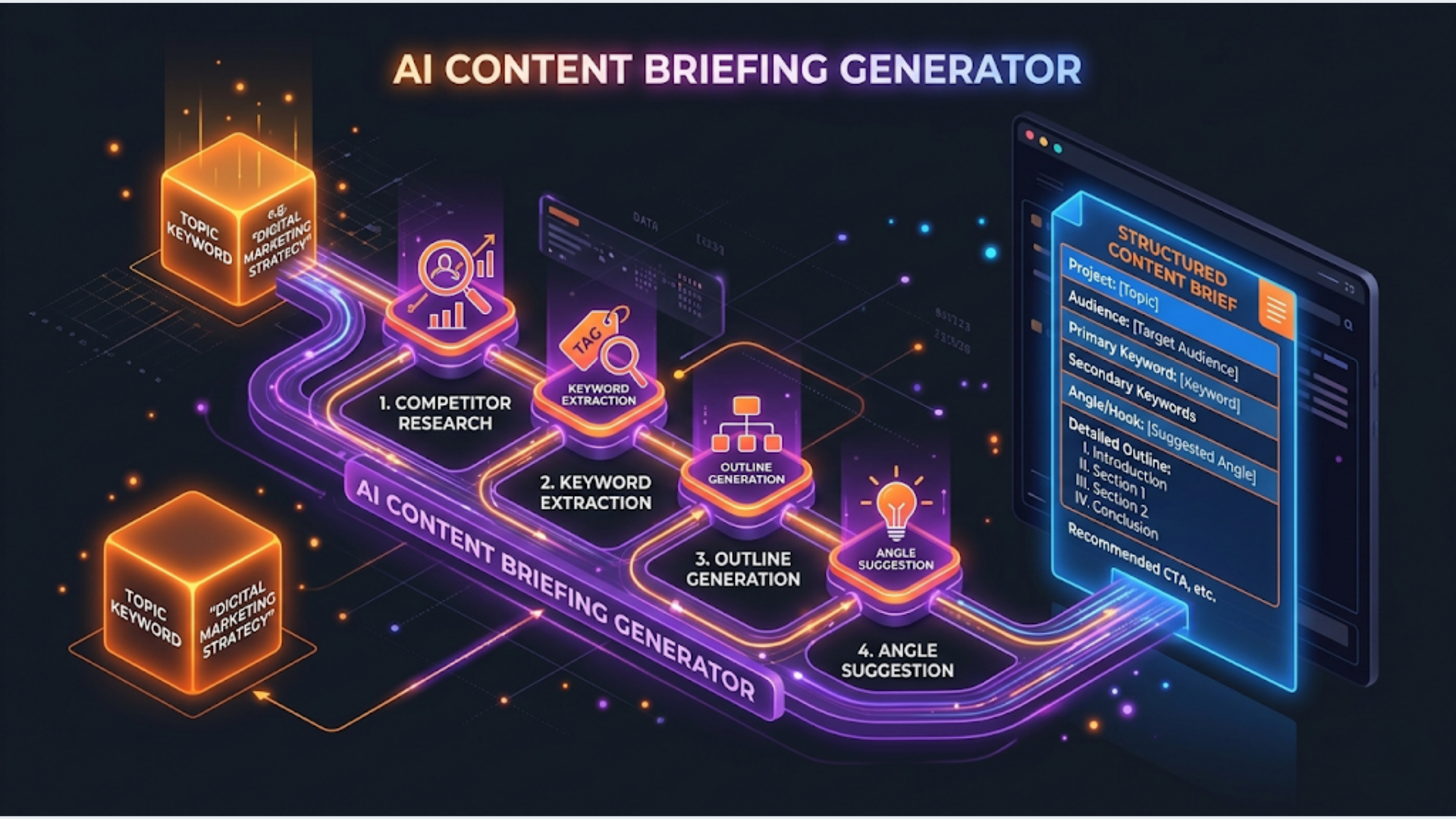
How to Build an AI Content Briefing Generator with n8n
A content brief takes 45-90 minutes to create manually. You research competitors, identify keywords, outline sections, determine the angle, write instructions for the writer. For a content team producing 20 pieces per month, that’s 15-30 hours just on briefs. Before a single word of actual content gets written.
Most of this research is mechanical. Search Google for the target keyword. Open the top 10 results. Scan their headings and structure. Note what they cover and what they miss. Check search volume and difficulty. Pick an angle.
An AI content briefing generator does all of this in 2-3 minutes per brief. Topic goes in, structured brief comes out. I build these systems using n8n. Here’s the complete architecture, including cost per brief and the exact workflow nodes.
What a Good Content Brief Contains
Before building the automation, you need to define the output. A brief that actually helps writers should include:
Target keyword and intent. The primary keyword, 5-8 secondary keywords, and the search intent (informational, transactional, navigational, commercial investigation).
Competitor analysis. Top 5-7 ranking articles for the keyword. For each: URL, title, word count, H2 headings, key topics covered.
Content gap. What the top results miss. This is the brief’s most valuable section. It tells the writer where to add original value.
Suggested outline. H1, H2s (5-7 sections), brief description of each section (1-2 sentences), suggested word count per section.
Angle/hook. What makes this piece different from the existing top results. The unique perspective or data point.
Target audience. Who is reading this and what stage of the buying journey they’re at.
CTA recommendation. What action the reader should take after reading.
SEO requirements. Title tag (under 60 chars), meta description (under 160 chars), internal link suggestions.
That’s the template. Now let’s build the system that generates it.
The n8n Workflow: Complete Architecture
The workflow has 5 stages. Total execution time: 2-3 minutes per brief.
Stage 1: Topic Input
Three input methods depending on your workflow:
Manual trigger. Open n8n, enter the topic/keyword, click execute. Good for ad-hoc briefs.
Google Sheets queue. Content team adds topics to a Sheet. n8n polls every hour, picks up new rows, generates briefs. Batch processing.
Slack command. Type /brief "whatsapp order bot small business" in Slack. n8n receives the webhook, processes, and posts the completed brief back to the channel.
The input payload:
{
  "topic": "WhatsApp order bot small business",
  "target_audience": "small business owners",
  "content_type": "how-to guide",
  "target_word_count": 2000,
  "brand_voice": "technical but accessible"
}
Stage 2: Competitor Research via Web Scraping
This is the backbone of the brief. n8n scrapes the top search results for the target keyword.
Node chain:
-
HTTP Request to a search API. SerpAPI ($50/month for 5,000 searches) or ScrapeIt ($29/month) returns Google search results as structured JSON. You get: title, URL, snippet, position for each result.
-
Split In Batches to process the top 7 results individually.
-
HTTP Request to fetch each URL’s HTML content. Use a scraping proxy or headless browser if sites block direct requests. BrightData Scraping Browser or ScraperAPI ($29/month) handle this.
-
HTML Extract node to pull structured data from each page:
- Title (H1)
- All H2 and H3 headings
- Word count (approximate from text length)
- Meta description
- First and last paragraph (for angle detection)
-
Merge all competitor data into a single JSON array.
Output from this stage:
{
  "competitors": [
    {
      "url": "https://example.com/whatsapp-bot-guide",
      "title": "How to Build a WhatsApp Bot",
      "word_count": 1850,
      "headings": ["Getting Started", "Choosing a Platform", "Building the Flow", "Testing"],
      "meta_description": "Step-by-step guide to..."
    }
  ]
}
Cost per brief for this stage: SerpAPI: $0.01 per search. Page scraping: $0.005-0.01 per URL. Total: approximately $0.05-0.10 for competitor research.
Stage 3: Keyword Extraction
Two approaches:
Option A: SEO API. DataForSEO ($0.01 per request) or SEMrush API ($119/month for 10,000 requests) returns related keywords, search volume, difficulty scores, and SERP features.
Option B: AI extraction. Feed the competitor data to Claude or GPT-4 and ask it to extract semantically related keywords. Cheaper but no search volume data.
Recommended approach: Use DataForSEO for the primary keyword’s data (volume, difficulty, SERP features), then use AI to extract semantic keywords from competitor content. Best of both worlds.
n8n node chain:
- HTTP Request to DataForSEO: keyword data for primary term
- Claude/GPT node: “Based on these competitor articles, list 15-20 related keywords grouped by intent (informational, commercial, transactional)”
- Merge keyword data with competitor research
Stage 4: AI Brief Generation
This is where the AI synthesizes everything into a structured brief. Feed all the research data to Claude (or GPT-4) with a detailed prompt.
The prompt template:
You are a senior content strategist. Based on the following research,
generate a detailed content brief.

TARGET KEYWORD: {{keyword}}
TARGET AUDIENCE: {{audience}}
CONTENT TYPE: {{content_type}}

COMPETITOR ANALYSIS:
{{competitor_data_json}}

RELATED KEYWORDS:
{{keyword_data_json}}

Generate a content brief with these sections:

1. TITLE OPTIONS: 3 title suggestions (under 60 characters each)
2. META DESCRIPTION: Under 160 characters
3. SEARCH INTENT: What the searcher wants to achieve
4. CONTENT GAP: What top results miss or do poorly
5. UNIQUE ANGLE: How to differentiate this piece
6. OUTLINE: H1 + 5-7 H2 sections, each with:
   - Section heading
   - 2-3 bullet points of what to cover
   - Suggested word count
   - Key keywords to include naturally
7. CTA RECOMMENDATION: Action for the reader
8. INTERNAL LINK SUGGESTIONS: 3-5 related topics to link to
9. TOTAL TARGET WORD COUNT: Based on competitor average +20%

Format as structured markdown.
AI model choice matters:
| Model | Cost per Brief | Quality | Speed |
|---|---|---|---|
| Claude 3.5 Sonnet | $0.02-0.04 | Excellent structure | 8-12 seconds |
| Claude 3.5 Haiku | $0.005-0.01 | Good for most briefs | 3-5 seconds |
| GPT-4o | $0.02-0.05 | Good structure | 10-15 seconds |
| GPT-4o-mini | $0.005-0.01 | Decent for simple topics | 3-5 seconds |
I use Claude Sonnet for complex topics where the content gap analysis needs nuance. Haiku for straightforward how-to briefs where the structure is predictable.
Stage 5: Output Delivery
The generated brief needs to go somewhere useful.
Option A: Google Docs. n8n creates a new Google Doc in a shared folder. Brief is formatted with proper headings and styling. The writer opens the doc, reads the brief, and starts writing in the same document.
Option B: Notion. n8n creates a new page in a Notion database. Tags it with keyword, status (Ready for Writing), assigned writer, and due date. Integrates directly into a content calendar.
Option C: Slack. Brief posted as a formatted message in a content channel. Good for quick review before committing to a doc.
Option D: Google Sheets. Brief summary (title, keyword, angle, word count) appended to a content tracker sheet. Full brief linked as a Google Doc.
For teams using Notion as their content hub, Option B is ideal. The brief becomes a database entry with all metadata searchable and filterable.
Content Team Workflow Integration
The briefing generator is one piece of a content production pipeline. Here’s how it fits into the full workflow.
Weekly content planning:
- SEO lead adds 10-15 target keywords to the “Brief Queue” Google Sheet
- n8n generates briefs overnight (batch processing)
- Morning: briefs are in Notion, ready for review
- Content lead reviews, adjusts angles, assigns writers
- Writers start from the brief, not a blank page
On-demand briefs:
- Someone spots a trending topic or a content gap
- They type
/brief "topic"in Slack - 3 minutes later, the brief is in the channel
- Team decides if it’s worth pursuing
Monthly content audits: Run the generator against your own existing content’s keywords. Compare your brief’s suggested structure against what you actually published. Find gaps in your own coverage.
Writer feedback loop: After the first 10-20 briefs, collect writer feedback. Which sections are useful? Which are ignored? Adjust the prompt template. A brief the writer doesn’t read is a wasted brief.
Cost Analysis: Full Pipeline
Let’s calculate the cost per brief for the complete pipeline.
| Component | Cost Per Brief |
|---|---|
| Search API (SerpAPI) | $0.01 |
| Page scraping (7 URLs) | $0.05-0.07 |
| Keyword data (DataForSEO) | $0.01 |
| AI generation (Claude Sonnet) | $0.02-0.04 |
| n8n execution | $0.00 (self-hosted) |
| Total per brief | $0.09-0.13 |
At $0.10 per brief, generating 100 briefs costs $10. Manually, 100 briefs at 60 minutes each is 100 hours of work. At $25/hour (a reasonable content strategist rate), that’s $2,500.
Cost reduction: 99.6%.
The quality isn’t identical to a senior strategist’s manual brief. But it’s 80-90% of the way there. The content lead spends 5-10 minutes refining each AI brief instead of 60 minutes creating from scratch.
Monthly costs for a team producing 40 briefs/month:
| Item | Monthly Cost |
|---|---|
| SerpAPI (40 searches) | $0.40 |
| Page scraping (280 URLs) | $2.80 |
| DataForSEO (40 lookups) | $0.40 |
| Claude API (40 briefs) | $1.60 |
| n8n hosting | $5-10 |
| Total | $10-15/month |
Compare that to the 40-60 hours of manual work it replaces. The ROI is absurd.
Advanced Features
Once the basic pipeline works, these additions increase brief quality significantly.
People Also Ask extraction. SerpAPI returns the “People Also Ask” questions for your keyword. Include these in the brief as an FAQ section suggestion. Google is literally telling you what questions to answer.
SERP feature targeting. If the keyword has a featured snippet, include instructions in the brief for targeting it (concise answer paragraph, table format, numbered list). The AI can analyze the current featured snippet and suggest how to earn it.
Competitive content scoring. Score each competitor article on a rubric: depth (word count), freshness (publish date), engagement signals (comments, shares if accessible), structure quality (heading hierarchy). The brief recommends targeting the weaknesses.
Brand voice injection. Include your brand’s voice guidelines in the AI prompt. The brief’s suggested angle and hook will align with your tone. I do this for every client’s content system.
Content clustering. When generating briefs for related topics, the AI can suggest internal linking between them. Brief for “WhatsApp order bot” links to brief for “best WhatsApp automation tools.” Builds topical authority.
Frequently Asked Questions
Does this replace content strategists? No. It replaces the mechanical research phase. The strategist still reviews, refines the angle, and makes editorial decisions. The value shifts from “can you research this keyword” to “is this the right angle for our audience.”
How accurate is the competitor analysis? The scraping captures structure (headings, word count, topics) accurately. It doesn’t capture quality, depth of analysis, or reader experience. The AI infers content gaps based on structural patterns, which works well 80% of the time. For nuanced topics, a human eye catches what the AI misses.
Can I use this for non-English content?
Yes. SerpAPI supports localized search results (country + language). The AI models generate briefs in any major language. Adjust the search parameters: gl=in&hl=hi for Hindi results in India, gl=de&hl=de for German results. Keyword data availability varies by language though.
What if a competitor page blocks scraping? Some sites block scrapers with Cloudflare or rate limiting. Use a rotating proxy service (BrightData, ScraperAPI) to handle this. If a specific URL fails, the workflow skips it and works with the remaining results. 5 out of 7 competitors is still plenty of data.
How do I handle topics with thin search results? For new or niche topics where fewer than 5 quality results exist, the brief will have less competitive data to work from. The AI compensates by relying more on its training knowledge. Add a “topic context” field to the input where you can paste industry reports or reference material that helps the AI understand the space.
Can this generate the actual content too, not just the brief? Yes, but I recommend separating them. The brief is a strategic document. Content generation is a creative task. You can chain them: brief generator outputs to a content writer agent that produces a draft. But the quality of the draft depends heavily on the quality of the brief. Get the brief right first, then automate the writing.
What’s the difference between this and tools like Frase, Clearscope, or MarketMuse? Those are SaaS products that do similar things with polished UIs. They cost $45-500/month. The n8n pipeline does the same core job (research, keyword analysis, brief generation) at $10-15/month. The trade-off: you build and maintain it yourself. No drag-and-drop interface. But full customization and no per-seat pricing.
Need help implementing this?
Book a free 30-minute discovery call. We'll map your current setup, identify quick wins, and outline what automation can do for your business.
Book a Free Discovery Call