Best WhatsApp Automation for D2C Brands in India (2026)
Best WhatsApp automation for Indian D2C brands: WATI for catalogs, Interakt for Shopify, AiSensy for bulk campaigns. Pricing, features, and setup compared.
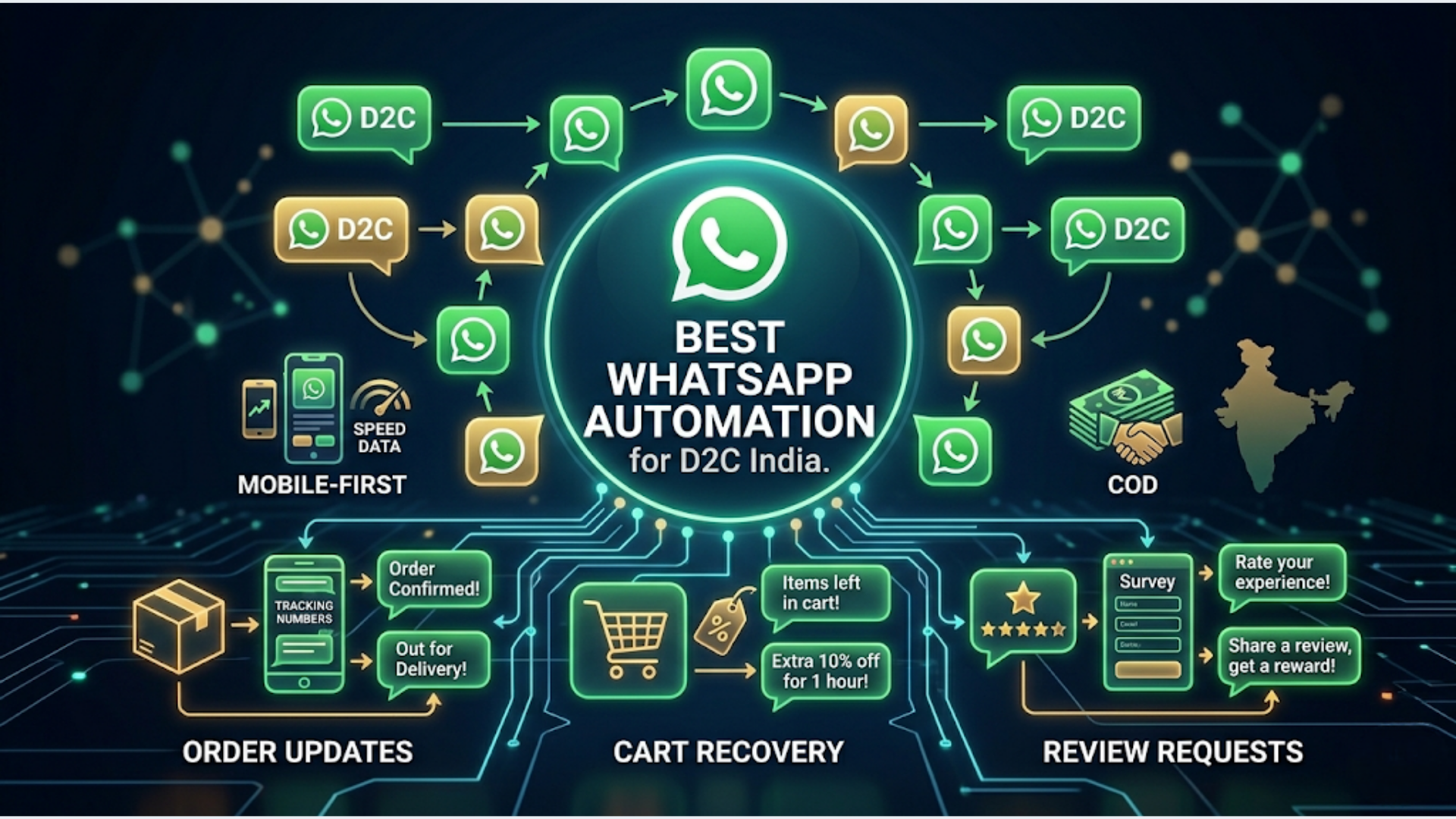
Best WhatsApp Automation for D2C Brands in India (2026)
WATI is the best overall WhatsApp automation tool for Indian D2C brands doing catalog-driven selling. Interakt is the top pick if your store runs on Shopify. AiSensy wins for high-volume broadcast campaigns where cost-per-message matters most. Gallabox works best for small teams under 5 people who need a quick setup.
D2C brands processing 200 to 10,000 orders/month are the sweet spot for WhatsApp automation. The tools are mature now. The question isn’t whether to automate WhatsApp (you should), it’s which platform fits your order volume, tech stack, and budget.
What D2C Brands Actually Need from WhatsApp
Before comparing tools, let’s be clear about what matters. Most D2C brands in India need WhatsApp to handle six core workflows:
Order Updates: Payment confirmation, shipping notification, out-for-delivery alert, delivered confirmation. This is table stakes. If your customers are checking “where is my order” manually, you’re wasting their time and your support team’s time.
Abandoned Cart Recovery: A customer adds products to cart and disappears. WhatsApp message within 30 minutes recovers 15-25% of abandoned carts. That’s real revenue. D2C brands recover ₹3-8 lakh/month from this single automation.
Catalog Browsing: WhatsApp’s native catalog feature lets customers browse products, ask questions, and place orders without leaving the chat. For brands selling 20-200 SKUs, this becomes a second storefront.
COD Confirmation: Cash on delivery accounts for 50-65% of Indian e-commerce orders. A WhatsApp message confirming the order and asking the customer to reconfirm reduces RTO (return to origin) by 25-40%. This alone justifies the cost of WhatsApp automation for most Indian D2C brands.
Review Collection: Post-delivery WhatsApp message asking for a product review gets 3-5x higher response rates than email. Reviews drive conversion. More reviews, more sales.
Loyalty and Re-purchase: Personalized re-purchase reminders based on product consumption cycles. Selling supplements? Remind them at day 25 of a 30-day supply. Selling skincare? Remind them when the product is likely running low.
Platform Comparison
Here’s the honest breakdown based on deploying each of these for production D2C workflows.
| Feature | WATI | Interakt | AiSensy | Gallabox | Gupshup |
|---|---|---|---|---|---|
| Starting Price | ₹2,499/mo | ₹999/mo | ₹999/mo | ₹999/mo | Custom (API-based) |
| WhatsApp API | Official BSP | Official BSP | Official BSP | Official BSP | Official BSP |
| Shopify Integration | Plugin (good) | Native (best) | Plugin (basic) | Plugin (basic) | API only |
| Catalog Support | Full native | Product sync from Shopify | Limited | Basic | API-driven |
| Chatbot Builder | Visual (drag-drop) | Flow builder | Keyword-based | Visual builder | Developer-focused |
| Broadcast Limit | Based on plan | Based on plan | Unlimited on higher plans | Based on plan | Unlimited (API) |
| Team Inbox | Yes (multi-agent) | Yes | Yes | Yes (strong) | No native inbox |
| API Access | Full REST API | Webhooks + API | API available | API available | Full API (core product) |
| COD Confirmation Flow | Built-in template | Shopify-native flow | Manual setup | Template available | Custom build |
| Abandoned Cart | Yes (automated) | Yes (Shopify-native) | Manual setup | Yes | Custom build |
| Analytics | Campaign + agent metrics | Order-tied analytics | Basic campaign stats | Conversation analytics | API-level metrics |
| Green Tick Verification | Assisted | Assisted | Assisted | Assisted | Assisted |
| Per-Message Cost | Meta rates + ₹0.50-0.80 markup | Meta rates + ₹0.30-0.50 markup | Meta rates + ₹0.20-0.40 markup | Meta rates + ₹0.40-0.60 markup | Meta rates + lowest markup |
On pricing clarity: Every WhatsApp BSP charges Meta’s conversation fees (₹0.47 for marketing, ₹0.32 for utility, free for service within 24h) plus their own markup per message. The per-message markup is where costs diverge significantly at scale.
WATI is the most complete package for D2C. Catalog management, multi-agent inbox, visual chatbot builder, and strong automation. The interface is clean, the documentation is solid, and the Shopify plugin works without constant babysitting. At ₹2,499/month starting price, it’s the most expensive, but you get the most polished product.
Interakt is purpose-built for Shopify stores. Product catalog syncs automatically, abandoned cart flows trigger natively, order status updates pull directly from Shopify. If your store is on Shopify and you want the least setup friction, Interakt is the answer. At ₹999/month, the entry point is accessible.
AiSensy wins on broadcast economics. If your primary use case is sending promotional campaigns to large lists (50,000+ contacts), AiSensy’s per-message markup is the lowest among the user-friendly platforms. The chatbot and automation features are more basic, but for campaign-heavy brands, the cost savings compound.
Gallabox is the small-team favorite. Clean interface, quick setup, shared inbox that feels intuitive. If you’re a 2-5 person team and need WhatsApp automation without a learning curve, Gallabox gets you running in a day.
Gupshup is the developer’s choice. It’s an API-first platform, not a dashboard-first product. If you have a development team and want full control over message flows, Gupshup gives you the lowest per-message cost and maximum flexibility. It’s not for non-technical teams.
5 WhatsApp Automations Every D2C Brand Should Run
These aren’t optional. These are the five workflows that pay for themselves within the first month.
1. Abandoned Cart Recovery
Trigger: Cart abandoned for 30 minutes (no payment completed). Message 1 (30 min): “Hey [Name], you left [Product] in your cart. Still interested? Here’s your cart: [link]” Message 2 (4 hours): Reminder with a 5-10% discount code if the first message wasn’t opened. Message 3 (24 hours): Last reminder. “Your cart expires tomorrow.”
Expected recovery rate: 15-25% of abandoned carts. At an average order value of ₹1,500 and 200 abandoned carts/month, that’s ₹45,000 to ₹75,000 recovered monthly. The WhatsApp automation costs ₹3,000 to ₹5,000/month. The math isn’t close.
2. COD Confirmation
Trigger: COD order placed. Message (immediate): “Hi [Name], we’ve received your order for [Product]. Total: ₹[amount] (Cash on Delivery). Please confirm you’ll accept delivery by replying YES.” If no reply in 6 hours: Follow-up message. If confirmed: Order proceeds to fulfillment. If no response in 24 hours: Flag for manual review (likely fake order).
This single automation reduces RTO by 25-40%. For brands doing 500+ COD orders/month with an average RTO cost of ₹150-300 per returned shipment, the savings are ₹18,750 to ₹60,000/month. This automation saves brands ₹1-3 lakh/month in RTO costs alone.
3. Shipping and Delivery Updates
Trigger: Order status changes in Shopify/logistics partner. Messages: Order confirmed, shipped (with tracking link), out for delivery, delivered.
This isn’t about recovery or sales. It’s about reducing “where is my order” support tickets by 60-70%. Every WISMO query your support team doesn’t have to answer is time they can spend on actual problems.
4. Post-Delivery Review Request
Trigger: Delivery confirmed + 2 day delay. Message: “Hi [Name], how’s your [Product]? We’d love a quick review: [review link]. Takes 30 seconds.” If no response in 3 days: One follow-up with a small incentive (₹50 store credit).
WhatsApp review requests get 3-5x the response rate of email. More reviews mean higher product page conversion. This creates a compounding effect on sales.
5. Re-purchase Nudge
Trigger: Product consumption cycle expiry (configurable per product category). Message: “Hi [Name], running low on [Product]? Reorder in one tap: [link]. Use code RESTOCK10 for 10% off.”
This works brilliantly for consumables: supplements, skincare, pet food, coffee, cleaning supplies. A well-timed re-purchase nudge converts at 20-35%. It’s the highest-ROI automation after abandoned cart recovery.
Global Context: How India’s WhatsApp Market Differs
Understanding why WhatsApp automation matters more in India than anywhere else.
WhatsApp dominance: 500+ million monthly active users in India. It’s not a messaging app. It’s the internet for most Indians. In the US and EU, WhatsApp is one of several channels. In India, it’s THE channel. Email open rates in India hover around 12-15%. WhatsApp message open rates: 85-95%.
COD prevalence: 50-65% of Indian e-commerce orders are COD. This doesn’t exist at this scale anywhere else. COD creates a unique problem (high RTO rates) that WhatsApp automation uniquely solves (confirmation messages before shipping).
Regional language needs: India has 22 official languages and hundreds of dialects. WhatsApp supports regional language templates. WATI, Interakt, and AiSensy all support Hindi, Tamil, Telugu, Marathi, Kannada, Bengali, and Gujarati templates. This matters for D2C brands selling outside metro cities.
Price sensitivity: Indian D2C brands operate on thinner margins than US/EU counterparts. The per-message cost difference between platforms (₹0.20 to ₹0.80 markup) matters at 50,000+ messages/month. That’s a ₹30,000/month difference just in markup fees.
Regulatory landscape: India’s data protection laws (DPDP Act 2023) require consent management for marketing messages. All BSP platforms handle opt-in/opt-out compliance, but you need to actively manage your consent database. Sending messages without consent risks getting your WhatsApp Business number banned.
Implementation Timeline and Cost Breakdown
Here’s what it actually takes to go from zero to fully automated WhatsApp for a D2C brand.
Setup Timeline
| Phase | Timeline | Activities |
|---|---|---|
| WhatsApp Business API approval | 1-3 days | Business verification, phone number setup, green tick application |
| Platform setup | 1-2 days | Account creation, Shopify/store integration, team inbox configuration |
| Template approval | 2-5 days | Submit message templates to Meta for review (plan for rejections and resubmissions) |
| Automation flows | 3-5 days | Build abandoned cart, COD confirmation, shipping updates, review, re-purchase flows |
| Testing | 2-3 days | End-to-end testing with real orders, edge case handling |
| Total | 2-3 weeks | From start to fully operational |
Monthly Cost Breakdown (INR)
| Cost Component | 500 orders/mo | 2,000 orders/mo | 5,000 orders/mo |
|---|---|---|---|
| Platform fee (WATI) | ₹2,499 | ₹4,999 | ₹9,999 |
| Meta conversation fees | ₹3,000-5,000 | ₹12,000-18,000 | ₹30,000-45,000 |
| BSP markup | ₹1,500-2,500 | ₹6,000-10,000 | ₹15,000-25,000 |
| Total | ₹7,000-10,000 | ₹23,000-33,000 | ₹55,000-80,000 |
| Cost Component | 500 orders/mo | 2,000 orders/mo | 5,000 orders/mo |
|---|---|---|---|
| Platform fee (Interakt) | ₹999 | ₹2,499 | ₹4,999 |
| Meta conversation fees | ₹3,000-5,000 | ₹12,000-18,000 | ₹30,000-45,000 |
| BSP markup | ₹900-1,500 | ₹3,600-6,000 | ₹9,000-15,000 |
| Total | ₹4,900-7,500 | ₹18,100-26,500 | ₹44,000-65,000 |
For brands doing under 1,000 orders/month, the platform fee is a small portion of total cost. Meta’s conversation fees dominate. At higher volumes, the per-message markup difference between platforms becomes significant.
DIY vs Agency Setup:
- DIY (with platform documentation): ₹0 setup, 2-3 weeks of your time
- Freelancer: ₹15,000-30,000 one-time setup
- Agency/automation specialist: ₹50,000-1,50,000 for full implementation with custom flows
I build these WhatsApp automation systems for D2C clients at triggerAll. The setup includes all five core automations, custom chatbot flows, and integration with your existing stack.
FAQ
Q1: How long does WhatsApp Business API approval take in India? A: Business verification through Meta typically takes 1-3 business days if your documents are in order. You need a valid GSTIN, business website, and a phone number that’s not already linked to WhatsApp. Green tick verification (official business badge) takes 2-4 additional weeks and requires a Facebook Business Manager with a verified ad account.
Q2: Can I use WhatsApp automation without a Shopify store? A: Yes. WATI, AiSensy, and Gallabox all work independently of any e-commerce platform. You can connect via API, Zapier, or n8n to any storefront (WooCommerce, Magento, custom). Interakt’s strongest features are Shopify-specific, so it’s less ideal for non-Shopify stores.
Q3: What’s the WhatsApp message limit for new business accounts? A: New WhatsApp Business API accounts start at Tier 1: 1,000 unique conversations per 24-hour period. As your quality rating stays high (low block/report rates), Meta automatically upgrades you to Tier 2 (10,000), then Tier 3 (100,000), then unlimited. This typically takes 2-4 weeks of consistent, compliant messaging.
Q4: Is WhatsApp automation cheaper than SMS for D2C in India? A: For transactional messages, SMS is cheaper (₹0.10-0.15 per SMS vs ₹0.32+ per WhatsApp utility message). For marketing messages, WhatsApp is more cost-effective when you factor in engagement: WhatsApp gets 85-95% open rates vs 20-30% for SMS. A ₹0.47 WhatsApp marketing message that 90% of people actually read beats a ₹0.15 SMS that 25% read.
Q5: Can I send WhatsApp messages in regional languages? A: Yes. All major BSP platforms support multilingual templates. You submit templates in each language for Meta approval. The key limitation: your chatbot needs language detection to route customers to the right template. WATI and Gallabox handle this with language preference settings. For more complex multilingual flows, I build custom language routing through n8n.
Q6: What happens if my WhatsApp Business number gets banned? A: If your quality rating drops (too many users blocking or reporting your messages), Meta restricts your messaging first, then bans the number. Recovery is possible but slow (appeal process takes 1-3 weeks). Prevention: always send messages to opted-in users only, keep your template rejection rate under 5%, and never send bulk promotional messages to cold contacts. Use a separate number for marketing broadcasts and transactional messages if you’re risk-averse.
Need help implementing this?
Book a free 30-minute discovery call. We'll map your current setup, identify quick wins, and outline what automation can do for your business.
Book a Free Discovery Call