Best Automation for Healthcare Clinics and Practices (2026)
Best automation tools and workflows for healthcare clinics in 2026. Appointment booking, patient reminders, intake forms, billing automation, and WhatsApp communication for Indian clinics.
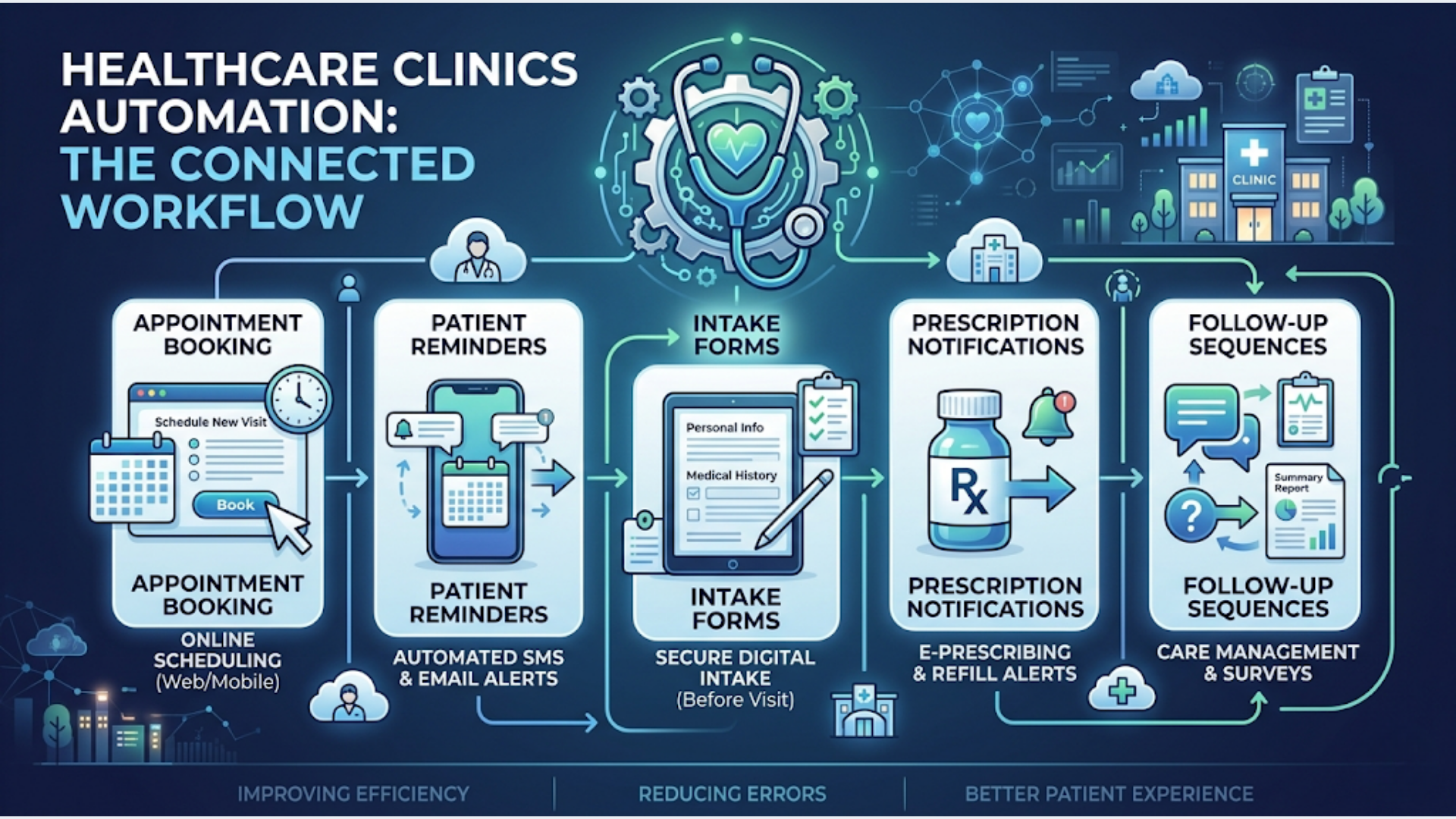
Best Automation for Healthcare Clinics and Practices (2026)
A typical multi-doctor clinic handles 80-150 patient interactions per day. Appointments, reminders, intake forms, prescriptions, follow-ups, billing. Every single one of these is a manual touchpoint where someone on staff picks up a phone, sends a message, or types data into a system.
The average clinic receptionist spends 3.5 hours daily just on phone calls for appointment booking and reminders. Multiply that across 6 working days. That’s 21 hours per week on tasks a workflow can handle in seconds.
Healthcare automation isn’t about replacing clinical judgment. It’s about eliminating the administrative overhead that has nothing to do with patient care. I build these systems for service businesses. Here’s what actually works for clinics in 2026.
Appointment Booking Automation
Manual appointment booking is the single biggest time sink in any clinic. Phone rings, receptionist answers, checks available slots, books the appointment, confirms verbally. Repeat 40-60 times a day.
The automated version:
Patient books through any of these entry points:
- WhatsApp message (“Book appointment with Dr. Sharma”)
- Website booking widget (Cal.com or Calendly embedded)
- Google Business Profile “Book” button
- Practo listing (for Indian clinics)
All bookings flow into one calendar system. Google Calendar works for single-doctor practices. For multi-doctor clinics, Cal.com ($15/month per doctor) handles doctor-specific availability, buffer times between appointments, and different appointment types (consultation, follow-up, procedure) with different durations.
n8n handles the orchestration:
- New booking triggers a webhook
- n8n checks for conflicts (double-booking prevention)
- Creates calendar event
- Sends confirmation to patient (WhatsApp in India, SMS/email elsewhere)
- Updates the clinic’s patient management system
- Sends internal notification to the assigned doctor
Waitlist automation. When a slot is fully booked, offer to add the patient to a waitlist. If a cancellation happens, n8n automatically notifies the next waitlisted patient. They get a WhatsApp message: “A slot just opened with Dr. Sharma at 3:30 PM today. Reply YES to confirm.” First to respond gets the slot.
| Booking Channel | Tool | Cost |
|---|---|---|
| WhatsApp bot | WATI + n8n | $49/month |
| Website widget | Cal.com | $15/month per seat |
| Google Business | Google Reserve | Free |
| Practo | Practo Pro | Rs 5,000-15,000/month |
Patient Reminders and No-Show Prevention
No-shows cost clinics real money. Industry average no-show rate is 20-30%. For a clinic charging Rs 500 per consultation, that’s Rs 5,000-7,500 lost daily on a 50-appointment schedule.
Automated reminders cut no-shows by 30-50%. The sequence that works:
48 hours before: WhatsApp message with appointment details, doctor name, clinic address (with Google Maps link), and options to confirm or reschedule. Include preparation instructions if relevant (“Fasting required 12 hours before your blood test”).
3 hours before: Short reminder. “Your appointment with Dr. Sharma is at 3:30 PM today. Reply C to confirm, R to reschedule.”
No response handling: If the patient hasn’t confirmed 2 hours before the appointment, the system flags it as at-risk. Staff can make a manual call or the slot gets released to the waitlist.
Post-appointment follow-up (24 hours after): “How was your visit? Rate 1-5.” Negative ratings trigger an alert to the clinic manager. Positive ratings get a Google Reviews prompt.
All of this runs on n8n with WATI for WhatsApp delivery. The cost per reminder sequence is approximately Rs 1-2 (WhatsApp conversation fees). Compared to the Rs 500+ revenue protected per prevented no-show, the ROI is obvious.
India-specific note: SMS reminders have poor open rates in India (15-20%) due to DND filters and spam. WhatsApp reminders see 85-95% open rates. If your clinic isn’t using WhatsApp for patient communication, you’re fighting the wrong channel.
Digital Intake Forms and Patient Onboarding
Paper intake forms are a nightmare. Patients fill them out with illegible handwriting. Receptionists re-type everything into the system. Data entry errors happen. Forms get lost.
The automated alternative:
Before the appointment, the patient receives a WhatsApp message with a link to a digital intake form. Tools that work:
| Tool | Best For | Cost |
|---|---|---|
| Google Forms | Basic intake | Free |
| Typeform | Better UX, conditional logic | $29/month |
| Jotform | HIPAA compliance (international) | $39/month |
| Tally | Clean forms, good free tier | Free for basics |
The form collects: personal details, medical history, current medications, allergies, insurance information, reason for visit, consent signatures.
n8n workflow on form submission:
- Form data arrives via webhook
- n8n formats and stores in Google Sheets or the clinic’s EHR
- Creates/updates patient record in the practice management system
- Generates a patient ID if new patient
- Alerts the doctor with a pre-visit summary 30 minutes before the appointment
Pre-visit summaries save doctors 3-5 minutes per consultation. Across 40 patients, that’s 2-3 hours of recovered clinical time daily.
For Indian clinics using Practo: Practo has its own patient records system, but it doesn’t integrate natively with external forms. n8n bridges this gap. Form data flows into your Google Sheets master record, and key fields sync to Practo via their API. Not perfect, but functional.
ABDM (Ayushman Bharat Digital Mission) compliance: India is building a national health data exchange. The ABDM Health ID (ABHA) will eventually be required for all digital health records. If you’re building intake automation now, include an ABHA number field. The full integration APIs are still maturing, but collecting the ID now means you’re ready when mandatory compliance kicks in.
Prescription Notifications and Medication Reminders
After a consultation, the doctor writes a prescription. In most clinics, this means the patient gets a handwritten note or a printout. If they lose it, they call the clinic. If they forget to take medication, they miss doses.
Automated prescription flow:
- Doctor finalizes prescription in their system (or a simple Google Form for smaller clinics)
- n8n generates a formatted prescription document (PDF via a template)
- WhatsApp sends the prescription PDF to the patient
- If the prescription includes scheduled medications, n8n sets up medication reminders
Medication reminders sequence:
- Morning medication: WhatsApp message at 8 AM. “Time for your morning dose: Metformin 500mg with breakfast.”
- Evening medication: WhatsApp message at 8 PM.
- Reminders run for the prescribed duration (7 days for antibiotics, ongoing for chronic conditions)
This is especially valuable for chronic disease management. Diabetes, hypertension, and thyroid patients who stay adherent to medication have significantly better outcomes. Automated reminders increase adherence rates from 50% to 75-80% in studies.
Pharmacy integration. If the clinic has an in-house pharmacy or a partnership, the prescription data can flow directly to the pharmacy’s order system. Patient arrives at the pharmacy, medication is already prepared. No waiting, no re-reading handwriting.
For Indian clinics, 1mg and PharmEasy have API access for prescription fulfillment. n8n can push prescription data to these platforms, giving patients the option to get home delivery without any manual re-entry.
Follow-Up Sequences and Chronic Care Management
The consultation ends. The patient walks out. What happens next?
In most clinics, nothing. Unless the patient remembers to book a follow-up, they fall off. For chronic conditions, this is dangerous. For the clinic’s revenue, it’s a leak.
Automated follow-up sequences:
| Condition Type | Follow-up Timing | Action |
|---|---|---|
| Acute (cold, infection) | 5-7 days after visit | ”How are you feeling? Need a follow-up?” |
| Post-procedure | 48 hours, then 1 week | Wound care instructions + check-in |
| Chronic (diabetes, BP) | Monthly | Medication refill reminder + test booking |
| Preventive | Annual | Annual checkup reminder |
| Lab results pending | When results arrive | ”Your lab results are ready. Book a review.” |
The n8n workflow:
- After each appointment, n8n reads the appointment type and diagnosis category
- Based on the category, it selects the appropriate follow-up sequence
- Scheduled messages fire at the right intervals
- Patient responses (book follow-up, no response, feeling better) update the patient record
Chronic care is the big opportunity. India has 77 million diabetics and 200+ million with hypertension. These patients need regular monitoring, medication adjustments, and lab tests. A clinic that automates chronic care follow-ups retains patients longer and catches complications earlier.
Monthly automated check-ins for chronic patients should include:
- Medication adherence check (“Have you been taking medications regularly?”)
- Symptom monitoring (“Any new symptoms this month?”)
- Lab test scheduling (“Your quarterly HbA1c test is due. Book here: [link]”)
- Lifestyle tips relevant to their condition
This isn’t replacing the doctor. It’s making sure the patient shows up for the appointments that matter.
Billing and Insurance Automation
Clinic billing involves multiple pain points: generating invoices, collecting payments, processing insurance claims, sending payment reminders for outstanding balances.
Invoice generation: After each consultation, n8n generates an invoice with consultation fee, procedure charges, medication costs, GST, and total. The invoice goes to the patient via WhatsApp as a PDF.
For Indian clinics, GST compliance is mandatory. The invoice must include: clinic GSTIN, SAC code (9993 for healthcare services), GST amount (exempt for healthcare services under most conditions, but 18% for cosmetic/elective procedures), and patient details.
Payment collection:
| Method | Tool | Fee | Settlement |
|---|---|---|---|
| UPI (at clinic) | PhonePe/Paytm QR | 0% | Instant |
| UPI (remote) | Razorpay payment link | 2% | T+2 |
| Cards | Razorpay terminal | 2% | T+2 |
| Insurance | Manual/TPA portal | Varies | 15-60 days |
| Outstanding balance | Razorpay auto-reminder | 2% | T+2 |
Outstanding balance follow-up: For patients with pending payments (common with insurance co-pay or procedure installments):
- Day 1: Invoice sent via WhatsApp
- Day 3: Reminder with payment link
- Day 7: Second reminder
- Day 14: Escalation to clinic manager for manual follow-up
Insurance pre-authorization is still largely manual in India. TPAs (Third Party Administrators) each have their own portals and processes. True automation here requires custom integrations per TPA. The practical approach: automate the data collection and form pre-filling, but the submission still needs manual review for accuracy.
Tool Comparison: Healthcare Automation Platforms
Several platforms target healthcare specifically. Here’s how they compare for clinic automation in 2026.
| Feature | n8n + Custom Stack | Practo | Cliniko | Jane App |
|---|---|---|---|---|
| Appointment booking | Custom (flexible) | Built-in | Built-in | Built-in |
| WhatsApp integration | WATI (native) | Limited | No | No |
| Patient records | Google Sheets/EHR | Built-in | Built-in | Built-in |
| Billing/Invoicing | Custom | Basic | Good | Good |
| India-specific (UPI, GST) | Full control | Good | No | No |
| ABDM compliance | Custom build | Partial | No | No |
| Multi-location | Yes | Yes | Yes | Yes |
| Monthly cost (3 doctors) | $60-80 | Rs 15,000-45,000 | $99-249 | $79-349 |
| Customization | Unlimited | Limited | Limited | Limited |
My recommendation: For Indian clinics, Practo handles the patient-facing side (discovery, booking, reviews) while n8n handles the operational automation (reminders, follow-ups, billing workflows, WhatsApp communication). They’re complementary, not competing.
For international clinics, Cliniko or Jane App provide solid all-in-one platforms. Add n8n only if you need custom workflows beyond what they offer natively.
The cost of doing nothing: A 3-doctor clinic with 100 daily patients typically employs 3-4 front desk staff. Automation doesn’t eliminate these roles, but it shifts their work from data entry and phone calls to patient experience and complex case handling. The same staff handles 50% more patients without burning out.
Frequently Asked Questions
Is healthcare automation HIPAA compliant? It depends on your stack. Google Workspace has a HIPAA BAA available. n8n self-hosted on your own servers means data never leaves your infrastructure. WATI’s WhatsApp messages are end-to-end encrypted. For US-based clinics, get a BAA from every vendor that touches patient data. For Indian clinics, DPDPA 2023 and upcoming ABDM guidelines apply instead.
Can I automate patient reminders without WhatsApp Business API? You can use SMS (via MSG91 or Twilio) or email. But in India, WhatsApp’s 85-95% open rate versus SMS’s 15-20% makes it the clear winner. Internationally, SMS works well in the US and UK. Email works for non-urgent communications like annual checkup reminders.
How do I handle emergency or urgent appointment requests? Build an “urgent” pathway into your booking bot. If a patient indicates urgency (keywords like “pain”, “emergency”, “bleeding”), the bot bypasses the standard booking flow and immediately alerts the on-duty doctor or receptionist. Never automate clinical triage decisions. The bot’s job is to route urgent requests to humans fast.
What about patient data privacy? Collect minimum necessary data. Store it in access-controlled systems. Don’t share patient data with third parties without consent. For Indian clinics, display your privacy policy and get digital consent during intake form completion. Encrypt data at rest if stored on your own servers.
How long does it take to implement clinic automation? Phase 1 (booking + reminders): 2-3 weeks. Phase 2 (intake forms + prescriptions): 2-3 weeks. Phase 3 (billing + follow-ups): 3-4 weeks. A full implementation takes 6-10 weeks. You start seeing ROI from Phase 1 itself.
Can this integrate with existing EMR/EHR systems? If your EMR has an API, yes. Most modern systems (Practo, Cliniko, Jane App, DrChrono) have APIs. n8n connects to them. For legacy systems without APIs, the workaround is email parsing or file-based sync (export CSV from EMR, n8n picks it up, processes it). Not elegant, but functional.
What’s the ROI for a typical Indian clinic? A clinic spending Rs 60,000/month on front desk staff can reduce routine task load by 40-60% with automation. At Rs 60-80/month for the automation stack, the payback period is immediate. The real ROI is in reduced no-shows (Rs 75,000-1,50,000/month saved for a busy clinic) and improved patient retention through follow-up automation.
Need help implementing this?
Book a free 30-minute discovery call. We'll map your current setup, identify quick wins, and outline what automation can do for your business.
Book a Free Discovery Call