Best AI Tools for Content Creation (2026)
Honest review of the best AI tools for content creation in 2026. Writing, images, video, audio. Pricing, real capabilities, and what is overhyped. Comparison table by use case.
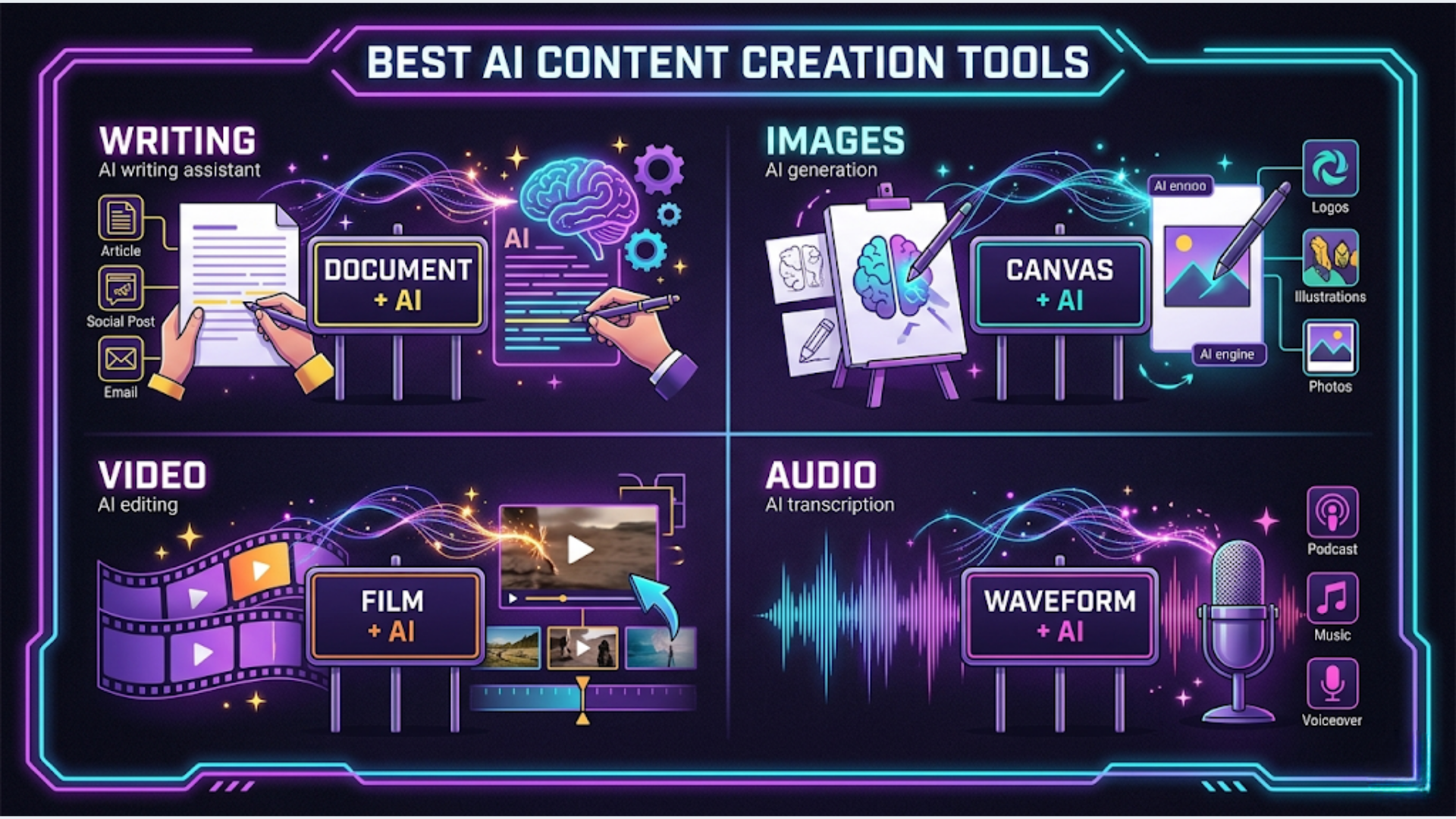
Best AI Tools for Content Creation (2026)
Every AI tool claims to “transform your content workflow.” Most of them save you 20 minutes of work and introduce 40 minutes of editing. Some genuinely change what is possible. The difference matters.
I build AI-powered content systems for clients. I use these tools daily, not as demos, but in production workflows that run autonomously. Here is what actually works, what is overhyped, and what you should spend money on versus what you should skip.
No affiliate links in this article. No sponsored placements. Just an honest assessment from someone who puts these tools to work.
AI Writing Tools: Claude, ChatGPT, Gemini, Jasper
The writing tool market has settled into a clear hierarchy.
Claude (Anthropic): My primary writing tool. Claude produces the most natural-sounding long-form content. Its biggest strength is following complex instructions without losing coherence over 2,000+ words. Claude understands nuance, tone, and voice consistency in ways that other models still struggle with.
Best for: long-form articles, newsletters, technical writing, analysis pieces, anything requiring sustained voice consistency. Pricing: Free tier available. Pro at $20/month. Team at $30/month per seat. Honest assessment: The best writer in the current generation. Not perfect. It can be verbose and sometimes hedges too much. You still need to edit, but you are editing good writing rather than rewriting mediocre output.
ChatGPT (OpenAI): The most well-known option. GPT-4o is capable across all content types. Its strength is versatility. Need a product description, then a social media caption, then a technical explainer? ChatGPT handles the context switches well.
Best for: short-form content, brainstorming, product copy, social media posts, quick-turnaround tasks. Pricing: Free tier (GPT-4o limited). Plus at $20/month. Team at $25/month per seat. Honest assessment: Good at everything, best at nothing. The default tone is “corporate helpful” which requires deliberate prompting to override. For LinkedIn-style content, you need to actively fight against its tendency to be generic.
Gemini (Google): Improved significantly in 2025-2026. The integration with Google Workspace is its killer feature. If your workflow lives in Google Docs, Sheets, and Gmail, Gemini reduces friction by working inside the tools you already use.
Best for: Google Workspace integration, research-heavy content (access to Google Search), summarizing long documents. Pricing: Free tier. Advanced at $20/month (includes Workspace integration). Honest assessment: The writing quality is a tier below Claude and ChatGPT for creative content. But for “pull data from these 5 sources and write a summary,” it is genuinely useful. Not the tool for brand-voice content.
Jasper: The incumbent “AI for marketing” platform. Templates for every content type: blog posts, ads, social posts, emails. Team collaboration features.
Best for: marketing teams that want pre-built templates and a structured workflow. Pricing: Creator at $49/month. Pro at $69/month. Business: custom pricing. Honest assessment: Overpriced for what it offers. Jasper uses the same underlying models (Claude and GPT) that you can access directly for $20/month. The templates add convenience, not capability. Unless your team specifically needs the collaboration features, save $30-50/month and use Claude or ChatGPT directly.
AI Image Generation: Midjourney, DALL-E, Ideogram, Flux
Image generation has exploded. Quality that required a graphic designer 18 months ago is now available for $10/month. But “available” and “production-ready” are not the same thing.
Midjourney: Still the quality leader for aesthetic, visually striking images. Best for: social media graphics, blog hero images, brand visuals, concept art. The output consistently looks professional without extensive prompt engineering.
Pricing: Basic at $10/month (200 images). Standard at $30/month (unlimited relaxed, 15 hours fast). Honest assessment: The best for “make something that looks good.” Weakness: text rendering in images is unreliable (getting better but not production-ready). Generating images with specific text overlays still requires post-processing in Canva or Figma.
DALL-E 3 (via ChatGPT): Integrated into ChatGPT Plus. The conversational interface means you can iterate on images through natural language: “make it more blue,” “remove the person on the right,” “make the text larger.”
Pricing: Included with ChatGPT Plus ($20/month). Honest assessment: Convenience is the selling point. Quality is below Midjourney for artistic output but above it for practical business graphics. Text rendering is better than Midjourney. If you need quick images without leaving your writing tool, DALL-E is the pragmatic choice.
Ideogram: The specialist for text-in-images. Logos, infographics with text, social media graphics with headlines. Ideogram renders text more accurately than any competitor.
Pricing: Free tier (25 images/day). Plus at $8/month. Pro at $20/month. Honest assessment: If your use case is “images with readable text,” Ideogram is the answer. For everything else, Midjourney or DALL-E produce better results. I use Ideogram specifically for quote cards and social graphics where the text needs to be perfect.
Flux (by Black Forest Labs): Open-source image model that rivals Midjourney in quality. Available through Replicate, fal.ai, or self-hosted.
Pricing: Pay-per-image on platforms like Replicate ($0.003-0.05 per image depending on model size and speed). Honest assessment: The best option for high-volume production where you need API access. If you are generating 500+ images per month for an e-commerce catalog or content pipeline, Flux through an API is dramatically cheaper than Midjourney’s subscription. Quality is comparable for most business use cases.
For Indian content creators specifically: Ideogram at $8/month is the best value. Indian social media content relies heavily on text-based graphics (Hindi quotes, offer announcements, festival greetings). Ideogram handles Hindi text rendering better than any competitor. Pair it with Canva for layout and you have a complete visual content system for under Rs 1,500/month.
AI Video Tools: Synthesia, HeyGen, Runway, Kling
AI video is the most overhyped category. I need to be honest about this.
Synthesia: Avatar-based video creation. Type a script, choose a digital avatar, get a video of a realistic person reading your script. Popular for training videos, product explainers, and internal communications.
Pricing: Starter at $22/month (10 minutes of video). Creator at $67/month (30 minutes). Honest assessment: Good for specific use cases like employee training, product tutorials, and sales outreach personalization. Terrible for anything requiring authenticity. Your audience knows it is AI. For YouTube content, social media, or anything public-facing, real video (even phone-shot) outperforms AI avatars every time. The uncanny valley is still real.
HeyGen: Similar to Synthesia. Key differentiator: better lip-syncing, more natural avatar movements, and a “video translate” feature that dubs your video into other languages while matching lip movements.
Pricing: Creator at $24/month (15 minutes). Business at $72/month (45 minutes). Honest assessment: The video translation feature is genuinely impressive and useful. If you create content in English and want to repurpose it for Hindi, Tamil, or Spanish audiences, HeyGen’s dubbing is the best in the market. For avatar-from-scratch videos, the same limitations as Synthesia apply.
Runway Gen-3: Generates video clips from text prompts or images. Not avatar-based. Actual video generation. Think “cinematic B-roll without hiring a videographer.”
Pricing: Standard at $12/month (625 credits). Pro at $28/month (2,250 credits). One 5-second clip costs 50-100 credits. Honest assessment: Incredible for B-roll and atmospheric footage. Still limited to 5-10 second clips. Cannot generate coherent scenes with dialogue, consistent characters across multiple shots, or anything requiring narrative continuity. Use it for supplementing real video, not replacing it.
Kling (by Kuaishou): China-developed video generation model that produces surprisingly high-quality 5-10 second clips. Available internationally.
Pricing: Free tier (limited). Pro at $8-15/month depending on region. Honest assessment: Best value for short-form video generation. Quality rivals Runway at a lower price. The downside: less control over output style, and the platform UI is less polished.
Reality check on AI video: No tool in 2026 reliably produces content-ready videos longer than 15 seconds from a single prompt. The workflow for AI-assisted video is still: record real footage, use AI for editing (captions, B-roll, color grading, background removal) and enhancement, not full generation. Anyone promising “full AI videos” is either selling something or showing cherry-picked demos.
AI Audio Tools: ElevenLabs, NotebookLM, Suno
ElevenLabs: Text-to-speech and voice cloning. The current gold standard. Clone your voice from 30 seconds of audio and generate unlimited narration in your voice.
Pricing: Free tier (10,000 characters/month). Starter at $5/month. Creator at $22/month. Pro at $99/month. Honest assessment: The best TTS available. Period. Voice clones are remarkably accurate. Use cases that work: podcast intros/outros, narrating blog posts for audio versions, voiceover for explainer videos, audiobook narration for short-form content. I use it in content pipelines to auto-generate audio versions of newsletter articles. At $5/month for the Starter plan, it is absurdly good value.
NotebookLM (Google): Not exactly a content creation tool, but its “Audio Overview” feature generates podcast-style conversations about any content you upload. Two AI hosts discuss your content naturally, with questions, insights, and banter.
Pricing: Free (included with Google account). Premium features coming. Honest assessment: The most surprising AI tool of 2025-2026. The generated audio is genuinely listenable. I have seen people use NotebookLM to create podcast episodes from their blog posts, reports, and research papers. It is not a replacement for a real podcast with a real host, but for content repurposing at zero cost, nothing else comes close.
Suno: AI music generation. Type a prompt, get a full song with vocals, instruments, and production.
Pricing: Free tier (10 songs/day). Pro at $10/month (500 songs). Premier at $30/month (2,000 songs). Honest assessment: Impressive technology. Limited business use case. Background music for videos, podcast intros, and hold music are the practical applications. If you are spending $50/month on stock music libraries, Suno at $10/month is a legitimate replacement. For everything else, it is a novelty.
Comparison Table: What to Use for What
| Use Case | Best Tool | Monthly Cost | Quality (1-10) |
|---|---|---|---|
| Long-form articles | Claude | $20 | 9 |
| Social media posts | ChatGPT | $20 | 8 |
| Product descriptions | ChatGPT | $20 | 8 |
| Blog hero images | Midjourney | $10-30 | 9 |
| Text-heavy graphics | Ideogram | $8 | 9 (for text) |
| High-volume images | Flux (API) | ~$0.01/image | 8 |
| Training videos | Synthesia | $22-67 | 7 |
| Video B-roll | Runway | $12-28 | 7 |
| Voiceover/TTS | ElevenLabs | $5-22 | 9 |
| Audio repurposing | NotebookLM | Free | 8 |
| Background music | Suno | $10 | 7 |
| Video translation | HeyGen | $24-72 | 8 |
| Research + summaries | Gemini | $20 | 8 |
The Honest “What Is Overhyped” Section
I am going to be direct about what does not work as well as the marketing suggests.
AI-generated blog posts without editing. Every tool produces content that needs human editing. Claude needs the least. But “press generate, copy, publish” produces mediocre content that Google increasingly penalizes and readers immediately recognize. AI is a first-draft machine, not a publishing machine.
AI avatars for public content. Training videos, yes. YouTube content, no. The technology is not there yet. Real video with a real person, even if imperfect, builds trust that no avatar can match.
AI image generators for brand consistency. Midjourney generates beautiful images. But generating 10 images that all look like they belong to the same brand is extremely difficult. You will spend more time prompting for consistency than a designer would spend creating from a template. Use AI for exploration and ideation, then hand the winners to a designer (or Canva template) for brand-consistent production.
“All-in-one” AI content platforms. Tools that promise writing, images, video, and audio in one platform (like some newer startups) typically do none of them well. Use the best tool for each modality. The switching cost between Claude and Midjourney is minimal.
Fully autonomous content pipelines without human oversight. I build autonomous content systems. They work. But every one of them has a human review step before publishing. The risk of brand damage from a single hallucinated fact or tone-deaf paragraph is not worth the 10 minutes you save by removing human review.
How to Build a Cost-Effective AI Content Stack
For a solo creator or small business, here is the stack I recommend:
Essential tier ($25-40/month):
- Claude Pro ($20) for all writing
- Ideogram Free or Plus ($0-8) for graphics
- NotebookLM (free) for audio repurposing
- Canva Free for layout and templates
Growth tier ($60-80/month):
- Claude Pro ($20) for writing
- Midjourney Standard ($30) for premium visuals
- ElevenLabs Starter ($5) for voiceover
- Canva Pro ($13) for templates and brand kit
Production tier ($120-180/month):
- Claude Team ($30) for writing with collaboration
- Midjourney Standard ($30) for visuals
- ElevenLabs Creator ($22) for high-volume audio
- Runway Standard ($12) for video B-roll
- HeyGen Creator ($24) for video translation
- Canva Pro ($13) for production
For Indian creators, the essential tier at Rs 2,000-3,500/month is a reasonable investment. Compare that to hiring a content writer (Rs 15,000-30,000/month) or a graphic designer (Rs 20,000-40,000/month). AI tools do not replace these roles entirely, but they reduce the volume of work that requires human talent.
FAQ
Which single AI tool gives the best ROI for content creation? Claude or ChatGPT at $20/month. Writing is the foundation of all content. Images, video, and audio are secondary. A well-written article can be repurposed into 10 social posts, 3 email snippets, 1 audio version, and 1 video script. Start with writing.
Are AI-generated images safe to use commercially? Midjourney, DALL-E, and Ideogram all grant commercial usage rights on paid plans. Free tiers often have restrictions. Check the specific terms. The bigger risk is unintentional similarity to copyrighted work. For brand-critical usage (ads, product packaging), have a human review the output.
Will Google penalize AI-written content? Google’s official position: they evaluate content quality, not content origin. In practice, low-quality AI content with no original insight ranks poorly. High-quality AI-assisted content with genuine expertise, original analysis, and human editing ranks fine. The key is adding value that the AI cannot generate on its own.
How much time does AI actually save in content creation? For first drafts: 60-70% time reduction. But editing AI output to match your voice and ensure accuracy takes 30-50% of the time you saved. Net time savings: roughly 30-40% per piece. The real gain is not time. It is volume. You can produce 3x the content in the same total hours.
Should I disclose that I use AI tools in my content? Legally, no requirement in most jurisdictions (as of 2026). Ethically, it depends on your audience and context. For SEO articles, disclosure is unnecessary. For thought leadership or opinion pieces, transparency builds trust. My approach: I use AI tools in my workflow and mention it when relevant. I do not add disclaimers to every piece.
What about AI tools for content in Indian languages? Claude and ChatGPT handle Hindi, Tamil, Telugu, and other Indian languages reasonably well for text. Quality drops compared to English. For Hindi content specifically, ChatGPT slightly edges Claude. For image generation with Hindi text, Ideogram is the best option. Voice generation in Indian languages: ElevenLabs supports Hindi with decent quality. The gap between English and Indian language AI tools is closing but still noticeable.
The AI content tool market is maturing. The best tools are genuinely useful. The worst tools are expensive toys that add complexity without value. Start with writing. Add visuals when you have a rhythm. Add video and audio when you have an audience that wants it.
If you want help building an AI-powered content production system for your business, triggerAll builds these pipelines.
Need help implementing this?
Book a free 30-minute discovery call. We'll map your current setup, identify quick wins, and outline what automation can do for your business.
Book a Free Discovery Call