Alternatives to WATI for WhatsApp Business API (2026)
Best WATI alternatives compared: Interakt, AiSensy, Gallabox, Gupshup, Twilio. Pricing, features, Shopify integration, and India BSP landscape for 2026.
Alternatives to WATI for WhatsApp Business API (2026)
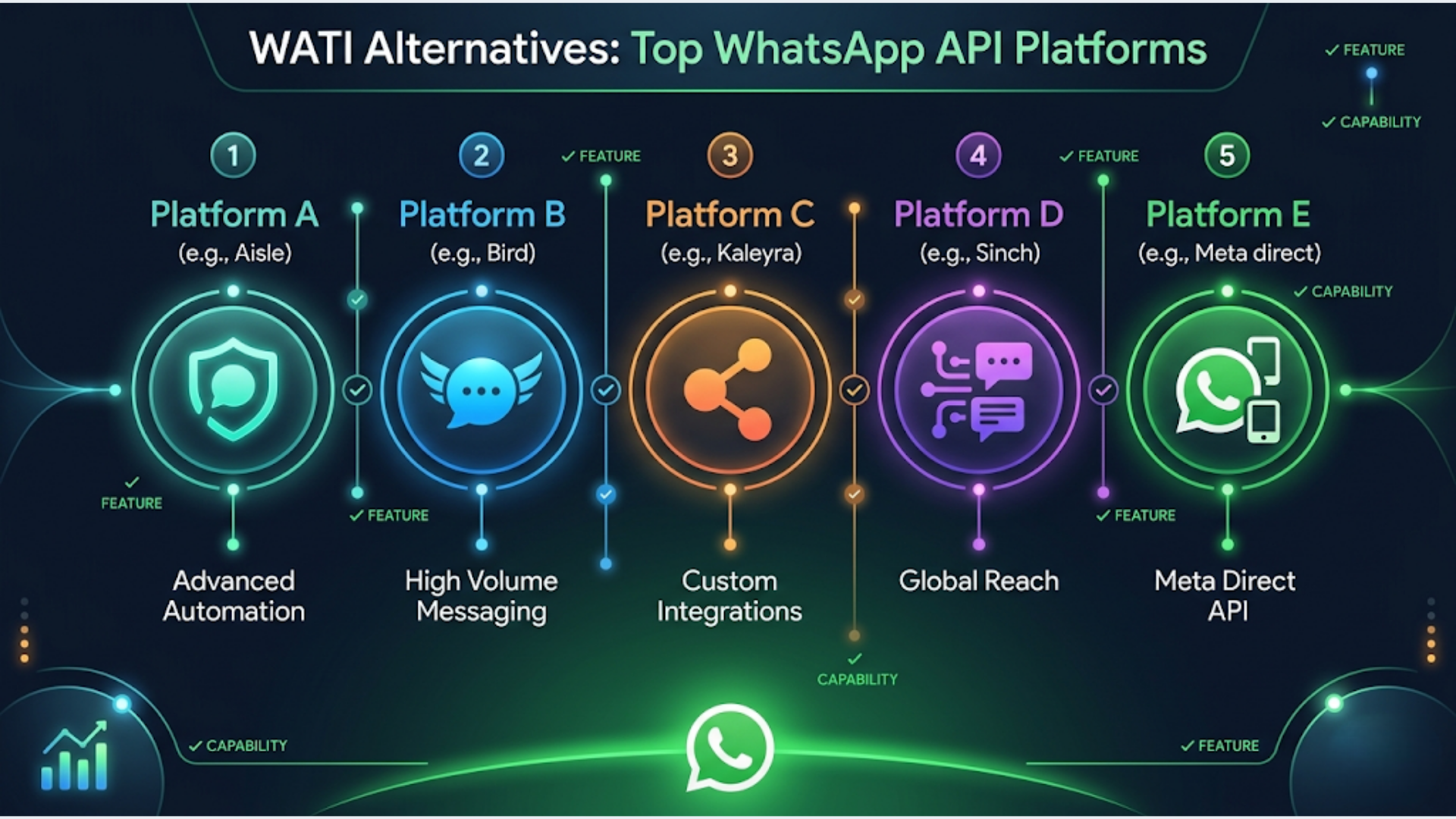
Interakt is the best WATI alternative for Shopify-based businesses. AiSensy wins for high-volume broadcast campaigns. Gallabox is the simplest option for small teams under 10 people. Gupshup gives developers the most control at the lowest per-message cost. Twilio is overkill for most businesses but unmatched for custom builds at scale.
WATI is a solid platform. I’m not here to trash it. But it’s not the right fit for every business, and at ₹2,499/month starting price, it’s the most expensive entry point among Indian BSPs. If you’re paying for features you don’t use, or hitting limitations that shouldn’t exist at your price point, there are better options.
Why Businesses Leave WATI
The reasons I see are consistent. They fall into five buckets.
Price-to-value mismatch. WATI’s base plan is ₹2,499/month. That’s 2-2.5x what competitors charge for comparable features. For a business sending 5,000 messages/month, the per-message markup compounds into a meaningful cost difference over 12 months.
Chatbot limitations on lower plans. WATI’s visual chatbot builder is good, but the lower-tier plans restrict the number of chatbot flows you can create. If you’re running separate flows for sales, support, and order tracking, you hit the ceiling fast.
Shopify integration isn’t native. It works through a plugin, and it works well. But it’s not the same as a platform built specifically for Shopify. Catalog sync, abandoned cart triggers, and order status updates require more manual configuration compared to Interakt’s native Shopify integration.
No built-in CRM. WATI is a messaging platform. It’s not trying to be a CRM. If you need contact management, deal tracking, or lifecycle automation, you’re integrating WATI with a separate CRM. Some competitors bundle basic CRM features.
API rate limits on starter plans. For businesses running automated workflows through n8n or Make, WATI’s API rate limits on lower plans can bottleneck high-volume sequences.
The Complete Comparison
Here’s every WATI alternative worth considering in 2026, with honest assessments based on actual deployments.
| Feature | WATI | Interakt | AiSensy | Gallabox | Gupshup | Twilio |
|---|---|---|---|---|---|---|
| Starting Price | ₹2,499/mo | ₹999/mo | ₹999/mo | ₹999/mo | Custom (API) | Pay-per-use |
| Per-Message Markup | ₹0.50-0.80 | ₹0.30-0.50 | ₹0.20-0.40 | ₹0.40-0.60 | Lowest | $0.005 + Meta |
| Shopify Integration | Plugin (good) | Native (best) | Plugin (basic) | Plugin (basic) | API only | API only |
| WooCommerce | Plugin | Plugin | Plugin | Plugin | API only | API only |
| Chatbot Builder | Visual (drag-drop) | Flow builder | Keyword-based | Visual builder | Developer SDK | Flex/Studio |
| Team Inbox | Multi-agent | Yes | Yes | Yes (strong) | No native | Flex (expensive) |
| Broadcast | Plan-based | Plan-based | Unlimited (higher) | Plan-based | Unlimited | Unlimited |
| CRM Built-in | No | Basic | No | Basic | No | No |
| API Quality | Good REST | Webhooks + API | Decent | Good | Excellent | Excellent |
| Green Tick Help | Assisted | Assisted | Assisted | Assisted | Assisted | Self-serve |
| Setup Complexity | Low | Low | Low | Very Low | High | Very High |
| Best For | Mid-size D2C | Shopify stores | Bulk campaigns | Small teams | Developers | Enterprise custom |
Interakt: Best for Shopify Stores
If your e-commerce runs on Shopify, Interakt is the strongest WATI alternative. Full stop.
The Shopify integration is native, not bolted on. Product catalogs sync automatically. Abandoned cart recovery flows trigger without configuration. Order status updates pull directly from Shopify order events. These aren’t features you set up. They work out of the box.
Where Interakt wins:
- Product catalog sync from Shopify is automatic and stays current
- Abandoned cart WhatsApp messages trigger natively with product images and cart links
- COD confirmation flow is pre-built (critical for Indian e-commerce where 50-65% of orders are COD)
- Order-tied analytics show revenue attributed to WhatsApp campaigns
- Starting at ₹999/month, it’s 60% cheaper than WATI’s entry point
Where Interakt falls short:
- The chatbot builder is less flexible than WATI’s drag-and-drop interface
- Non-Shopify integrations require more manual setup
- Advanced automation sequences need external tools (n8n, Make) for complex logic
- The dashboard can feel cluttered when managing high volumes
Best fit: Shopify stores doing 200-5,000 orders/month. Indian D2C brands where COD confirmation and abandoned cart recovery are the primary use cases.
AiSensy: Best for High-Volume Broadcasts
AiSensy’s advantage is simple: it’s the cheapest way to send WhatsApp messages at scale.
When you’re blasting promotional campaigns to 50,000+ contacts weekly, the per-message markup is the number that matters. AiSensy’s markup (₹0.20-0.40 per message on top of Meta’s conversation fees) is the lowest among platforms with a usable dashboard. Over 100,000 messages/month, that’s a ₹20,000-40,000/month saving compared to WATI.
Where AiSensy wins:
- Lowest per-message markup among user-friendly platforms
- Unlimited broadcasts on higher plans (no artificial caps)
- Click-to-WhatsApp ad integration is well-implemented
- Template approval turnaround is fast
- Segment-based campaigns with decent targeting options
Where AiSensy falls short:
- The chatbot builder is keyword-based, not visual flow-based. Less intuitive for complex conversation trees
- E-commerce integrations are basic compared to Interakt or WATI
- Team inbox functionality is serviceable but not exceptional
- Analytics are campaign-focused, not customer-journey-focused
- API documentation isn’t as polished as WATI or Gupshup
Best fit: Marketing-heavy businesses sending 50,000+ promotional messages monthly. Brands where broadcast campaigns (not conversational commerce) drive the bulk of WhatsApp ROI.
Gallabox: Best for Small Teams
Gallabox is what WATI would be if it were designed for a 3-person team that needs to be live in a day.
The setup is the fastest among all platforms here. From sign-up to sending your first automated message takes under 2 hours. The shared inbox is intuitive (think of it as a WhatsApp version of Freshdesk). The chatbot builder is visual and doesn’t require technical knowledge.
Where Gallabox wins:
- Fastest setup time. You can be operational within hours
- Shared inbox is clean, intuitive, and handles team assignment well
- Basic CRM features built in (contact management, tags, notes)
- Pre-built templates for common Indian business workflows (appointment booking, order status, lead qualification)
- Solid for small service businesses (salons, clinics, agencies)
Where Gallabox falls short:
- Broadcast limits on lower plans are restrictive
- Advanced automation requires external integrations
- E-commerce integrations are basic
- Not designed for high-volume message throughput
- Per-message markup (₹0.40-0.60) is higher than AiSensy
Best fit: Service businesses with 2-10 team members. Clinics, salons, agencies, consultancies where WhatsApp is used for appointment booking, client communication, and basic lead qualification.
Gupshup: Best for Developers
Gupshup isn’t a dashboard product. It’s an API-first messaging infrastructure platform.
If you have a development team (or work with one) and want to build a WhatsApp experience that’s entirely custom, Gupshup gives you the most flexibility at the lowest cost. No pre-built chatbot builder. No drag-and-drop flows. Just APIs, SDKs, and documentation.
Where Gupshup wins:
- Lowest per-message cost (they’re a direct Meta BSP with minimal markup)
- API quality and documentation are excellent
- Supports rich message types that dashboard platforms often lag behind on
- Multi-channel support (WhatsApp, SMS, RCS, Viber) through unified API
- Handles massive scale without throttling
Where Gupshup falls short:
- No native team inbox. You build your own or integrate a third-party one
- No visual chatbot builder. Conversation flows are code
- Not suitable for non-technical teams. Period
- Customer support is developer-focused, not hand-holding
- Analytics are API-level, not campaign-level
Best fit: Tech companies building WhatsApp into their product. Businesses with development teams wanting full control. High-volume transactional messaging (50,000+ messages/day).
Twilio: Best for Enterprise Custom Builds
Twilio is the nuclear option. You wouldn’t choose it for simple WhatsApp automation. You choose it when WhatsApp is a channel within a larger communication platform you’re building.
Where Twilio wins:
- Unmatched flexibility. Build literally anything
- Multi-channel (WhatsApp, SMS, voice, email, video) through one API
- Twilio Flex gives you a fully customizable contact center
- Global reliability and uptime guarantees
- Enterprise-grade security and compliance
Where Twilio falls short:
- Pricing is complex and expensive. Per-message fees + platform fees + Flex fees add up
- No pre-built WhatsApp commerce features. Everything is custom
- Requires significant development effort for basic functionality
- Not cost-effective for businesses under 10,000 messages/day
- India-specific features (UPI deep links, COD flows) need custom development
Best fit: Enterprise businesses building custom communication platforms. Companies where WhatsApp is one channel among many (voice, SMS, email) and everything needs to work together.
The India BSP Landscape in 2026
The Indian WhatsApp BSP market has consolidated. There were 30+ providers in 2023. In 2026, five platforms handle 80%+ of the market.
Meta tightened BSP requirements in 2025. Smaller providers either merged, shut down, or became resellers of larger BSPs. This is actually good for businesses. Fewer options means more mature products, better support, and more competitive pricing.
Key India-specific considerations:
UPI Integration. WhatsApp Pay is live in India, but adoption for business payments is still low. Most businesses use UPI payment links (Razorpay, Cashfree) sent through WhatsApp messages. All platforms listed here support this through template messages.
Template Approval. Meta’s template approval process applies to all BSPs equally. But some BSPs (WATI, Interakt, Gallabox) have teams that help you craft templates that get approved on the first submission. Gupshup and Twilio leave template creation entirely to you.
Vernacular Support. Indian businesses often need templates in Hindi, Tamil, Telugu, Marathi, etc. All platforms support multi-language templates, but WATI and Gallabox have the best interfaces for managing multiple language variants of the same template.
Compliance. India’s data localization requirements mean your WhatsApp data should be stored on Indian servers. WATI, Interakt, AiSensy, and Gallabox all use Indian hosting. Gupshup has Indian data centers. Twilio’s default is US-hosted, but you can configure regional hosting.
How to Choose (Decision Framework)
Stop comparing feature lists. Answer these four questions.
1. What’s your primary use case?
- Conversational commerce (selling through chat) → WATI or Interakt
- Broadcast campaigns (promotions, announcements) → AiSensy
- Customer support (team inbox, ticket assignment) → Gallabox or WATI
- Custom product integration → Gupshup or Twilio
2. What’s your e-commerce platform?
- Shopify → Interakt (first choice), WATI (second)
- WooCommerce → WATI or AiSensy
- Custom-built store → Gupshup or Twilio
- No e-commerce (service business) → Gallabox
3. What’s your monthly message volume?
- Under 10,000 → Any platform works. Choose by ease of use
- 10,000-50,000 → Per-message markup starts mattering. Compare AiSensy vs Interakt
- 50,000+ → AiSensy or Gupshup for cost efficiency
- 500,000+ → Gupshup or Twilio for infrastructure reliability
4. Do you have developers?
- No developers → Gallabox, Interakt, or AiSensy
- One developer / automation builder → WATI or Interakt with n8n/Make
- Development team → Gupshup
- Full engineering team → Twilio
Migration from WATI: What to Expect
Switching WhatsApp BSPs is not as painful as it sounds. Your WhatsApp Business number stays the same. Your chat history does not transfer (this is a Meta limitation, not a BSP limitation).
Migration timeline: 3-7 business days.
Steps:
- Sign up with the new BSP
- Request number migration through the new BSP (they handle the paperwork with Meta)
- WATI releases the number (this takes 24-48 hours)
- New BSP registers the number on their platform
- Re-submit your message templates for approval (templates don’t transfer between BSPs)
- Rebuild chatbot flows on the new platform
- Update webhook URLs in your automation tools (n8n, Make, Zapier)
What you lose: Chat history, chatbot flow configurations, template approvals (need resubmission). What you keep: Your phone number, your contact list (export from WATI), your business verification status.
The biggest time cost is rebuilding chatbot flows. If you have 10+ complex flows on WATI, budget a week for rebuilding and testing on the new platform. This is the kind of automation migration I build for businesses. The technical work is straightforward. The testing and QA is where the time goes.
FAQ
Is WATI still good in 2026? Yes. WATI is a polished, feature-rich platform. The issue isn’t quality. It’s that cheaper alternatives now match most of WATI’s features. If WATI is working for you and you’re not price-sensitive, there’s no urgent reason to switch.
Can I use my same WhatsApp number with a different BSP? Yes. WhatsApp Business API numbers are portable between BSPs. The migration takes 3-7 business days. Your number stays the same. Chat history does not transfer.
Which WATI alternative is cheapest? For per-message cost, Gupshup is cheapest (but requires developers). Among user-friendly platforms, AiSensy has the lowest per-message markup. For overall platform cost including subscription, Interakt, AiSensy, and Gallabox all start at ₹999/month vs WATI’s ₹2,499/month.
Do I need a BSP or can I use Meta’s Cloud API directly? You can use Meta’s Cloud API directly. It’s free (you only pay Meta’s conversation fees). But you get no dashboard, no team inbox, no chatbot builder, no analytics. You’d build everything yourself or through tools like n8n. For non-technical teams, a BSP is the practical choice.
Which alternative is best for WhatsApp chatbots? WATI still has the best visual chatbot builder. If chatbot complexity is your priority, WATI is hard to beat. Among alternatives, Gallabox’s builder is the most intuitive. For code-based bots with maximum control, Gupshup.
What about Respond.io and Trengo? Both are solid multi-channel platforms but they’re not WhatsApp BSPs. They connect to WhatsApp through a BSP (usually Twilio or 360dialog). This adds another layer (and cost). If you specifically want WhatsApp automation, a direct BSP is simpler and cheaper.
How much can I save by switching from WATI? A business sending 20,000 messages/month switching from WATI to AiSensy saves approximately ₹7,000-12,000/month (₹1,500 on subscription + ₹5,500-10,500 on per-message markup). Over 12 months, that’s ₹84,000-1,44,000. Not trivial for a small business.
Need help implementing this?
Book a free 30-minute discovery call. We'll map your current setup, identify quick wins, and outline what automation can do for your business.
Book a Free Discovery Call